Saturday, August 14, 2021

Unyielding Despair

In the first week of the upcoming semester my classes will be talking about the view of life called existentialism, so I thought it might not be out of place to offer a little mood music here on VP to perhaps nudge us toward reflection upon what's sometimes referred to as our "existential predicament."
The question this song by the group Kansas raises is, if it's true that all we are is dust in the wind what meaning or significance is there to our lives?

A character in a novel (The Nausea) by French existentialist philosopher Jean Paul Sartre is sitting in a restaurant ruminating on the pointlessness of human existence. The man reflects, "I was thinking ... that here we are eating and drinking to preserve our precious existence, and that there’s nothing, nothing, absolutely no reason for existing."

Sartre also claims that, "Life has no meaning the moment you lose the illusion of being eternal." Pretty depressing, but that's the existential view in a nutshell.

Of course, one need not be an existentialist to think life is an absurd exercise in meaninglessness. All one need believe is that our existence ends with our death.

The psychologist Sigmund Freud wrote that "The moment a man questions the meaning and value of life he is sick since objectively neither has any existence."

The filmmaker Ingmar Bergman adds that, “You were born for no purpose. Your life has no meaning. When you die you are extinguished.”

And the great philosopher Arthur Schopenhauer perceived the problem more clearly than most when he noted that, "Unless the point of life is to suffer, there is no point."

He adds this lamentably droll observation: "Life is bad today, tomorrow will be worse, until we die," and, "Life is a task, the task of staying alive and staving off boredom." The world, for Schopenhauer, is a "penal colony" in which "happiness is measured by the absence of suffering."

Schopenhauer titled the book from which these quotes are taken, Studies in Pessimism. It's not hard to see why.

Alex Rosenberg, the philosophy department chair at Duke University, frames the problem of our human predicament succinctly when he writes: "What is the purpose of the universe? There is none. What is the meaning of life? Ditto."

Bertrand Russell put the same miserable thought this way:
Such, in outline, but even more purposeless, more void of meaning is the world which Science presents for our belief. Amid such a world, if anywhere, our ideals henceforward must find a home.

That Man is the product of causes which had no prevision of the end they were achieving; that his origin, his growth, his hopes and fears, his loves and his beliefs, are but the outcome of accidental collocations of atoms; that no fire, no heroism, no intensity of thought and feeling, can preserve an individual life beyond the grave; that all the labours of the ages, all the devotion, all the inspiration, all the noonday brightness of human genius, are destined to extinction in the vast death of the solar system, and that the whole temple of Man's achievement must inevitably be buried beneath the debris of a universe in ruins - all these things, if not quite beyond dispute, are yet so nearly certain, that no philosophy which rejects them can hope to stand. Only within the scaffolding of these truths, only on the firm foundation of unyielding despair, can the soul's habitation henceforth be safely built.
What these thinkers are urging us to recognize is that death annihilates all, it's the big eraser, obliterating everything we do and rendering our existence on the planet a pointless exercise in absurdity.

They urge upon us a realistic view against those who agree on the one hand that death is the end of our existence but on the other that there can nevertheless be some purpose to our lives.

Maybe so, but the purpose is a bit like that of a prisoner who insists on making his bed and brushing his teeth before accompanying the executioner to the scaffold.

At least that's how the existentialist, and many others who reject the belief that human beings survive the death of their material bodies, see this life, and they're doubtless correct if indeed death really is a personal annihilation. Unless what we do matters forever it's hard to see how it can really matter at all.

Maybe, though, what we do in this life does matter forever. Maybe our physical death is not the end of our existence. If so, that changes everything.

Friday, August 13, 2021

What Exactly Is Matter?

Materialism is the belief that everything in the universe - including our bodies, our brains, our thoughts, our sensations - all of it is reducible in principle to material "stuff." There's no mental substance, no mind, just brains and the functions the brain performs. But if that's so, then what is the material stuff everything is made of? What, exactly, is matter?

Physicists, many of whom are materialists, tell us that matter is made up of particles which are themselves simply a "wave function," but then what's a wave function? What's it made of? No one seems to have an answer.

This video takes the viewer down to the smallest bits of matter, but when we ask what these smallest bits are comprised of the only reply from physicists is a shrug of the shoulders.

At some point matter just seems to dissolve into energy, forces, and fields which are themselves inscrutable. They can be measured, but if we ask what it is, precisely, that we're measuring we just get another shrug for an answer. The fundamental nature of matter is a riddle:
Neuroscientist Michael Egnor helps us understand the provenience of the idea that everything is made of matter. He writes:
The materialist conception of matter derives in part from Democritus and Lucretius (two ancient materialist philosophers), but I believe that the most cogent view of matter as held by modern materialists is that of Descartes.

Descartes defined matter as res extensa — literally, substance extended in space. Matter, in the Cartesian view, is characterized by extension — length, width, and depth, and by associated properties such as mass that accompany extension in space. In the Cartesian view, all subjective mental properties, such as qualia [our sensory experience of, for instance, pain or color] and intentionality [the fact that something like ink on paper can be about something, can have meaning], were defined away — excluded — from matter itself. How, then, could the mind exist if subjective properties had no basis in matter?

In order to explain subjective experience and the mind, Descartes posited the existence of a second substance, res cogitans, which entailed subjective mental experience and which was [not] composed [of] matter in human beings. This was Cartesian substance dualism. The body and the mind were separable substances, each existing in its own right. Furthermore, Descartes believed that only humans had minds. Animals were automatons, essentially mindless machines made of meat.

Modern materialists have discarded Descartes’ mental substance, and have tried to explain nature and consciousness via matter alone. Modern materialists are Descartes’ descendants: although they have discarded Cartesian dualism, they retain Cartesian materialism. To the modern materialist, what really exists is matter extended in space, tangible stuff, and all intangible stuff (like the mind) needs to be explained in terms of tangible matter. Hence the bizarre cornucopia of materialist theories of mind, such as philosophical behaviorism, identity theory, computer functionalism, and eliminative materialism.
Of course, none of this explains what matter actually is. If it's "extended substance" then what kind of substance? And how can such a nebulous entity explain human cognition, human values, or any of the products of human consciousness? Egnor puts the question this way:
How, from a materialist perspective, can we explain the laws of physics? How can we explain abstract things, like universals and mathematics, if all that exists is matter extended in space? How can the mind arise from matter — how can meat think? How can we square the materialist understanding of nature with quantum mechanics, which reveals very non-materialist properties of matter at its most fundamental level?
The nature of matter is a profound mystery and the belief that everything is made up of, and/or arises from, this mysterious substance is really nothing more than a prejudice that derives from a naturalistic worldview.

Naturalism holds that there are no supernatural entities. If there were supernatural entities they'd be immaterial, thus naturalism cannot allow something like an immaterial mind into its ontology because that would lead to the conclusion that humans, at least, have souls. And once souls are allowed to exist then the naturalist fears he will have stepped onto a slippery slope leading to an affirmation of the existence of God and other things supernatural.

In other words, naturalism is heavily reliant for support upon materialism. Without it naturalism loses much of its ability to persuade.

Nevertheless, there's no reason not to believe that the fundamental stuff of the universe isn't material at all but rather mental. Indeed, this is the direction in which modern physics has been moving since the early years of the twentieth century.

Perhaps, so far from mind arising from matter, our perception of matter actually is a product of mind.

Just as Copernicus sparked a revolution in science by getting us to look at the solar system from a different perspective - a heliocentric rather than a geocentric perspective - looking at the world from the perspective of mental substance rather than material substance could spark an analogous revolution not only in science but also in metaphysics.

Thursday, August 12, 2021

Code Red for Humanity!

It's a core principle of left-wing movements that tend toward totalitarianism, as most do, to create a perpetual atmosphere of crisis. If the movement is out of power, the crisis destabilizes the government in power, and if the movement itself controls the government crises afford ample opportunities to consolidate and expand their control.

Both the Covid pandemic and climate change have perhaps been hyped into crises for this very reason.

The Intergovernmental Panel on Climate Change (IPCC) just released its latest climate report, and the analysis in many quarters has been apocalyptic.

Bjorn Lomborg, author most recently of False Alarm: How Climate Change Panic Costs Us Trillions, Hurts the Poor, and Fails to Fix the Planet, has a piece at The New York Post in which he derides the attempt to create a sense of crisis from a report that actually offers pretty meager grounds for it. He writes that,
[T]he always-breathless Guardian literally summarized this scientific report as finding mankind “guilty as hell” of “climate crimes of humanity.” (Needless to say, the report never says any such things.)

UN Secretary-General António Guterres called the findings a “code red for humanity,” saying we can only avert catastrophe by acting in the next couple of months. Of course, the United Nations has a long history of claiming catastrophe is right around the corner:

The first UN environment director claimed half a century ago that we had just 10 years left, and the then-head of the IPCC insisted in 2007 that we had just five years left.

In contrast to the hyperventilating media, the report is actually serious and sensible (and very, very long). It doesn’t surprise, since it is a summary of already-published studies, yet it reconfirms that global warming indeed is real and a problem.
The earth is indeed gradually warming and according to an op-ed at The Wall Street Journal by theoretical physicist Steven Koonin, author of the 2021 book Unsettled: What Climate Science Tells Us, What It Doesn't, and Why It Matters, the IPCC report predicts that the mean global temperature will be about 1.5 degrees higher in 2100 than it is today, an increase that will have minimal economic impact.

Koonin also notes that the IPCC report was less balanced than it might've been. For example,
The summary of the most recent U.S. government climate report...said heat waves across the U.S. have become more frequent since 1960, but neglected to mention that the body of the report shows they are no more common today than they were in 1900.

The Summary for Policy Makers section [of the report] says the rate of global sea-level rise has been increasing over the past 50 years. It doesn’t mention that it was increasing almost as rapidly 90 years ago before decreasing strongly for 40 years.
Lomborg culls this interesting nugget from the report:
Since the heat dome in June, there has been a lot of writing about more heat deaths. And the IPCC confirms that climate change indeed has increased heatwaves.

However, the report equally firmly, if virtually unacknowledged, tells us that global warming means “the frequency and intensity of cold extremes have decreased.”

This matters because globally, many more people die from cold than from heat. A new study in the highly respected journal Lancet shows that about half a million people die from heat per year, but 4.5 million people die from cold.

As temperatures have increased over the past two decades, that has caused an extra 116,000 heat deaths each year. This, of course, fits the narrative and is what we have heard over and over again. But it turns out that because global warming has also reduced cold waves, we now see 283,000 fewer cold deaths.
Another thing we haven't heard much from our media about is that warmer winters mean less heating fuel being burned and thus less CO2 being spewed into the atmosphere.

Anyway, here are a couple of other points from Lomborg's column:
Likewise, we have heard a lot about flooding in Germany and elsewhere being caused by climate change. But the new UN report tells us it has “low confidence in the human influence on the changes in high river flows on the global scale” — and low confidence in attributing “changes in the probability or magnitude of flood events.”

The report tells us that the evidence isn’t there to say floods are caused or driven by climate change. You don’t hear this, but so far climate change saves 166,000 lives each year.

It also mentions climate upsides like the fact that more CO₂ in the atmosphere has acted as a fertilizer and created a profound global greening of the planet. One NASA study found that over a period of 35 years, climate change has added an area of green equivalent to twice the size of the continental United States.

But don’t expect to read about this in any of the breathless articles on climate impact.
Lomborg goes on to argue that the calamity scenarios always assume that human beings will be frozen in place in the face of impending disaster and unable or unwilling to adapt to the changing conditions, but this, of course, is nonsense.

I recall that in the 1970s we were told that we were reaching "peak oil" and that the supply was running out. Then we developed fracking technology, and the "crisis" passed.

We were told that world population would far outstrip food supply by the 1990s and that we'd be overwhelmed with famine or plague or both, but the population "bomb" never materialized, and the "crisis" passed.

We were told that the need for paper would soon outstrip supply, making it extremely costly, but then computers came along, followed by the internet, the need for paper dropped precipitously, and the "crisis" passed.

We were told, too, that photographic film would become prohibitively expensive because it used silver which was becoming increasingly scarce. Then people developed digital photography which doesn't use film, and the crisis passed.

With climate change we're told that melting of the polar ice will be disastrous but aside from requiring humans to cope with rising sea levels it's hard to see why. Would the net effect of melting Greenland's ice be a detriment or a benefit? Certainly it would open a vast expanse of territory for human habitation and resource exploitation.

Is that not a good thing? Has anyone studied this?

Instead of playing Chicken Little over climate change perhaps we should first consider all the consequences, or at least those we can reasonably foresee, and stop making crises out of things that aren't a crisis.

After all, this world presents us with enough genuine worries without people inventing more.

Lomborg closes his article with this:
[T]he scare stories on climate impacts are vastly overblown and not supported by this new climate report. One of the clearest ways to see this is through climate economics. Because of climate change, the average person worldwide will be “only” 436 percent as well off in 2100 as they are now, instead of 450 percent.
I think our descendants can live with that.

Wednesday, August 11, 2021

Do We Have a Duty to the Unvaccinated?

We're once again being confronted with "a crisis." The Delta variant of Covid is more contagious than the original and this is inducing a panic in some quarters.

Some media precincts are excited about "breakthrough" cases in which a fully vaccinated individual nevertheless comes down with the disease. Demands for mask mandates, even for children, and talk of lockdowns are being bandied about because we must "do something" to "save lives."

It should be noted that people who contract the Delta variant don't get any sicker and are no more likely to die than if they contracted the original Covid, but, even so, the impression is given that this form of the virus is much more virulent than the form that afflicted the world in 2020.

It is more contagious, though, and that has stoked fears that even vaccinated people are at risk and need to wear masks, most of which offer only marginal protection, just like unvaccinated people. This is nonsense as an ABC News analysis of the CDC data makes clear:
More than 99.99% of people fully vaccinated against Covid-19 have not had a breakthrough case resulting in hospitalization or death, according to the latest data from the US Centers for Disease Control and Prevention.

The CDC reported 6,587 Covid-19 breakthrough cases as of July 26, including 6,239 hospitalizations and 1,263 deaths. At that time, more than 163 million people in the United States were fully vaccinated against Covid-19.

Divide those severe breakthrough cases by the total fully vaccinated population for the result: less than 0.004% of fully vaccinated people had a breakthrough case that led to hospitalization and less than 0.001% of fully vaccinated people died from a breakthrough Covid-19 case.
In other words, a vaccinated individual has less chance of being hospitalized due to Covid than they have of being struck by lightning (.0065%).

Moreover most of the breakthrough cases -- about 74% -- occurred among adults 65 or older. So, if you're not in that age group and are fully vaccinated your chances of getting the disease are even lower.

Here's a graphic posted on VP last week that illustrates the chances of a fully vaccinated individual suffering a breakthrough case. The graphic uses slightly different numbers but their significance is the same as those used in the ABC report:
Nevertheless, CDC leaders have updated the agency's mask guidance, recommending that fully vaccinated people also wear masks indoors when in areas with "substantial" and "high" Covid-19 transmission to prevent further spread of the Delta variant. But why?

Why should people who have chosen to get vaccinated who have little risk of getting seriously ill, endure the inconvenience of wearing an all but useless mask to "protect" those who've chosen not to get vaccinated.

If someone chooses not to be vaccinated that's their choice (Isn't it the left which insists, "My body, my choice"?), but why should everyone else be obliged to accommodate them and protect them from the possible consequences?

Why do some people insist on treating their fellow citizens like children?

Tuesday, August 10, 2021

What's the Point?

When one side in an argument deploys facts and the other chooses to employ rhetorical irrelevancies that score points with an unthinking audience but which do not address the other side's facts, we can be sure that the discussion is headed nowhere.

This is one reason why people today often cannot get anywhere discussing politics and/or religion, and why such discussions often degenerate into mindless name-calling and insults. Too many people think that whoever unleashes the most clever zingers against his adversary has won the argument.

This is very unfortunate for any society that seeks to embrace truth and avoid superstition, prejudice and bigotry. An argument ideally should be a discussion between two people, or two groups of people, both of which want to arrive at the truth.

When one side is interested only in obfuscation or scoring zingers, truth is not their goal and engaging in an exchange and defense of ideas with that person or persons is pointless.

Bill Maher, a man of the left, had on his show recently a conservative, Ben Shapiro, and a liberal, Malcolm Nance to discuss Critical Race Theory (CRT) and, presumably, whether CRT should be taught, or is being taught in schools.

Shapiro started off the segment with a succinct and lucid description of CRT, summarizing it in less than two minutes. Malcolm Nance responded by promptly changing the subject, confusing the issue by accusing those who oppose having CRT taught in schools of really saying they don't want history taught in schools.

This is, of course, disingenuous. If anything, conservatives like Shapiro want more history taught in schools. Many Americans are scandalously ignorant of anything that happened in their country or the world the day before yesterday, and that ignorance has pernicious consequences.

As Thomas Jefferson once said, "Any nation that expects to remain ignorant and free expects what never was and never will be."

What conservatives don't want taught, as Maher suggests at the end of the segment, is that all whites and only whites are racist, that every disparity between blacks and other races is proof of institutional racism, that whites qua whites enjoy a privilege denied to others, that objective truth, facts, reason and logic are oppressive tools of white supremacy, and that people living today have a responsibility for what people of their same race may have done two centuries ago.

The nine minute video of this segment of Maher's show is instructive in illustrating how an argument should not be conducted and how fruitless it is to debate someone whose main goal is looking clever rather than mounting a reasonable defense of his position.

Monday, August 9, 2021

Biological Extravagance

One of the perplexities of modern evolutionary theory is how structures, systems, and abilities evolved that are completely superfluous to an organism's survival.

Natural selection, according to the theory, acts upon genetic variations, favoring those that suit the organism for its environment and culling from the population those which don't. But nothing in the theory explains, or at least explains well, biological extravagance, notwithstanding that we see such extravagance all around us.

An essay at Evolution News discusses three examples of biological phenomena that far exceed anything that would have been necessary for fitness. The three are the Venus Flytrap, the stripes on a zebra, and the prodigious memory capability of the human brain.

Here's what the article says about the Venus Flytrap:
New work by researchers in Germany, published in Current Biology, shows that this plant can count! The team's video, posted on Live Science (see below), shows how the trigger hairs inside the leaves generate action potentials that can be measured by electrical equipment.

Experiments show that the number of action potentials generates different responses. Two action potentials are required to close the trap. When closed, the plant starts producing jasmonic acid.

The third spike activates "touch hormones" that flood the trap with digestive juices. The fifth spike triggers uptake of nutrients. The struggling insect will trigger some 50 action potentials. The more they come, the more the trap squeezes tighter and tighter, as if knowing it has a stronger prey.

The squeezing presses the animal against the digestive juices, also allowing more efficient uptake of nutrients.

"It's not quite plant arithmetic, but it's impressive nonetheless," says Liz Van Volkenburgh of the University of Washington in Seattle. "The Venus flytrap is hardwired to respond in the way that's now being described," she says.

Wayne Fagerberg at the University of New Hampshire in Durham agrees. "Obviously it doesn't have a brain to go 'one, two, three, four'," he says. "Effectively, it's counting. It's just not thinking about it."

In our experience, "hardwired" things that can count and activate responses are designed. This elaborate mechanism, involving multiple responses that activate machines on cue, seems superfluous for survival. The Venus flytrap has photosynthesis; it can make its own food.

The argument that it needs animal food because it lives in nutrient-poor soil is questionable; other plants, including trees, do fine without animal traps.
Here's the video mentioned above:
How did such an astonishing ability, not just the ability to capture prey but also the ability to count, ever evolve through blind, purposeless processes in a plant?

Regarding the prodigious memory capabilities of the human brain - ten times what neuroscientists had previously estimated and in the same ballpark as the Worldwide Web (!) - one wonders what need is there for such extravagance? How and why would such enormous capacity evolve by chance?

Evolution News comments:
A petabyte is 1015 bytes, or a thousand terabytes — and that’s a conservative estimate. An evolutionist might be able to defend enough memory in a hominid brain to remember dangers from predators and where to find food or a mate, but why this superabundance of capacity?

It’s also efficiently stored, searchable, and quickly accessible. It is so good, in fact, that computer engineers want to imitate its “design principle” to reach that kind of incredible power and energy efficiency.
I'm reminded of a quip by philosopher Alvin Plantinga who was discussing the brain's superfluous ability to do higher math and the utter implausibility of such an ability being explained by a process that merely suits human brains for reproductive success.

Plantinga observed dryly that, after all, it's only the rare graduate student whose prospects for reproductive success are enhanced by his ability to solve differential equations.

Saturday, August 7, 2021

Liberal Fascism (Pt. II)

Yesterday's post, borrowing from Jonah Goldberg's 2007 book Liberal Fascism, addressed the relationship between progressivism and fascism, and sought to show that fascism is in fact an ideology of the left, and not, as is so often alleged nowadays, a species of extreme conservatism.

This post will try to bolster that case by going into a bit more detail about the origins and nature of fascism.

Fascism is a difficult concept to define and even scholars disagree on what it is. Nazi fascism under Hitler, for example, was much different than Italian fascism under Mussolini.

The Nazis were racist anti-semites. The Italians were not. In fact, Jews were relatively safe in both Spain and Italy until 1943 when the Germans took over the government of Italy. They were much safer in those fascist states than they were under the liberal regimes in France and the Netherlands.

Goldberg states that, "Before Hitler ... it never occurred to anyone that fascism had anything to do with anti-semitism."

What both forms of fascism shared in common, however, was a totalitarianism that was nationalistic, secularist, militaristic, and socialist. Mussolini began his political life as a radical socialist and the Nazi party was formally called the National Socialist party.

Both forms of fascism were strongly revolutionary, anti-capitalist, and anti-Christian. Indeed, Mussolini was a firm atheist who despised the Catholic church and who declared Christianity to be incompatible with socialism.

Both forms of fascism suppressed free speech (as our contemporary progressive social media platforms are doing); both were eager to force people to be healthy for their own good (as many progressives are urging our government to do with mask mandates); and both feed on crises because crises present opportunities for government control and national unity.

Crisis is routinely identified as a core mechanism of fascism because it short circuits debate and democratic deliberation. Hence all fascistic movements commit considerable energy to prolonging a heightened state of emergency.

It was the progressive Rahm Emanuel, advisor to President Obama, who asserted that one should never let a crisis go to waste, and the perpetuation by the left of the sense of crisis over the current pandemic is a good example of how a crisis affords ample opportunities for the expansion of government power.

The differences between fascism and the communism usually associated with the left were minimal. Perhaps the biggest difference was that communists believed that the strongest bond between workers, regardless of nationality or ethnicity, was their struggle against the propertied classes. Communism was, and is, an internationalist movement.

Fascists recognized that this was nonsense. What bonded people together, they saw, was not class but ethnicity and nation, blood and soil. Other than that the two ideologies were fraternal twins.

When Mussolini founded his fascist party in 1919 their platform consisted of a number of proposals among which were the following:
  • Lowering the voting age to eighteen
  • Ending the draft
  • Repealing titles of nobility
  • A minimum wage
  • Establishing rigidly secular schools
  • A large progressive tax on capital that would amount to a partial expropriation of all riches
  • The seizure of all goods belonging to religious congregations, i.e. repealing the church's tax-exempt status
  • The nationalization of all arms and explosives industries
There's nothing in that list that wouldn't warm the heart of an old socialist warhorse like Bernie Sanders or a young one like Alexandria Ocasio-Cortez.

As for the version of fascism embraced by the Nazis, Goldberg says this:
The Nazis rose to power exploiting anti-capitalist rhetoric that they indisputably believed.... Nazism also emphasized many of the themes of later New Lefts in other times and places: the primacy of race, the rejection of rationalism, and emphasis on the organic and holistic - including environmentalism, health food, and exercise - and, most of all, the need to "transcend" notions of class.

For these reasons Hitler deserves to be placed firmly on the left because first and foremost he was a revolutionary. Broadly speaking, the left is the party of change, the right the party of the status quo. On this score Hitler was in no sense, way, shape, or form a man of the right. There are few things he believed more totally than that he was a revolutionary.
To somehow seek to conflate Hitler in particular and fascism in general with contemporary American conservatism, as many have tried to do ever since the 1950s, is historical idiocy. "American conservatives seek to preserve both traditional values and the classical liberal creed enshrined in the Constitution," Goldberg writes, "... whereas Hitler despised both of them."

In that his fascism, and that of Mussolini, has much more in common with today's left than with the modern right.

Friday, August 6, 2021

Liberal Fascism (Pt. I)

Last summer when antifa ("antifascists") were feeling their oats there was much written about this or that person or institution being "fascist." The word came to be used much like the term "racist," and indeed the two seem to be interchangeable in the jargon of the left.

Like the word "racist" the word "fascist" is an all-purpose epithet used to define anyone or anything that the user doesn't like, and just as the term "racist" is rarely defined by those who invoke it, rarely, if at all, do those who employ the word "fascist" to describe those they hate ever venture to tell us what they mean by it.

Usually, fascism is thought to be an ideology of the right, but as Jonah Goldberg explains in his excellent 2007 book Liberal Fascism,
[F]ascism, properly understood, is not a phenomenon of the right at all. Instead it is, and has always been, a phenomenon of the left.

This fact - an inconvenient truth if there ever was one - is obscured in our time by the equally mistaken belief that fascism and communism are opposites. In reality, they are closely related, historical competitors for the same constituents, seeking to dominate and control the same social space.... [I]n terms of their theory and practice, the differences are minimal.
Prior to WWII American progressives were enamored of fascism, especially the program promoted by Mussolini in Italy, and, in fact, Goldberg relates, American progressivism was the font from which both the Nazis and the Italian fascists drew many of their ideas.

After the war, when the crimes of Hitler were revealed, American progressives disavowed any association with German fascism, but the fact remains that in the 1920s and 30s fascist ideas like eugenics, for example, were very popular on the American left.

After the war Stalin, having been betrayed by his erstwhile Nazi allies, began to label as fascist all ideas and movements that stood in his way, and the American left, having thrown in their lot with the Soviet communists, followed his lead.

Thus, as Goldberg puts it, "Socialists and progressives aligned with Moscow were called socialists or progressives, while socialists disloyal or opposed to Moscow were called fascists." But they were all socialists and thus leftists.

Goldberg states that the United States temporarily became a fascist country under progressive leadership during WWI, making the U.S. the first country in the Western world to feature totalitarian fascism. How else, Goldberg asks,
[W]ould you describe a country where the world's first modern propaganda ministry was established; political prisoners by the thousands were harassed, beaten, spied upon, and thrown in jail simply for expressing private opinions; the national leader accused foreigners and immigrants of injecting treasonous "poison" into the American bloodstream; newspapers and magazines were shut down for criticizing the government; nearly a hundred thousand propaganda agents were sent out among the people to whip up support for the regime and its war; college professors imposed loyalty oaths upon their colleagues; nearly a quarter million goons were given legal authority to intimidate and beat "slackers" and dissenters; and leading artists and writers dedicated their crafts to proselytizing for the government.
All of this, not to mention official racism, was perpetrated by the progressives in the administration of Woodrow Wilson.

Goldberg documents this and much, much more in his book. I found myself thinking of the affinity American progressives have for fascist solutions the other day as I read that, to the applause of our progressive media, President Biden deliberately flouted what he knows is constitutional law in order to have his CDC extend the ban preventing landlords from evicting tenants who do not pay their rent.

The Supreme Court has already ruled that the CDC has no authority to impose, much less enforce, such bans, but President Biden went ahead and did it anyway.

Isn't disregarding the Constitution and the law exactly what a Mussolini or Hitler would do?

Thursday, August 5, 2021

Steven Weinberg R.I.P.

Steven Weinberg, one of the greatest theoretical physicists to have ever lived, passed away last week at the age of 88. According to the obituary at the CERN Courier, Weinberg, who won the Nobel Prize in 1979,
[R]evolutionised particle physics, quantum field theory and cosmology with conceptual breakthroughs that still form the foundation of our understanding of physical reality....His inimitable way of thinking has been the inspiration and guidance for generations of physicists, and it will certainly continue to serve future generations.

[He] is among the very few individuals who, during the course of the history of civilisation, have radically changed the way we look at the universe.
Steven Weinberg 1933-2021

Unfortunately, his naturalism prevented him from seeing the theistic implications of the cosmic fine-tuning of which he was, of course, well-aware. Instead, he opted for the only (remotely) plausible alternative, the multiverse hypothesis, the weakness of which he recognized but which he believed to be the only alternative to a cosmic Creator.

An adamantine naturalistic materialist, he had an aversion to any suggestion that there might be a Divine mind behind the cosmos. In a 1999 speech he assured his audience that “One of the great achievements of science has been, if not to make it impossible for intelligent people to be religious, then at least to make it possible for them not to be religious. We should not retreat from that accomplishment.”

His refusal to acknowledge that the universe was the product of intelligent agency led him to insist that it was all just a vast expanse of meaninglessness. He once wrote that “The more the universe seems comprehensible, the more it also seems pointless.”

His naturalism also led him to the brink of despair. In an article in 2008 he stated that,
... the worldview of science is rather chilling. Not only do we not find any point to life laid out for us in nature, no objective basis for our moral principles, no correspondence between what we think is the moral law and the laws of nature....

We even learn that the emotions that we most treasure, our love for our wives and husbands and children, are made possible by chemical processes in our brains that are what they are as a result of natural selection acting on chance mutations over millions of years.

And yet we must not sink into nihilism or stifle our emotions. At our best we live on a knife-edge, between wishful thinking on one hand and, on the other, despair.
This is indeed where naturalism leads. It's a sterile worldview that lacks any basis for morality, love, hope, meaning, justice or human dignity. It's certainly bleak, but, of course, if it's true one should, like Weinberg, have the courage to accept it.

Fortunately, there's no evidence that it's true and much evidence that it's not. Embracing it is not a question of where the evidence lies because for many it's not a question of evidence. It's a question of will.

Those who embrace naturalism do so, often, for the same reason Weinberg embraced the multiverse - they simply don't want the alternative to be true.

Wednesday, August 4, 2021

The Genius of Flight

From time to time I've posted something about birds because I have a special fondness for them. They're exquisite creatures. Not only are they amazingly diverse in form and function, not only are so many of them incredibly beautiful, but their biology is fascinating as well.

One example of avian beauty is a bird found in Central America called the Resplendent Quetzel, Seeing one of these in good sunlight literally takes the viewer's breath away:

Birds' adaptations for flight are especially fascinating. This beautiful, recently released eleven minute video titled The Genius of Flight highlights a few of these adaptations and makes the point that it's difficult to imagine how purposelessness and chance could've engineered such marvels.

Enjoy:

Tuesday, August 3, 2021

A Prediction about Genetic Engineering

One of the fascinating developments in biology over the past decade has been the discovery of what's called CRISPR gene editing.

Pronounced "Crisper," this technology works something like the cut and paste function on your computer and, the expectation is, it will eventually be used to actually edit the human genome, by cutting out certain genes and replacing them with others.

William Dembski has an interesting piece on this at Evolution News in which he describes how CRISPR would work and the uses to which it could be put. He issues both a caution and a prediction.

First, the caution. He bases it on the difference between therapeutic applications of gene editing and the enhancement of traits and functions that are otherwise normal:
Such changes would give biologists the power to direct human destiny. Heady stuff. But the power to play God has dangers. Such changes could become permanent, locked into the human germ line. That may not seem like a bad thing for therapeutics and prevention, as in eliminating sickle cell disease or Huntington’s disease, where the genetic mistakes are clear and correctible.

But that would only be the beginning, not the end.

What about gene edits designed not to eliminate disease but rather to enhance existing traits and functions? Such traits and functions would be perfectly normal and yet might be preferred in an enhanced form, such as height or intelligence. Therapy/prevention is one thing, but enhancement is another....

Yet the line between therapeutics and enhancement can be blurry: is a male who would be 4 feet 10 inches without some sort of genetic intervention being cured of a disease-like condition or being enhanced by adding six inches to his stature? What about someone who is 5 feet 6 inches getting an extra 6 inches? What about someone who is 6 feet 2 inches getting an extra 6 inches?

Given the human impulse to control nature with technology (an impulse especially evident in our age), it’s hard to imagine CRISPR not being used to produce enhancements in humans (consider militaries who want more effective soldiers, parents who want smarter and more beautiful children, governments who want more pliable citizens, etc.)...
. These concerns aren't the only dangers involved in trying to manipulate the genome, however. Many genes code for more than one trait and are partially involved in the functioning of other genes. What effect would changing a gene have on other traits in the body? This question underlies Dembski's prediction:
The big question, then, is whether CRISPR gene editing will allow for huge improvements of human and other animal forms via genetic enhancements. My prediction is that it won’t. Specifically, I predict that attempted enhancements of the human germ line using CRISPR gene editing will (1) quickly hit an “enhancement boundary” beyond which enhancements are no longer feasible and (2) prove self-canceling in the sense that intended benefits will be undone by unintended deficits.
The genome is a highly complex, highly integrated system. Changing any part of it could cause an unforeseeable catastrophe somewhere else. Dembski asks rhetorically,
[W]hat if adding 6 inches to height leads to circulatory problems or a lack of coordination? What if increasing intelligence (if genes that make for greater intelligence even exist or can be identified) leads to greater obsessive-compulsiveness? What if improving creativity leads to bipolarity?

I’m not saying that, in nature, increased height is correlated with increased pulmonary problems or intelligence with OCD or creativity with bipolarity. I don’t know. But I am saying that when we monkey with nature by doing CRISPR gene editing, we may see such correlations so that one step forward here leads to one step backward there. This is the prediction, and we’ll see.

Also, I’m not saying anything about the societal impact of CRISPR changing the distribution of traits in the human population, which may also lead to unexpected and unhappy consequences (immediately, perhaps, because CRISPR enhancements will first go to the rich, exacerbating concerns over inequality and privilege).

I therefore frankly doubt that CRISPR gene editing (and indeed all gene editing technologies) in the hands of humans will lead to benefits unhampered by deficits.... when designs are implemented by intelligent agents, they almost always involve multiple coordinated changes.
There's much more on this at the link. Dembski concludes his article with this summation:
To sum up, from an intelligent design perspective, there is no compelling reason to think that CRISPR gene editing will constitute an enhancement tool for building superior humans. Quite the opposite: there are compelling reasons to think that CRISPR gene editing will fail as an enhancement technology.

Leaving off clear genetic defects, which can be viewed as genetic accidents that occurred over the course of natural history, I predict that CRISPR-based genetic enhancements will backfire, with deficits counterbalancing or perhaps even outweighing benefits, so that people at the end of the day will avoid them because of the uncertainty and ill effects they bring.
One question this all raises is how will the preliminary experiments on editing human enhancements be conducted without posing serious risks to human beings. Suppose it were discovered, for example, that enhancing human intelligence also correlatively enhances an inclination to anti-social or violent behavior in adults.

Tragically and cruelly, the discovery would come a little late in the day for those affected by the genetic manipulation.

Monday, August 2, 2021

The Best Information Storage Device Known to Man

Here are some fascinating facts about data storage from the journal Science:
Humanity has a data storage problem: More data were created in the past 2 years than in all of preceding history. And that torrent of information may soon outstrip the ability of hard drives to capture it.

Now, researchers report that they’ve come up with a new way to encode digital data in DNA to create the highest-density large-scale data storage scheme ever invented. Capable of storing 215 petabytes (215 million gigabytes) in a single gram of DNA, the system could, in principle, store every bit of datum ever recorded by humans in a container about the size and weight of a couple of pickup trucks.

DNA has many advantages for storing digital data. It’s ultracompact, and it can last hundreds of thousands of years if kept in a cool, dry place.

And as long as human societies are reading and writing DNA, they will be able to decode it. “DNA won’t degrade over time like cassette tapes and CDs, and it won’t become obsolete,” says Yaniv Erlich, a computer scientist at Columbia University.

And unlike other high-density approaches, such as manipulating individual atoms on a surface, new technologies can write and read large amounts of DNA at a time, allowing it to be scaled up.
It is astonishing that chance and natural selection could have produced a data storage apparatus with this degree of capacity. If brilliant engineers bringing to bear all the genius of the human species and highly sophisticated technology can't develop storage media that can even come close to what nature has produced pretty much by lucky accident, shouldn't we be askin whether it was really an accident?

We know that minds can intentionally produce exquisitely designed information storage mechanisms but we have no experience of such technologies being created by sheer chance. Since, we have a uniform experience of such prodigies being produced by minds, and since, as David Hume taught us, that for which we have experience is much more credible than that for which we don't, the claim that DNA and its amazing data storage capacity are the product of intelligent engineering is much more credible than the belief that it's a fortuitous accident.

Anyway, here's a four minute video which gives a brief explanation of the sort of research being done on using DNA as a data storage medium:

Saturday, July 31, 2021

More On the Unvaccinated

A recent VP post highlighted a column by Jim Geraghty in which he noted that claims that the unvaccinated are mostly MAGA folks are unsupported by the evidence. In fact, there's quite a lot of evidence, cited in the post, that the unvaccinated are largely either Democrat voters or non-voters. Yesterday Geraghty added a few statistics to that column.

In addition to the cities cited in the previous post, cities in which the unvaccinated far outnumber the number of Trump voters, there are these:
  • Alexandria, Va. is only 58 percent fully vaccinated, with 67 percent having one shot.
  • Washington, D.C. is only 53 percent of D.C. residents are fully vaccinated, and 62 percent are partially vaccinated.
Trump didn't do well in either city so most of the unvaccinated are likely Democrats or non-voters.

Jonah Goldberg adds some acerbic thoughts to this:
And while it’s true that the average hardcore Trump voter is more likely to be vaccine-resistant than the average Democrat, the places where vaccine hesitancy poses the greatest problem aren’t in rural America.

They’re in largely blue cities and counties across America, because that’s where the population density is (30 percent of a highly populated area has a lot more people in it than 70 percent of a sparsely populated one). And most of those people aren’t Trump voters.

When urban and suburban minorities resist vaccination, it’s an indictment of American structural racism or some such nonsense—and it is mostly nonsense. When rural whites resist vaccination, it’s proof Republicans want to kill people. It’s all such partisan garbage.

But even if you disagree with that, it’s just idiotic to single out white Republicans for your scorn and condescension. As Jim Geraghty notes, 40 percent of New York City’s Department of Education employees aren’t vaccinated. Where was the media’s ridicule of that before this week?

Indeed, according to elite liberal logic, the Fox-besotted flyover people don’t know any better. Well, what’s the excuse for metropolitan healthcare workers who have lagged in getting vaccinated? As much as anything it’s the failure of these people to get vaccinated that’s causing the new wave of mandates coming down the pike.
Additionally, neither of the nation's largest teachers' unions, another heavily Democratic constituency, are particularly insistent that their members be vaccinated:
So far, the nation’s two largest education unions, The National Education Association and the AFT, have declined to call for vaccine mandates. Instead, the NEA says that teachers should be given the option of weekly testing, while the AFT says it should be decided in contract negotiations between the workers and the company.
Geraghty concludes with a quote from Jay Caruso:
You cannot work yourself into a frenzy denouncing unvaccinated rural Americans and Trump voters as a bunch of ignorant, tin-foil-hat-wearing lunatics who are extending the pandemic and the suffering it has caused for everyone and then shrug when a bunch of teachers refuse to get vaccinated.

The fact that these unions — powerful allies of the Democratic Party — are going to get little to no grief for their position that their members don’t need to get vaccinated if they don’t want to reveal that the vast majority of pro-vaccination rhetoric is really just political tribalism, dressed up in the rhetoric of public health.
Meanwhile, what's the actual risk to the vaccinated population? The New York Post runs this graphic to illustrate (via Hot Air):
The risk to vaccinated people of suffering serious illness or death from Covid, Alpha or Delta, is miniscule. Marc Thiessen's perspective at the Washington Post is a fitting conclusion:
[Y]our chance of dying from a lightning strike is .0007 percent, and your chance of dying from a seasonal flu is 0.1 percent. If you’re vaccinated, you have a much greater chance of dying from a hornet, wasp or bee sting, a dog attack, a car crash, drowning, sunstroke, or choking on food than you do of dying from covid-19.

Friday, July 30, 2021

The Darwinian Roots of Racism

A few days ago I wrote on VP that modern racism owes a great deal of its animating force to the work of Charles Darwin and his epigones in the 19th and 20th centuries who propagated the idea that white Europeans were more evolutionarily advanced than "savage" races like the Africans.

This belief coupled with the idea of a struggle for existence among species and races and the popularization of the slogan "survival of the fittest" provided the rationale and justification for much of the horrific treatment of blacks in the Americas and as much or more in Africa.

It's estimated, for example, that between the years 1885 to 1908 the Belgians under Leopold II were responsible for the deaths of ten million Congolese. These indigenous people were systematically tortured and slaughtered as though their existence meant nothing.

Men, women and children had their hands amputated when the quota of rubber was not met. Others were shot for sport. Countless more starved to death in slave labor or died from diseases.

Robert Conrad's novella Heart of Darkness (1899) conveys something of the vicious attitude of the Europeans toward the indigenous people of the Congo and the horrific treatment to which they were subjected. Conrad has the main character of the story, Charlie Marlowe, accidentally come upon a group of sick and dying Africans who had been impressed by the Europeans into labor gangs, languishing in a grove of trees:
Black shapes crouched, lay, sat between the trees leaning against the trunks, clinging to the earth, half coming out, half effaced within the dim light, in all the attitudes of pain, abandonment, and despair....[Meanwhile] the work was going on. The work! And this was the place where some of the helpers had withdrawn to die.

They were dying slowly - it was very clear....they were nothing earthly now - nothing but black shadows of disease and starvation, lying confusedly in the greenish gloom....Brought from all the recesses of the coast ...lost in uncongenial surroundings, fed on unfamiliar food, they sickened, became inefficient, and were then allowed to crawl away and rest.

These moribund shapes were as free as air - and nearly as thin.
David McCullough's account of the early efforts by the French to build the Panama Canal with black labor brought in from the West Indies in his book Between the Seas tells a similar tale of the late 19th century attitude of the Europeans toward blacks.

My point is not to indict whites as uniquely evil, as the Critical Race Theorists would have it. I'm quite sure that, even though it couldn't be proven, if the circumstances were reversed and blacks had the same power over others in the 19th century as did whites, they would've been every bit as cruel as were the Europeans.

Cruelty is an inherent trait of the human condition. It's not, contra the Critical Race Theorists, the exclusive vice of any particular race.

My point is rather to observe that the attitude among Europeans of racial superiority and their belief that black Africans were less valuable even than their livestock, and certainly more expendable, was a direct consequence of the widespread acceptance in the late 1800s of Darwinian evolution.

On naturalistic Darwinism there's really no reason why anyone who is inclined to treat others as inferiors, to treat them cruelly, and who has the power to do so, shouldn't. Naturalistic Darwinism offers no basis for a moral objection to racism. It renders moral sentiments no more authoritative than any other vestige of our evolutionary history.

Moreover, according to the accepted Darwinian intellectual climate shaped by Darwinism, some races really were superior and others really were inferior, and Darwin himself wrote in The Descent of Man (1871) that the savage races would one day be extirpated by the superior races in the struggle for survival. Europeans simply saw themselves as carrying out nature's imperative.

Anyone who doubts that Darwinian assumptions in the 19th and early 20th century led to utterly cruel and inhumane treatment of Africans and other peoples from around the world would do well to watch this 50 minute documentary on the subject:
There's nothing in Darwinian naturalism that makes racism and cruelty wrong. The only basis that exists for condemning these evils is the belief that everyone is equal in the eyes of God in whose image we all share and who holds all of us accountable for how we treat each other. Take that belief away and we're back to an amoral dystopia like the Belgian Congo or Panama in which might makes right - the strong flourish and the weak perish.

Thursday, July 29, 2021

Taking Consciousness Seriously

When you look at grassy lawn and see a green expanse or when you place sugar on your tongue and have an experience of sweet, have you ever wondered what, exactly, this green or sweet sensation actually is?

If all that's going on when you see the grass or taste the sugar (or hear music or smell a flower or feel a pain) is that electrochemical reactions are occurring in the material brain, where and what are the actual sensations they produce? If you could observe the interior of a brain you wouldn't observe "green" or "sweet" anywhere so how do movements of molecules across synapses translate into sensations?

The problem of explaining exactly what a sensation of color, taste, sound or pain is is just one aspect of what's called the "Hard Problem" of consciousness. There are a half dozen or so others.

The problem wasn't attracting much attention among philosophers until the mid-nineties when a young Australian philosopher named David Chalmers read a paper at a conference in Tucson, Arizona. His talk focused attention on what is one of the deepest mysteries in all of science and philosophy: the nature of consciousness.

A piece at Mind Matters describes the meeting, its effect on the attendees and quotes from an article in The Guardian in 2015 which calls that meeting the day philosophers began taking consciousness seriously:
The brain, Chalmers began by pointing out, poses all sorts of problems to keep scientists busy. How do we learn, store memories, or perceive things? How do you know to jerk your hand away from scalding water, or hear your name spoken across the room at a noisy party?

But these were all “easy problems”, in the scheme of things: given enough time and money, experts would figure them out.

There was only one truly hard problem of consciousness, Chalmers said.

It was a puzzle so bewildering that, in the months after his talk, people started dignifying it with capital letters – the Hard Problem of Consciousness – and it’s this: why on earth should all those complicated brain processes feel like anything from the inside? Why aren’t we just brilliant robots, capable of retaining information, of responding to noises and smells and hot saucepans, but dark inside, lacking an inner life?

And how does the brain manage it? How could the 1.4kg lump of moist, pinkish-beige tissue inside your skull give rise to something as mysterious as the experience of being that pinkish-beige lump, and the body to which it is attached?

What jolted Chalmers’s audience from their torpor was how he had framed the question. “At the coffee break, I went around like a playwright on opening night, eavesdropping,” Hameroff said. “And everyone was like: ‘Oh! The Hard Problem! The Hard Problem! That’s why we’re here!’”

Philosophers had pondered the so-called “mind-body problem” for centuries. But Chalmers’s particular manner of reviving it “reached outside philosophy and galvanised everyone. It defined the field. It made us ask: what is this that we’re dealing with here?”
The significance of this, or at least part of the significance, is that for a century or more the regnant view among philosophers was materialism, the belief that everything, including human beings, was comprised of a single substance - matter - and that everything about us and the world could be explained in terms of material (physical and chemical) processes and laws.

The conviction that everything was matter or reducible to matter (or energy) left no room for belief in a soul, mind or anything fundamentally immaterial, and if there are no immaterial entities in the universe there was no need to think there were immaterial entities outside the universe either. The idea of immaterial supernatural beings like angels, demons or God became dispensable and untenable.

The Hard Problem has upset all that. As the article at Mind Matters points out we're no closer to solving the difficulty today than we were a quarter century ago, although we have made some interesting discoveries. According to the article we've learned that:
  • people in a persistent vegetative state can have active conscious lives
  • people can control artificial limbs by thoughts alone
  • in, perhaps, the strangest development, the mind can sometimes discover information when detached from a clinically dead brain.
The last is what happens in what are called Near-Death or Post-Death experiences, in which people declared medically dead are nevertheless resuscitated and report knowledge of what had happened during the time their brain was dead.

None of these phenomena are easily explained, or explicable at all, by materialism. Here's a fascinating example of one such experience that defies any materialistic explanation:
Materialism is teetering. There's too much it can't explain (see here and here for more examples).

If and when it finally passes into the archives of discredited philosophical ideas what will take it's place? And if there is something immaterial about us, a mental substance of some sort, how does it work and what are the implications of that for our belief about life after death?

Wednesday, July 28, 2021

The Unvaccinated

Watching some of the progressive cable shows, most notably MSNBC, one might get the impression that the only thing happening in the world is Covid-19 resurgence with the Olympics maybe coming in second.

The big concern about Covid is that so many people decline to be vaccinated, and some in the media seem to want us to believe that these refuseniks are all MAGA maniacs. Whenever the topic is discussed, which is pretty much continuously throughout the day, someone on the show reminds us that Covid cases are spiking in lots of red states like Texas, Florida and Missouri.

Of course, the fact that the Biden administration has pretty much invited the rest of the world to cross our southern border without so much as a temperature scan might have something to do with the numbers in Texas, but even so, the assumption that conscientious objectors to vaccination are all Trumpsters is quite likely wrong.

Jim Geraghty provides some helpful statistics at National Review. Geraghty suggests that the relevant metric isn't the statewide vaccination rate, but the vaccination rate in our major cities which, of course, are only sparsely populated by Republicans.

He writes:
[S]ignificant percentages of the residents of the deepest-blue cities in America are still unvaccinated, and simple math demonstrates that there just aren’t enough Trump voters around to make up the not-yet-vaccinated-and-in-no-hurry demographic in those places.

For example, as of this weekend, 41 percent of New York City residents were not vaccinated. Trump won 22 percent of the vote in NYC.

  • In Chicago, 43 percent of residents are not vaccinated. Trump carried 24 percent of the vote in Cook County.
  • In the city of San Francisco, about a quarter of residents are not vaccinated. Trump carried about 12 percent of the vote in the city last year.
  • In Los Angeles County, just under 30 percent of residents are not vaccinated; Trump won 26.8 percent in 2020.
  • In Maricopa County, Arizona, which includes Phoenix, 52 percent of residents are not vaccinated; Trump won 48 percent of the vote there in 2020.
  • In Harris County, Texas, which includes Houston, about 48 percent are not vaccinated; Trump won 43 percent in that county in 2020.
  • In Philadelphia, Pa., about 37 percent of residents are unvaccinated. Trump won 17.9 percent of the vote there in 2020.
  • In Multnomah County, which includes Portland, Ore., just under 63 percent have at least one dose, meaning that 37 percent are unvaccinated. Trump won under 18 percent in that county in 2020.
  • In Milwaukee County in Wisconsin, 61.6 percent have at least one dose, meaning 38.4 percent are unvaccinated. Trump won 29.4 percent of the vote in 2020.
  • Detroit has vaccinated just under 40 percent of its residents; Trump carried 5 percent of the vote in that city.
Geraghty goes on to add the obvious:
Even in the absurd hypothetical scenario where every Trump voter from 2020 in these cities and the surrounding counties refused to get vaccinated, the unvaccinated group would have to include significant numbers of people who voted for Biden or other candidates.
Why are we hearing so little criticism of this specific rejectionist demographic? Why are those who lustily criticize Florida, Texas and Missouri largely mute about the numbers of those who disdain vaccination in our major cities? Geraghty opines:
A lot of social-media users who are comfortable — or even enthusiastic about — showing anger and disdain at Republicans in Florida, Texas, or Missouri wouldn’t allow themselves to show the same sentiment toward unvaccinated Biden-supporting or non-voting residents of New York City, San Francisco, Los Angeles, Chicago, Philadelphia, etc.

A lot of people who sneer or take glee at infections among Trump voters in rural areas would perceive infections among residents of Portland, Milwaukee, or Detroit quite differently.

A lot of America’s remaining unvaccinated live in big cities, but most of the news coverage wouldn’t lead you to that conclusion. There are Democrats and independents in America who are not vaccinated — and not particularly interested in getting vaccinated - and they're at risk, too.
Quite so, but I have a question that's been nagging at me for some time. Why are progressives so adamant about vaccinations, even to the point of talking about making them mandatory? If the vaccines work, and we're told they do, then anyone who wishes to be protected against serious illness can easily receive the inoculation.

Those who choose not to do so are a risk only to themselves and others who, like them, choose not to be vaccinated. And once these folks contract the virus most of them recover and have a measure of immunity.

So why do our liberal nurse Ratcheds demand that those people get the vaccine whether they want it or not?

Perhaps there's a good answer to this, but I haven't heard it explained, certainly not by Dr. Fauci, who never really seems to explain anything, nor by any of the other commentators on television. If you can help me with this please use the contact button above and clear it up for me. Thanks.

Tuesday, July 27, 2021

Abolition Was a Uniquely Christian Movement

One of the peculiarities of our current cultural moment is that many African Americans, associating Christianity with slavery, repudiate their "Christian" name and adopt an Arabic or Islamic identity.

I say this is peculiar because according to Rodney Stark in his book For the Glory of God, Africans suffered as badly, if not worse, from Islamic slavery as they did from the European variety. This is especially true if Islamic slavery is compared to slavery as it was practiced in North America.

Muslim slave-trading began many centuries before Europeans discovered the New World and carried at least as many Africans into bondage, and probably more, as were shipped across the Atlantic. By 1600 more than 7 million Africans had been transported to Islamic countries, and another 1.2 million more were transported there between 1800-1900.

These numbers only reflect the number of Africans who arrived at the destination. The death toll while being transported (by African slavers, it should be noted) from the interior to the African coast was somewhere between 20%-40%. Another 3%-10% died while waiting to be shipped, and 12%-16% died in transit on hellish slave ships. Altogether, of those initially taken as slaves, 35%-66% died before reaching the Islamic slave markets.


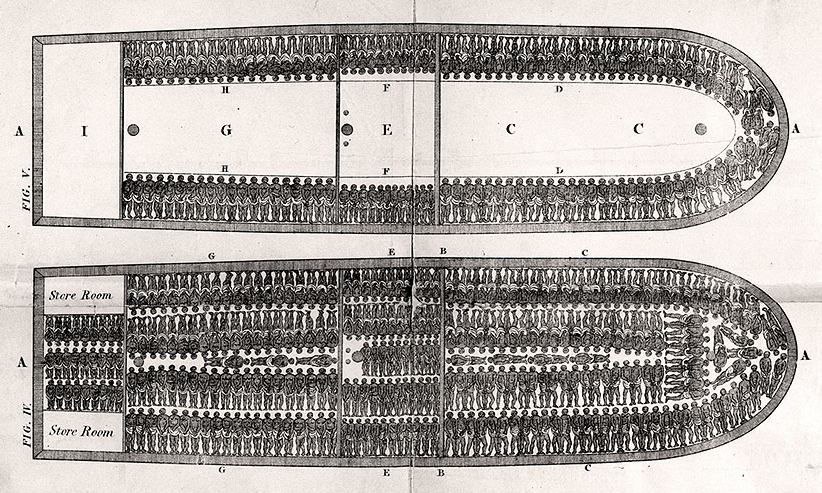
This pic and the one below show the horrible conditions to which African slaves
were subjected on slave ships. The filth, heat, and stench would've been overpowering.

It's sometimes said that Africans were treated better by Muslims than they were in the West, but Stark argues that this is dubious. Although roughly equal numbers of Africans arrived in both the West and in the Islamic world there's no substantial black population today in the "land of Islam." This is attributed in large measure to very low fertility due to the practice of castrating black males and of killing any infants who showed black ancestry.

Castration not only meant that black males who survived it couldn't reproduce, it also created a very high mortality rate among males due to infection and blood loss.

Just as science arose only once, so too, did effective moral opposition to slavery, and, like science, it arose only in the West and by Christians. Slavery has existed in every society able to afford it, including Native American societies, but of all the world's religions only Christians developed the belief that slavery was a great sin and must be abolished.

Antislavery efforts began to appear in Christian literature soon after the decline of Rome and eventually led to its disappearance in all but the fringes of Christian Europe by the end of the 16th century. When Europeans subsequently instituted slavery in the New World they did so over strenuous papal opposition. Unfortunately, by this time in history Rome was too weak to exert its influence over slave-owners in the Western hemisphere.

It's an interesting detail that relatively few slaves were imported into North America. From 1626 to 1808 when it became illegal to import slaves in the U.S., the total number of imported African slaves was about 400,000. By contrast, 3.6 million went to Brazil, 1.6 million were imported by the Spanish colonies, and about 3.8 million wound up in the horrific Caribbean sugar plantations.

Eventually, due to the efforts largely of Quakers in North America and the Clapham Sect in England, most notably William Wilberforce, the slave trade was first abolished and then slavery itself was eventually done away with in the West.

There was, however, no similar abolition movement in the Islamic world. Slavery was only ended in the Muslim world because of Western pressure to do so, but it persisted nevertheless well into the 20th century (Saudi Arabia banned it in 1962, Mauritania in 1981).

The British navy embargoed Muslim slave ships and British and French colonial troops intercepted countless slave caravans, freeing the slaves and sometimes executing slave traders on the spot. In North America a catastrophic civil war was fought, primarily over the issue of slavery.

Stark notes how the people who finally ended this moral scourge were acting essentially altruistically. They themselves had nothing to gain from their efforts and some paid dearly for their commitment to the cause of freeing blacks.

He concludes that although a Christian culture was certainly not a sufficient basis for ending slavery, it was nonetheless a necessary one since it was almost solely Christian thinkers and activists, working within a Christian understanding of human rights and equality, who reached anti-slavery conclusions and sought to help the larger culture recognize that they were participating in a great evil.

Perhaps if this history were more widely known fewer African Americans would be inclined to reject their Christian identity in favor of an Islamic one.

Monday, July 26, 2021

Science Is Rooted in a Christian Worldview

In his book For the Glory of God Baylor historian and sociologist Rodney Stark claims that Christian monotheism led to, among other things, both science and the end of slavery. Stark debunks several of the more persistent myths about the interplay and significance of Christianity for both the emergence of modern science and the abolition of slavery.

Ever since the 17th century opponents of Christianity have sought to perpetuate the myth that religion and science have been locked in mortal combat. The myth culminated in the work of Andrew Dickson White, author of A History of the Warfare of Science with Theology in Christendom (1896), a book whose themes are still influential today even though they've been almost entirely discredited by subsequent scholarship.

Stark shows how White's account of Columbus being impeded by religious men in Spain who thought the world was flat is totally false, as is belief in an epoch of "Dark Ages" which descended upon Europe like a shroud over the minds of men. There were no "Dark Ages," nor did anyone with any learning in Columbus' day think the world was flat. His proposal to sail across the Atlantic to India was resisted because it was believed, rightly, that Columbus had seriously underestimated the circumference of the globe and that he would never be able to make it to his destination.

Indeed, he would not have made it had he not serendipitously come upon the New World.

So, too, traditional accounts of the theories of Copernicus and the persecution of Galileo by the Church are often riddled with misinformation intended to make Christianity and Christians look like benighted fools and frame the founders of modern science as secular heroes struggling against an oppressive Church.

The facts are otherwise. As Stark points out, 50 of the 52 men who were most influential in the development of modern science in the 16th and 17th centuries were Christians, and over 60 percent of these were devoutly so, including some of the greatest names in the scientific pantheon: Boyle, Brahe, Descartes, Gassendi, Hooke, Huygens, Kepler, Leibniz, Newton, Pascal, Vesalius, et al.

Stark observes that so far from being inimical to science, the Church made it possible for science to flourish by building and staffing universities where men could pursue learning centuries before the "Enlightenment," but perhaps even more important than centers of scholarship was the pervading worldview in Europe that gave rise to modern science.

The theological assumptions that the cosmos had been created by an intelligent being, that it was logical, law-like and designed, and that its secrets could be unlocked through the application of human reason, all provided the impetus to explore and investigate the world and led to the burgeoning of scientific discovery.

This, Stark argues, is why "science arose only once in history - in medieval Europe - because only there was found a culture dominated by a belief in a rational, conscious, all-powerful Creator," and only in Christian Europe were men free to investigate nature and to "think God's thoughts after Him."

The belief that science and religion are antithetical to each other is a myth perpetuated by some in order to promote a naturalistic, materialistic metaphysics, but metaphysics is not science. The real conflict over the last two centuries has been between teo metaphysical worldviews, theism and naturalism, and scientists, qua representatives of science, have, or should have, nothing to say about either of these.

Saturday, July 24, 2021

Theistic Implications Don't Render a Paradigm Unscientific

Opponents of Intelligent Design (ID) often conflate ID with Creationism, perhaps because it confuses the public and enables ID's critics to make the claim that ID is a religious effort and not a scientific enterprise. The conflation is intellectually irresponsible because those who seek to identify ID with Creationism know, or should know, that they're not the same thing.

Creationists, particularly young earth creationists, use a literal reading of the first eleven chapters of the Bible as the interpretive grid which they impose upon the empirical evidence that scientists have uncovered.

ID proponents, on the other hand, base their arguments entirely upon science and philosophy and make no reference to the Bible or any religious text. They argue that the evidence scientists have discovered is best explained in terms of intelligent agency and very poorly explained in terms of purely natural processes and forces.

Whether ID is right or wrong is a question for scientists and philosophers to decide. It's not a religious or theological question.

Those who seek to obfuscate the difference between Creationism and ID either aren't being honest or haven't read any of the substantial corpus of work published by proponents of ID over the last three decades.

One of the most compelling ID proponents on the contemporary scene is philosopher of science Stephen Meyer whose books, Signature in the Cell, Darwin's Doubt, and Return of the God Hypothesis each make a case for the proposition that the origin of the universe, the fine-tuning of the universe, the origin of life, and the infusion of new information necessary for the diversification of body plans during the Cambrian period, taken together make a powerful case for the conclusion that life and the universe were intentionally engineered by an intelligent mind.

Now it's certainly the case that ID has implications for one's metaphysical convictions, but that should hardly disqualify ID from competing in the scientific arena with naturalistic explanations, since naturalistic accounts also have their own metaphysical implications.

In the following seven minute video Meyer discusses the metaphysical implications he sees resulting from the superior explanatory power of ID. He summarizes the argument against naturalistic explanations for the origin of life, the origin of the cosmos and cosmic fine-tuning and concludes that the scientific evidence points to a transcendent intelligent creator. For a much fuller presentation of these arguments check out his book Return of the God Hypothesis, a book that I think would convince anyone whose mind was not already a priori opposed to Meyer's conclusion.

Friday, July 23, 2021

The Most Pressing Question

The last couple of posts have addressed themes touched upon by the late Rabbi Jonathan Sacks in his book Morality: Restoring the Common Good in Divided Times. As we've noted in the previous posts, he talks in the book, inter alia, about our collective lostness - our contemporary forfeiture of objective truth, dignity, freedom, and morality as well as the loss of any ground for human rights.

There's one more thing he argues that we've lost in the modern age that I'd like to focus on today: Meaningfulness.

Sacks tells the sad story of author David Foster Wallace who took his own life at the age of 46 in September of 2008. Wallace once said that the emptiness of modern life manifests itself in a kind of lostness.

He noted that he and his friends were affluent, highly educated and successful in their chosen walks of life, but despite these advantages some of them were deeply into drugs, others were workaholics, others were going to singles bars every night.

They were, he said, "adrift."

He told a magazine in 1993 that "this is a generation that has an inheritance of absolutely nothing as far as meaningful moral values."

Reading his story reminded me of Ernst Hemingway's semi-autobiographical novel The Sun Also Rises written in 1926 and F.Scott Fitzgerald's Great Gatsby written the year before. They both describe a lost generation living lives of not-so-quiet desperation, lives spent in an alcoholic haze, enmeshed in petty squabbles and projects, trying to find something with which to satiate their hunger for meaning and purpose.

Albert Camus' novel The Stranger (1942) is a somewhat similar tale of the ultimate pointlessness of human existence.

The century since Hemingway and Fitzgerald has brought material blessing that those artists could never have imagined, but the emptiness of modern life, despite our comforts and technology, is as painful as ever.

A character in the movie Contact captures our existential anguish well when he says that, "In all of our searching the only thing we’ve found that makes the emptiness bearable is each other."

The great Russian novelist Leo Tolstoy was perhaps ahead of his time when he asked, “What will come from what I am doing now, and may do tomorrow? What will come from my whole life? Otherwise expressed—Why should I live? Why should I wish for anything? Why should I do anything? Again, in other words, is there any meaning in my life which will not be destroyed by the inevitable death awaiting me?”

Filmmaker Ingmar Bergman insisted that, “You were born for no purpose. Your life has no meaning. When you die you are extinguished.”

Why this awful nihilism that has descended upon Western societies like a suffocating smog over the last 100 years?

French philosopher Jean Paul Sartre hints at an answer when he asserted that, "Life has no meaning the moment you lose the illusion of being eternal."

Writer Somerset Maugham puts it similarly when he wrote that, "If death ends all, if I have neither to hope for good nor to fear evil, I must ask myself what am I here for….Now the answer is plain, but so unpalatable that most will not face it. There is no meaning for life, and [thus] life has no meaning.”

Death, these men tell us, is the big eraser. It wipes away anything that could possibly make life worth the suffering, the boredom, the terror that existence holds for so many. And as David Foster Wallace observed even those who live in relative comfort, maybe especially those, are not exempted from the ennui and the pain of existential emptiness.

Put differently, unless what we do matters forever, it doesn't matter at all. For this reason, to quote Evelyn Waugh, "Life is unintelligible and unendurable without God."

Sacks cites a New York Times article on the despair evinced by the soaring statistics of depression, suicide and self-harm, especially among the young. The article quotes one person who confessed that, "Drugs and alcohol are the only shining rays of light in my otherwise unbearable existence."

Another admitted that, "I no longer find much of anything meaningful, fulfilling or satisfying. Whatever used to keep me going has gone. I am currently struggling to find any motivation to keep going."

The German philosopher Friedrich Nietzsche foresaw in the 19th century that the loss of God would eventually unmoor mankind and plunge him into a cold, empty void of meaninglessness and despondency. In The Gay Science (1882) he wrote:
"Whither is God?" he [Nietszche's Madman] cried; "I will tell you. We have killed him---you and I. All of us are his murderers. But how did we do this? How could we drink up the sea? Who gave us the sponge to wipe away the entire horizon? What were we doing when we unchained this earth from its sun? Whither is it moving now? Whither are we moving? Away from all suns?

Are we not plunging continually? Backward, sideward, forward, in all directions? Is there still any up or down? Are we not straying, as through an infinite nothing? Do we not feel the breath of empty space? Has it not become colder?

Is not night continually closing in on us? .... God is dead. God remains dead. And we have killed him.
Modern man lives by the conceit that he can do away with God and the only consequence of his abandonment is that he's now free to sleep in on Sunday morning. This is very naive.

When we do away with God, as I've maintained over the last several posts, not only have we no longer anything upon which to base objective truth, mutual trust, human dignity, freedom of the will, objective morality, and human rights, but we also become untethered, lost in the cosmos, to borrow from the title of a Walker Percy novel.

We lose all hope of having any lasting meaning, purpose or significance. That's why the question of God is the most pressing question in all of life and why I return to it so often on Viewpoint.

Thursday, July 22, 2021

Do Human Beings Have Dignity?

Article I of the U.N. Universal Declaration of Human Rights adopted in 1948 states that "All human beings are born free and equal in dignity and rights."

Unfortunately, the worthies who composed this statement chose not to explore the deeper question of how being born a human being gives us either equality or dignity. Indeed, where does the idea of human dignity come from? And where do our rights come from?

Dignity (by "dignity" I mean worth, value or significance) derives from our ability to choose between right and wrong actions. Thus, dignity is related to morality. Immanuel Kant writes in his Groundwork to the Metaphysics of Morals that, "Morality, and humanity in so far as it is capable of of morality, is that which alone has dignity."

But this is at odds with the prevailing worldview of our modern secular society. We may pay lip service to dignity, but in a secular world which no longer believes that God is relevant or even exists why should anyone think that anyone else possesses such a thing?

Psychologist B.F. Skinner titled his most famous book Beyond Freedom and Dignity (1971) and urged us to get over thinking that we possess either free will or any other specialness that conferred dignity upon human beings.

Cosmologist Stephen Hawking claimed that “The human race is just a chemical scum on a moderate-sized planet, orbiting around a very average star in the outer suburb of one among a hundred billion galaxies.” If we're just scum from whence do we get the idea we have anything remotely resembling dignity?

The brilliant early twentieth century Supreme Court Justice Oliver Wendell Holmes declared that "When one thinks coldly I see no reason for attributing to man a significance different in kind from that which belongs to a baboon or a grain of sand." Well, how much dignity do either a baboon or a grain of sand possess?

There's actually only one adequate source of human worth, but it's a source not open to naturalistic thinkers like Skinner, Hawking or Holmes. If it's true that we are in fact, as our Declaration of Independence states, all created equally and also true that we are created in God's image and prized by Him, then human beings do indeed have enormous value and significance.

If, however, there is no God, then it follows that what we call human dignity is a fiction we tell each other to make ourselves feel noble. And, if the notion of dignity is a fiction then so is the idea of human rights for there can be no rights if man has no special worth or significance.

If man has no special value then human rights are just arbitrary words hung on skyhooks; they're like paper money that has nothing of value backing it up.

Put differently, if there is no God, if all there is is the material universe, then Skinner is correct and human freedom is an illusion. We are all in the grip of the physical laws of nature and what we "choose" is what we've been determined by our environment or our genes to choose. And, if there is no freedom, if our choices are the inevitable products of factors beyond our control, then there can be no morality, since morality depends upon the freedom to choose, and if there's no morality there's no dignity, and if no dignity then no human rights.

We are, as Holmes suggested, simply a different species of baboon.

Freedom, morality, dignity and rights are all ontologically dependent upon there being a personal God. One can say, of course, that there is no God, but what he can't say, and be consistent, is that there is no God but that morality, human dignity and human rights all nevertheless still exist.

To say that is to talk nonsense.