Friday, October 21, 2022

An Attempt to Evade the Hard Problem

In an interesting article at Mind Matters News neurosurgeon Michael Egnor critiques an attempt by a materialist neuroscientist named Anil Seth to circumvent what philosopher David Chalmers called "The Hard Problem" of consciousness (You can watch a video featuring Chalmers discussing the Hard Problem here).

Egnor starts off by explaining what the "Hard Problem" is:
Philosopher David Chalmers famously divided the problem of understanding how consciousness is related to the brain by distinguishing between the easy and hard problems of consciousness.

The easy problem of consciousness is typically faced by working neuroscientists — i.e., what parts of the brain are metabolically active when we’re awake? What kinds of neurons are involved in memory? These problems are “easy” only in the sense that they are tractable.

The neuroscience necessary to answer them is challenging but, with enough skill and perseverance, it can be done.

The hard problem of consciousness is another matter entirely. It is this: How can first-person subjective experience arise from brain matter? How do we get an ‘I’ from an ‘it’? Compared with the easy problem, the hard problem is, from the perspective of materialist neuroscience, intractable.
By this Egnor means that the hard problem is trying to explain how electro-chemical activity in the brain is converted into sensations like the color red or the fragrance of perfume or how electro-chemical reactions in the brain give rise to a meaning when you read a page in a book.

No one knows how this happens. It's one of the deepest mysteries of the universe. If one is a dualist of one kind or another, and believes that we have an immaterial mind or soul, then perhaps this faculty is in some way involved in this mysterious translation from the physical materiality of brain function to the immaterial sensations of color or pain.

But if one is a materialist then that solution is not available to her, and so the nature of the bridge between the material and the immaterial is completely inexplicable.

One way out of the impasse is to simply deny that one's conscious experience is anything more than an illusion - what Seth calls a "controlled hallucination" occasioned by the integration of sensory inputs by the brain hemispheres.

In other words, consciousness is an illusion created by the complex interactions of the two hemispheres of the brain.

Egnor elaborates on Seth's view:
...the essence of his theory of consciousness is that the brain integrates a cacophony of sensory inputs to fabricate an explanation for perceived reality — a “controlled hallucination” — that we call consciousness.

This view, that consciousness is, in one sense or another, the consequence of massive parallel processing going on in neural circuits in the brain, is common among modern neuroscientists.

But it can’t be true.
Egnor cites two phenomena as reasons why Seth's "controlled hallucination" theory doesn't fit the facts:
...consider the neurological consequences of split brain surgery and the congenital brain condition called hydranencephaly.

In split brain surgery, neurosurgeons cut the massive bundle of nerve fibers connecting the cerebral hemispheres in order to lessen the propagation of seizures in patients with epilepsy. The two brain hemispheres are disconnected — information from one hemisphere cannot readily be transmitted to the other.

This radical disconnection of the brain hemispheres causes massive interference with the [sensory inputs that Seth posits as the source of our hallucination of consciousness] but, contrary to what Seth’s theory seems to predict, there is no impairment of consciousness whatsoever.

Patients with split brains (I have performed the surgery myself) have very subtle perceptual disabilities of which they are almost always unaware, and there is no impairment in consciousness.
Contrary to what Seth's theory would predict, despite the patient having his brain cut in half, his consciousness remains undivided and unimpaired.

An even more difficult problem for Seth's theory of “controlled hallucination” is hydranencephaly:
Hydranencephaly is a condition in which children are often born without brain hemispheres. The cause is usually a massive intrauterine stroke that destroys all of the brain above the brainstem.

Nearly all of the perceptual circuits on which Seth’s theory depends are not merely cut, but are completely destroyed, yet children with hydranencephaly are fully conscious.

I have cared for these children myself (I am a pediatric neurosurgeon). Although they are quite handicapped, they are certainly conscious, interactive, and show a full range of emotions — laughter, crying, glee, fear, and such.

Complete destruction of the cerebral hemispheres is fully compatible with consciousness.

Seth’s theory that consciousness is a “controlled hallucination” occasioned by integration of massive sensory inputs by the brain hemispheres falls apart when we consider that disconnection of the hemispheres — and even destruction of the brain hemispheres — is compatible with full consciousness (despite profound sensory and motor disabilities).
Egnor concludes that,
Only a dualist or idealist understanding of the mind–brain relationship can survive the evidence provided by split brain research and routine clinical experience with children with hydranencephaly.

The only “controlled hallucination” here is the belief that materialism can explain the mind.
As an addendum, Egnor's article includes this video of a child born with hydranencephaly and missing 80% of his brain. As the viewer can see, the child, though severely disabled, is still fully conscious:
Egnor adds this note:
Jaxon Buell (2014–2020) died at five years of age due to complications from his condition (80% of his brain missing). “Jaxon was unable to walk or talk, but his parents shared his many milestones on the now-deleted Facebook page We Are Jaxon Strong, where followers saw him smiling and appearing to communicate with noises and eye contact.” – People magazine (April 7, 2020)

Thursday, October 20, 2022

Political Taxonomy

If you've been paying any attention at all to the political talk surrounding the upcoming election (Tuesday, November 8) you've probably read or heard mention of liberals and conservatives, socialists and libertarians, far left and far right. Unfortunately for those new to the political scene, or just casual observers, the terms are rarely defined so their meanings are often poorly understood.

I thought it might be helpful to correct this lack of understanding by rerunning a post (slightly updated) that's been featured on VP during other election seasons, and which explains some basic differences between the various political ideologies:

Probably one reason a lot of people steer clear of politics is that they find the ideological labels (as well as words like ideological itself) to be confusing. Terms like left, right, liberal, conservative, progressive, libertarian, fascism, socialism, and communism are thrown around a lot by our punditry, but they're rarely accompanied by any explanation of what they mean.

This post will try to correct that omission so that as we get closer to the election readers might have a somewhat better understanding of what they're reading and hearing.

For starters, let's define a political ideology as the set of principles which guide and inform one's social, economic, and foreign policies. It's a kind of political worldview. All the terms listed above denote various political ideologies.

The following diagram will give us a frame of reference to talk about these terms:


Let's start on the right side of the spectrum and define the terms going right to left. Each of them expresses a different understanding of the role of government in our lives and a different understanding of the rights citizens possess vis a vis the state.

I have one quibble, though, with the diagram. I personally don't think either anarchy or mob rule belong on it since neither is a stable ideology. They both either evaporate, as did Occupy Wall Street, or they morph into communism or fascism.

With that said, let's consider the remaining elements of the spectrum:

Libertarianism: This is the view that the role of government should be limited largely to protecting our borders and our constitutionally guaranteed rights. Libertarians believe that government should, except when necessary to protect citizens, stay out of our personal lives and out of the marketplace. They are also very reluctant to get involved in foreign conflicts.

Senator Rand Paul who was an early candidate for the Republican nomination for president in 2016, is perhaps the most well-known contemporary libertarian politician. The late Ayn Rand (who wrote Atlas Shrugged and for whom Rand Paul is named) is a well-known libertarian writer.

Conservatism: Conservatives tend to lean toward libertarianism in some respects, particularly in their belief in free markets, but see a somewhat more expansive role for government. The emphasis among conservatives is on preserving traditional values and the Constitution and also upon limiting governmental authority in the federal government in Washington and giving it back to the states and localities.

Conservatives are reluctant to change the way things are done unless it can be shown that the change is both necessary and has a good chance of improving the problem the change is intended to address.

Conservatives take a strict view of the Constitution, interpreting it to mean pretty much what it says, and oppose attempts to alter it by judicial fiat. Supreme Court justice Clarence Thomas is a conservative. Conservatives also oppose government interference in the market by over-regulation and oppose high tax rates as being counter-productive.

They generally oppose illegal immigration and believe in a strong national defense, but, though more willing to use force abroad when our interests can be shown to be threatened, are nevertheless leery of foreign adventures.

Senators Tim Scott and Tom Cotton are contemporary conservative politicians, and the Wall Street Journal opinion page generally promotes a conservative point of view.

Moderates: Moderates tend to be conservative on some issues and liberal on others. They see themselves as pragmatists, willing to do whatever works to make things better.

They tend to be non-ideological (although their opponents often interpret that trait as a lack of principle). Senator Joe Manchin is considered a moderate politician and Wall Street Journal columnist Peggy Noonan would be an example of a moderate journalist.

Liberalism: Liberals endorse an expansive role for government. They take a loose view of the Constitution, interpreting it according to what they think the Founders would say if they wrote the document today.

They tend to think that traditional values shackle us to the past and that modern times and problems require us to throw off those impediments. They agree with libertarians that government should stay out of our personal lives, but they believe that government must regulate business and tax the rich and middle classes to subsidize the poor and their "Green" energy agenda.

They tend to hold a very strong faith in the power of government to solve our problems, a faith that conservatives and libertarians think is entirely unwarranted by experience. Joe Biden campaigned for president as a liberal politician, but he has governed as a progressive.

Progressivism: Progressivism can be thought of as hyper-caffeinated liberalism. Almost all prominent members of today's Democratic party are progressives as are many in the mainstream media and on cable networks like CNN and MSNBC.

Progressives often see the Constitution as an obstacle to progress.

Whereas conservatives view the Constitution as a document which protects individual rights, progressives see it as an archaic limitation on the ability of government to promote social and economic justice. They tend to be indifferent to, or even disdainful of, traditional values and institutions such as marriage, family, and religion.

Progressives are essentially socialists who are reluctant, for whatever reason, to call themselves that. A humorous depiction of progressivism can be found here. Former President Barack Obama and former candidate Hillary Clinton are progressives as is current VP Kamala Harris.

Socialism: As stated in the previous paragraph, socialists are progressives by another name. Both progressives and socialists desire that power be located in a strong central government (they're sometimes for this reason referred to by their opponents as "statists.") and both wish for government to be involved in our lives "from cradle to the grave" (see this ad which ran in the 2016 presidential campaign). They favor very high tax rates by which they hope to transfer wealth to poorer communities and reduce the disparity in income between rich and poor.

Perhaps one difference between socialists and progressives is that though both would allow corporations and banks to be privately owned, socialists would impose more governmental control over these institutions than progressives might. Senator Bernie Sanders is an example of a contemporary socialist and Venezuela is an example of a socialist country.

Fascism: Typically fascism is considered an ideology of the right, but this is a mistake. Fascism, like communism, is a form of totalitarian socialism. Indeed, the German Nazis as well as the Italian fascists of the 1930s were socialists (The Nazi party was in fact the National Socialist Party).

Fascism is socialist in that fascists permit private ownership of property and businesses, but the state maintains ultimate control over them. Fascism is usually militaristic, nationalistic, and xenophobic. It is totalitarian in that there is usually only one party, and citizens have few rights.

There is no right to dissent or free speech, and fascists are prone to the use of violence to suppress those who do not conform.

Those on the far left on campus who shout down speakers and professors whose message they don't like are, unwittingly perhaps, adopting fascistic tactics. Paradoxically, so is Antifa, which is shorthand for "anti-fascist."

Vladimir Putin is often called an authoritarian but has in recent months increasingly governed like a classical fascist.

Communism: Like fascism, communism is totalitarian and socialist, but it's a more extreme brand of socialism. Under communism there is no private ownership. The state owns everything.

Moreover, communism differs from fascism in that it is internationalist rather than nationalist, and it traditionally didn't promote a militaristic culture, although it certainly doesn't shy from the use of military force and violence to further its goals. Like fascism, however, communism does not permit free speech, and those who dissent are executed, tortured or cruelly imprisoned.

Few completely communist nations remain today, though throughout much of the twentieth century the Soviet Union, Eastern Europe, China, Cuba and many other Asian and African states were all communist. Today North Korea is probably the only truly communist nation. Many other former communist countries are today evolving into various forms of fascism.

Scarcely any contemporary politicians would admit to being communists though some of Barack Obama's close associates and friends over the years, such as Bill Ayers and his wife, Bernardine Dohrn, Van Jones, and mentor Frank Marshall Davis are, or were, all communists.

Senator Bernie Sanders denies being a communist but he has throughout his life been sympathetic to communist governments, even spending his honeymoon in the old Soviet Union.

I hope this rather cursory treatment of the various points on the political spectrum will be helpful as you seek to make sense of what you're seeing, hearing and reading about the upcoming elections.

Wednesday, October 19, 2022

The Uniqueness of Earth

An article at Salvo (subscription required) drives a spike into the notion that the galaxy, and perhaps the universe, are filled with habitable planets and that intelligent life elsewhere in the cosmos is an inevitability.

The article, by astronomer Hugh Ross, observes that the conviction that there simply must be life out there somewhere and that our earth is not unique in being fit for sustaining life is based on four assumptions:
  1. The density and kinds of planets throughout our galaxy and all other galaxies in the universe are roughly the same as what we observe in the vicinity of our solar system.
  2. About 20 percent of all planets are habitable.
  3. Life inevitably will arise on all habitable planets.
  4. The probability of a technologically advanced civilization arising from simple life-forms is better than one chance in 10 billion.
Each of these assumptions, especially #3, is deeply problematic, but Ross focusses in this article on #2.

The belief that 20% of all planets are habitable is based on the fact that of the 3000+ planets discovered so far, 20% of them lie at a distance from their star that would permit water to exist in the liquid state. Since water is a necessary condition for life, it's assumed that these planets could sustain living things.

Ross points out, however, that though water is a necessary condition for life, it's not a sufficient condition. There are, in fact, nine different "habitable zones" and all nine must overlap in order for life to exist on a planet.

In addition to the water habitable zone there are also the following:
  1. Ultraviolet habitable zone
  2. Photosynthetic habitable zone
  3. Ozone habitable zone
  4. Planetary rotation rate habitable zone
  5. Planetary obliquity habitable zone
  6. Tidal habitable zone
  7. Astrosphere habitable zone
  8. Electric wind habitable zone
Ross explains each of these zones in his recently released book Improbable Planet, but in the Salvo article he simply observes that:
Typically, these zones do not overlap. For example, the distance a planet must be from its host star so that it receives enough ultraviolet radiation to enable the synthesis of many life-essential compounds, but not so much as to kill living things, is rarely the same distance that a planet must be from its host star for liquid water to possibly exist on its surface.

For 97 percent of all stars, the liquid water habitable zone does not overlap the ultraviolet habitable zone.
Thus,
A planet is a true candidate for habitability only if it simultaneously resides in all nine habitable zones....So far, astronomers have measured the characteristics of 3,484 planets. Only one of all these 3,484 planets resides in all nine known habitable zones. That one is Earth.
For all we know there may be other habitable zones in addition to these nine, but there are in any case several conclusions to be drawn from the information Ross provides us. First, the principle of mediocrity - the principle, held by many naturalistic scientists, that the earth is not exceptional in any significant way - is ludicrous.

Second, the notion that residence of a planet in the water habitable zone is sufficient to justify hopes that life could exist on that planet is naive.

When the necessity for all nine habitable zones overlapping is combined with the dozens of other parameters that any planet must possess in order to be suitable for life suggests that life-sustaining planets are probably extremely rare.

In fact, if it turns out that such planets are not reare that finding in itself would be so astonishing as to point to intelligent, purposeful engineering of the universe.

Tuesday, October 18, 2022

Is There Life After Death?

Robert Lawrence Kuhn hosts a show titled Closer to the Truth which features guests from various philosophical and scientific disciplines who offer fascinating insights into their areas of expertise.

One recent episode featured an interview with philosopher J.P.Moreland who has written extensively in the philosophy of mind.

In this 11 minute episode Kuhn and Moreland explore the question of life after death. It's an interesting discussion and one which is, as Moreland notes at the end, one of the most important questions in life.

If, as materialists maintain, we just are our bodies and there's nothing else that comprises our self then it becomes much more difficult to believe that there's any sense in which we survive our physical death.

On the other hand, if our physical, material bodies are not all there is to us, if we also possess an immaterial soul or mind which is crucial in the expression of our consciousness, then life after physical death becomes much more plausible.

Here's the episode and Moreland's take on the question:

Monday, October 17, 2022

The Inflation Numbers

Matthew Continetti at The Washington Free Beacon discusses last week's inflation report for September:
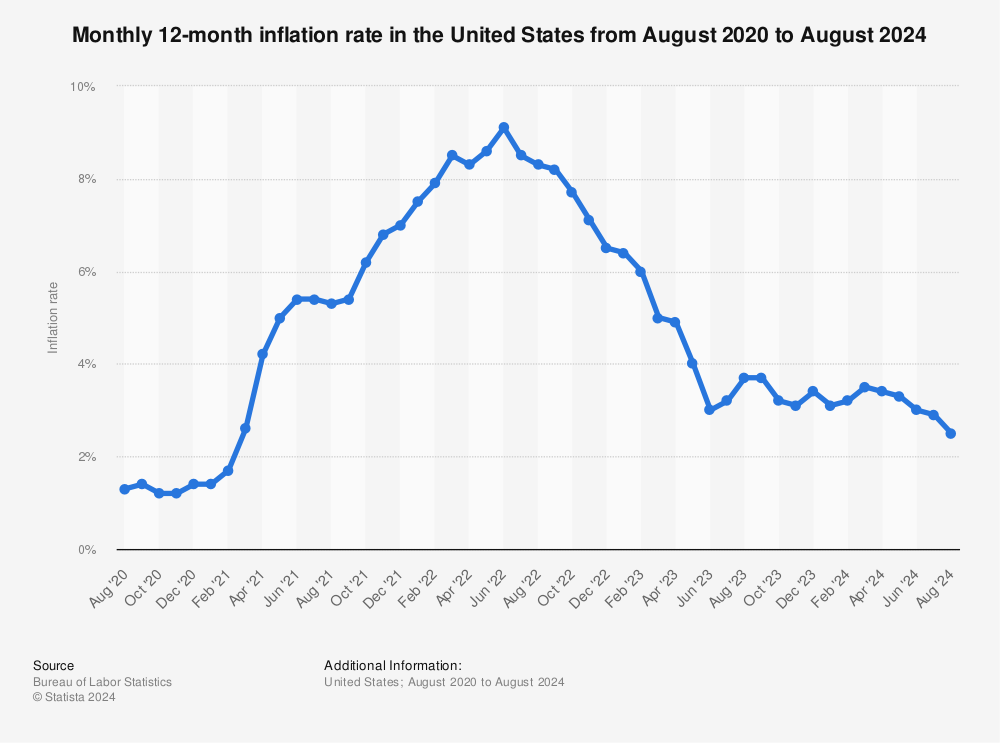
Last Thursday the Bureau of Labor Statistics announced that consumer price inflation, at an 8.2 percent annualized rate, was higher than expected through September.
The rate has been 7.9 percent or higher each month since last February and is the highest it's been in over 40 years. When Mr. Biden took office the rate was 2.5 percent. Mr. Biden sees no evil, however. Continetti writes that the White House...
...doesn’t see any troubles. According to President Biden, the most recent BLS data are superfluous. After all, everybody already knows that "Americans are squeezed by the cost of living: that’s been true for years, and they didn’t need today’s report to tell them that."

As a matter of fact, Biden said in a statement, rising costs are "a key reason I ran for President." And anyway, the situation is under control. "My policies—that Democrats delivered—directly tackles [sic] price pressures we saw in today’s report."
As is his inveterate habit, our Fabulist in Chief is spinning another yarn here. Continetti explains:
I don’t remember Biden staking his 2020 candidacy on inflation. He couldn’t have. The inflation hadn’t happened. It didn’t arrive until the spring of 2021. By which time Biden was living—during weekdays, at least—at 1600 Pennsylvania Avenue.

Nor do I recall Biden warning the country about the coming threat of rising prices. To the contrary: Varsity Joe was captain of "Team Transitory." The "temporary" inflation would subside, he and his teammates argued, as kinks in the supply chain got worked out and the Federal Reserve tightened the money supply.
Also as is his custom, the finger of blame gets pointed everywhere but at his own self:
By the winter of 2022, Biden was blaming high prices on corporate greed and "Putin’s price hike." Now he says inflation is the fault of the opposition party.

No reason is provided; this president isn’t into causality. "If Republicans take control of Congress," Biden warns, "everyday costs will go up—not down."
This is a very odd claim to make since gas averaged about $2.17 in 2020 before Democrats took over in January 2021 and prices soared.

Here's a chart showing the inflation rate over the last few years:

Statistic: Monthly 12-month inflation rate in the United States from January 2020 to August 2022 | Statista

Find more statistics at Statista.

What caused inflation to rise so fast and so far? Government spending and a policy of trying to strangle oil and gas production. Continetti explains President Biden's spending in more detail at the link.

It's ironic that Mr. Biden promised that no one earning under $400,000 will have their taxes increased, but inflation is a tax and it's hurting everyone, especially those on fixed incomes.

It's also ironic that the Biden administration has done everything it can to kill the fossil fuel industry, but they're outraged at the Saudis for not selling us cheaper gas. They've also decided that the Venezuelan tyrants are not such bad guys after all and are seeking to relax sanctions on Venezuela so that they'll sell us their petroleum.

Our energy policy certainly seems weird.

Saturday, October 15, 2022

The Quiet Epidemic

There's a silent epidemic stalking the U.S., but it's not one borne by a virus or bacterium. It's a psycho-social affliction that harms both the elderly and the young, especially young men.

It's a major cause of illness, suicide and other forms of early death among young men, and, according to Marisa G. Franco at The Economist, "is more fatal than a poor diet or lack of exercise and as corrosive as smoking fifteen cigarettes a day."

It's loneliness. One wouldn't think with all the social networking and opportunities for developing relationships in our culture that loneliness would be such a problem, but it apparently is.

In his book Bowling Alone Robert Putnam wrote that social capital - things like civic and political participation, religious participation, workplace networks, informal networks, mutual trust, and altruism - increased in the US until the 1970s and then suddenly decreased and has continued to decrease right up to the present.

The erosion of social capital has been accelerated by, among other things, the decline of church membership, the weakening of family ties, and a diminution of community involvement.

This is tragic given that human well-being depends on interpersonal interactions and relationships.

Prolonged loneliness is associated with an increased risk of depression, anxiety, dementia, stroke and heart disease, so it needs to be taken very seriously.

Part of the problem is that people today often live far from their families and the people they grew up with.

Once upon a time most people spent their whole lives in the community into which they were born, but that's no longer the case.

Many of us go off to school, or relocate across the country, or even overseas, chasing the available jobs and opportunities.

While this may be reasonable, perhaps even necessary, it means we often lack the ability, or opportunity, to ‘put down roots’, and thus build up a network of friends and relations that could be relied upon to counteract eventual loneliness.

It’s interesting, and maybe surprising that a 2018 survey of 20,000 Americans found fewer elderly people experienced loneliness than did younger people, even though older folks were less likely to be able to do anything about their loneliness.

Older teens and young adults, seem to be hit hardest by loneliness, and their sense of isolation became especially acute during the Covid pandemic.

It’s ironic, though, that in a world of social media so many young people are so lonely.

It’s also extremely dangerous. Hannah Arendt in her classic work The Origins of Totalitarianism writes that totalitarianism feeds on lonely people by giving them a sense of belonging to something greater than themselves.

The sense of belonging fills the void once occupied by family, religion and community.

She states that, “...terror can rule absolutely over men who are isolated against each other and that...one of the primary concerns of all tyrannical government is to bring that isolation about.”

Thus, it is the ambition of tyrants, especially tyrants on the left, to fragment the family, destroy the church, and eliminate a sense of community.

Arendt wrote that, “What prepares men for totalitarian domination...is the fact that loneliness...has become an everyday experience of the ever growing masses of our century.”

It's alarming that we see these same trends toward weakening the family, religion and community in many of the cultural trends and public policies that are occurring today.

Are we being set up for a serious assault on our freedom? Will the epidemic of loneliness make it easier for a totalitarian party to accomplish what tyrants have achieved in country after country ever since the French Revolution in 1789?

Friday, October 14, 2022

Putin's Folly and Russian Losses

The Russian invasion of Ukraine has taken an awful toll on Russian men and machines. According to Vodkapundit in PJ Media, reports coming out of Latvia claim that as many as 90,000 Russian troops are classified as "irrecoverable loss."

These are troops who have been killed or seriously wounded or went missing since hostilities began last February 23rd.

The numbers are based on a report from a Latvian web site called "iStories" founded by Russian journalists and whose sources include a former officer of the Russian special services, and an active FSB intelligence officer.

The loss amounts to almost half of the 190,000 men who were sent into Ukraine last winter.

This is an astonishingly high casualty rate, and the Kyiv Posts' figures for lost armaments are equally as shocking:
One wonders how long the Russian people, and Putin's intelligence officers, generals and members of his inner circle are going to tolerate this before they decide that Russia and Russian families have suffered enough in this pointless war.

Thursday, October 13, 2022

Understanding Darwinism and Believing in it

Keith Blanchard (who apparently has no particular expertise in biology) wrote a column for The Week a few years ago that gained some attention at the time and which perpetuates some common misunderstandings.

The ostensible purpose of his article was to exhort people to embrace evolution as science and not as a matter of faith. As Blanchard says, we should understand evolution, not believe in it.

If his point is simply that we can grasp the basic elements of evolutionary theory without making a doxastic commitment to them ourselves, well, then that seems a little banal, but if his point is that if you understand those elements you will presumably believe them to be true then his point is manifestly, glaringly, false.

There are many people who understand the main idea of Darwinian evolution perfectly well, but who reject it nonetheless. Many of those who reject evolution are not so much hostile to the idea of some kind of universal relationship among living things, but rather the way naturalistic metaphysics is smuggled in along with the less innocuous aspects of the evolutionary package.

I might add that I have no quarrel with evolution. It may in some sense be true for all I know.

My quarrel is with naturalism and naturalistic views of evolution which tell us that evolution is a blind, unguided, completely natural process. That's a claim that goes well beyond the empirical evidence.

In other words, human beings may have arrived here through some sort of descent through modification, but if so, there's much reason to believe that there was more to our developmental journey as a species than purely unintentional, unintelligent, physical processes like mutation and natural selection.

At any rate, Blanchard offers a summary of the basic claims of evolutionary theory which, were they correct, could apply to any kind of biological evolution, naturalistic or intelligently directed. The problem is, Blanchard's summary describes evolutionary theory as it stood about fifty years ago.

Few evolutionists accept Blanchard's view today as anything more than a heuristic for elementary school children.

Here's his summary with a few comments. For a much more extensive critique of Blanchard's essay go here.

Blanchard writes:
  • Genes, stored in every cell, are the body's blueprints; they code for traits like eye color, disease susceptibility, and a bazillion other things that make you you.
No doubt our genes code for many aspects of our physical body, but Blanchard does not say that they code for everything that makes us us and for good reason. There's no genetic explanation for some our most important traits. It's a mystery, for example, how genes could possibly produce human consciousness, or many behaviors in the animal kingdom.

How, after all, does something like an immaterial mind arise from material interactions of chemical compounds in the brain? Not only do we have no explanation for how conscious experience arises in individual persons, we have no explanation for how such a thing could ever have evolved by physical processes in the human species.

The same is true of behaviors. All birds of any particular species behave similarly, but how do genes, which code for proteins which in turn form structures or catalyze chemical reactions, produce a behavior?

It's no more clear how molecules of DNA can produce behavior than it is how molecules of sucrose can produce the sensation of sweet.
  • Reproduction involves copying and recombining these blueprints, which is complicated, and errors happen.
Yes, they do and those errors are almost always dysgenic. They detract from fitness not enhance it, just as an error in copying computer code is much more likely to cause a system to crash than it is to cause it to work better.
  • Errors are passed along in the code to future generations, the way a smudge on a photocopy will exist on all subsequent copies.
As I said above, a smudge is a flaw. As similar "smudges" accumulate the result is not a new and different picture of high quality, it's an increasingly weaker and useless representation of the old.
  • This modified code can (but doesn't always) produce new traits in successive generations: an extra finger, sickle-celled blood, increased tolerance for Miley Cyrus shenanigans.
These examples, particularly the last, are dysgenic to human beings. Polydactyly may not be dysgenic but neither does it confer a survival advantage. If it did it would spread through the population, but it hasn't.
  • When these new traits are advantageous (longer legs in gazelles), organisms survive and replicate at a higher rate than average, and when disadvantageous (brittle skulls in woodpeckers), they survive and replicate at a lower rate.
This is the selectionist theory of evolution, i.e. that natural selection, acting on genetic mutations, drives evolution. It is held today by few biologists because it's fraught with empirical difficulties. In order to finesse these difficulties biologists have adduced other mechanisms such as genetic drift to do the heavy lifting in evolution.

In fact, as Michael Behe pointed out in his book The Edge of Evolution, any theory based on fortuitous mutations defies probability. Many traits require several specific mutations occurring at almost the same time in an organism, and the chances of this happening are astronomically low.

I repeat, this might have happened through a long evolutionary process, but to say that the process was completely natural (a claim Blanchard doesn't make, by the way) is to go beyond empirical science and enter the realm of faith and metaphysics, and even the belief that it happened at all requires a considerable amount of blind faith.

We can understand the basic lineaments of evolutionary theory, but that doesn't mean that it's appropriate to believe that the process actually happened. To believe in it is to have faith that the theory is the true explanation for how we got to be here.

There are people who understand the theory and who believe it's true. There are people who understand the theory and don't believe it, and there are many who understand it and are agnostic, believing that the scientific evidence often conflicts with the theory, as Stephen Meyer has so powerfully shown in his first two books Signature in the Cell and Darwin's Doubt.

In my opinion, a humble agnosticism with respect to the actual mechanisms by which life originated and diversified is the most intellectually prudent course.

I'm far more confident, however, in the truth of the claim that however we came to exist as a species it's far more probable that it was the result of the purposeful agency of an engineering genius than that blind chance accomplished the equivalent of producing a library of information entirely unintentionally.

Wednesday, October 12, 2022

A Hopeless Bind

The late Robert Jastrow was a highly accomplished astronomer and an agnostic. He was also a materialist, i.e. he maintained that everything that exists can be explained in terms of matter and the laws which govern it. For a strict materialist there are no immaterial substances like minds, souls or God.

In the short video below Jastrow explains how his agnosticism and materialism combine to place him in a hopeless philosophical bind, and yet he refuses to relinquish them.

Here's the video:
If the universe came into existence, which it obviously did, then it must have had a cause. Whatever caused the universe must have not only transcended the universe - which means it must have transcended space, time and matter - but it must also have been incomprehensibly powerful and intelligent.

It's plausible, too, to think that the fine-tuning of the structure of matter on both the very tiny and the extraordinarily large scales, as well as the exquisitely precise values of the forces, parameters and constants of the universe, all suggest that this intelligent agent had a conscious purpose in creating a universe that could sustain life.

If it did have a conscious purpose then it was a personal agent since conscious purposes are attributes of personal beings.

So Jastrow's hopeless bind is that his agnostic materialism prevents him from acknowledging that there are any non-physical agents acting in or on the universe while his science tells him that there must be a transcendent, non-physical, personal cause that brought the universe into being.

One wonders if he carried that bind with him to the grave or if he finally resolved it.

Tuesday, October 11, 2022

Soul, Mind, Spirit and Immortality

Robert Lawrence Kuhn hosts a show titled Closer to the Truth. Kuhn's guests are thinkers from various disciplines who offer fascinating insights into their areas of expertise.

One recent episode featured an interview with Christian philosopher J.P.Moreland who has written extensively in the philosophy of mind.

In this 11 minute episode Kuhn and Moreland explore the relationship that Moreland believes exists between soul, mind and spirit.

Whether or not any or all of these faculties actually exist Moreland's articulation of them is certainly interesting.

Check it out:

Monday, October 10, 2022

Is Naturalism Incompatible with Reason?

Human reason poses an interesting problem for metaphysical naturalists of both a modern and a postmodern inclination. Metaphysical naturalists hold that only nature exists and that human beings are simply the product of impersonal forces.

Naturalists who embrace a modern or Enlightenment worldview argue that reason is our most trustworthy guide to truth while postmoderns assert that reason is an inadequate guide to truth.

Yet both must employ reason in order to make their respective cases. The modern has to assume reason is trustworthy in order to argue that it's trustworthy, which is surely question-begging, and the postmodern has to assume reason is trustworthy in order to conclude that it's not trustworthy at all, which is surely self-refuting.

In neither case can it be said that the modern or the postmodern is thinking rationally. We can have confidence that our reason generally leads us to truth, especially metaphysical truth, only on the assumption that God exists, is Himself rational, and has created us in his image.

If we join the naturalist in assuming God does not exist then we must conclude that our rational faculties are the product of processes which have evolved those faculties to suit us for survival, not for the attainment of true beliefs.

As Harvard's Steven Pinker puts it, "Our brains were shaped for fitness, not for truth. Sometimes truth is adaptive sometimes not."

Here's philosopher Patricia Churchland on the same subject: "Evolution selects for survival and “Truth, whatever that is, definitely takes the hindmost.”

And philosopher John Gray: "Modern [naturalism] is the faith that through science humankind can know the truth and so be free. But if Darwin's theory of natural selection is true this is impossible. The human mind serves evolutionary success, not truth."

Each of these thinkers embraces metaphysical naturalism, but on that view there's no basis for thinking that their reason is a trustworthy guide to truth, which makes their claim that reason isn't a trustworthy guide to truth itself untrustworthy. What a muddle.

Anyway, a trio of philosophers discuss the conundrum in which naturalists find themselves in this video:
The same argument is an integral part of philosopher Alvin Plantinga's Evolutionary Argument Against Naturalism which he discusses in this video:

Saturday, October 8, 2022

The Epigenome

Recall your tenth grade biology class wherein you learned that the code or blueprint for building a living organism was contained in the DNA in the nucleus of the cell. Segments of DNA form genes and these code for proteins and those build the body of the organism.

Well, biologists are learning that that's only part of the story, and maybe a very small part at that. It's beginning to look as if the information that directs the construction and maintenance of the organism is dispersed throughout the cell and maybe even throughout the organism.

This is the thesis of a new book by Thomas Woodward and James Gills who argue that beyond the organism's genome (the set of genetic instructions contained in DNA) there is a deeper level of instruction, the epigenome, that is to the genome what the submerged part of an iceberg is to its tip.

Their book is titled The Mysterious Epigenome and according to Casy Luskin who reviews the book at Evolution News and Views, it's a very accessible introduction which is geared toward the layman interested in the biological sciences. Luskin quotes the authors:
In probing the operation of DNA, scientists have learned much more about a second biological encyclopedia of information that resides above the primary information stored within our DNA.

Researchers have discovered a complex system in the cell -- sophisticated "software" situated beyond DNA -- that directs DNA's functions and is responsible for our embryonic development and the differentiation of a single, fertilized egg cell into more than two hundred cell types in a mature body.

This higher control system is also implicated in aging processes, cancer, and many other diseases. It guides the expression of DNA, telling different kinds of cells to use different genes, and to use them in the precise ways that meet the needs of those different cells.

This "information beyond DNA" plays a crucial role in each of our sixty trillion cells, telling the genes exactly when, where, and how they are to be expressed.

[T]he living cell possesses vast riches of life-enabling codes, which go far beyond the spiral thread of DNA itself. Information, in a diversity of usable forms, is lodged in virtually every corner of the cell, from the outer cortex to the centrosome, with its system of microtubules, to the histones with their decorated tails, to the methylation patterns attached to DNA.

The mutual integration of these systems and layers of information is a marvel to behold. Unraveling these complex relationships will surely occupy the diligent study of biologists for decades to come.
Luskin himself asks the question that is inevitably raised by the discovery of this new layer of information in the cell:
Could this newly discovered information arise by the Darwinian mechanism? A key issue addressed by the book has to do with the implications of the epigenome for the debate over Darwinian theory and intelligent design.

The authors believe this new information points to "irreducible complexity" in the cell, and ask: "How can scientists account for a nature-driven origin of the cell's complexity when they stumble upon new layers of information -- a whole new system of coded-language -- above and beyond the cell's DNA?"
Woodward and Giles close by pointing out the challenge posed by the epigenetic revolution to materialist views of evolution:
[T]he epigenome adds tremendous pressure to the already-weak Darwinian explanatory apparatus. Random changes, inherited over generations, must not just explain the explosion of DNA as one moves up the purported tree of life; one must also now explain by these mindless mechanisms the rise of each sophisticated layer of the epigenome.
Biologists are just beginning to understand this new source of information. Indeed, the whole field is really on the cutting edge of a fascinating biological frontier. As Luskin says:
The newly discovered layers of cellular complexity they discuss are astounding. What's even more astounding is the likelihood that if Woodward and Gills were to rewrite this book in another five years, they would have much more to add about known levels of cellular epigenetic information.
The deeper we probe, the more we learn, the more complex, the more information-rich, we find living cells to be. It makes the old 20th century materialism seem almost quaint.

Here's a computer animation which shows in greatly simplified form how the cell constructs proteins. The question that it raises is how the cell knows how and when to perform all these operations? What's the "control center," so to speak, that coordinates and directs all of this activity, and how did such an amazing thing ever evolve?
The amazing choreography of all this makes one wonder if perhaps the panpsychists (those who believe that everything is pervaded by mind) aren't on to something. Perhaps mind, or a Mind, pervades the whole universe and is responsible for the information-rich mechanisms we find in living cells.

Friday, October 7, 2022

The Argument Clinic

Why is it that we can't have disagreements about politics, religion, whether to get vaccinated or not, climate change, evolution or a host of other topics without people losing their tempers, and not uncommonly, their minds? Why is it that disagreements ruin friendships and split families?

I know of married couples who've divorced over political disagreements, and I'm sure there are couples who've experienced serious tension in their marriage over religion.

It seems that it'd be good for those of us who enjoy the to and fro of engaging with friends, family and acquaintances around ideas that are important to us to keep in mind that there are more important things than proving ourselves right on this or that issue.

It would be good to keep in mind that those who disagree with us will not be won over to our way of seeing things if our demeanor is arrogant, scowling and angry. They certainly won't find our opinions compelling if we resort to insulting them or their ideas.

The most effective way to disagree is with a humble attitude, acknowledging to ourselves and to the other person that we could be wrong about whatever it is we are discussing. A winsome approach, full of humility and humor, is likely to be far more persuasive than pummelling one's interlocutor with polemical body blows.

In almost every instance, it'll be more important that we love the person with whom we're engaged in conversation than that we "win" an argument with them. After all, as an old aphorism has it, "A man convinced against his will is of the same opinion still."

If the other person gets angry and insulting then it's better that we change the subject to something less contentious. What good can come of continuing it under those circumstances anyway?

If we can love those with whom we disagree, if we can say, "I don't think you're correct, but you're more important to me than my being right," I think we'll be much more attractive to those who differ with us and much more effective in presenting our views and gaining those views a serious hearing.

Political, philosophical and religious differences are important, in many cases extremely so, but they're not the most important thing. The most important thing is that we treat each other with dignity, respect and kindness.

Folks on social media often don't treat each other that way, but we should.

It's also important to remember that an argument is not a shouting match or an insult fest. An argument is simply an attempt to defend what one believes to be the truth of some matter by putting forth reasons for believing it.

If doing this devolves into people yelling at each other then it's no longer an argument, it's a quarrel or a verbal brawl.

Anyway, writing this post brought to mind an old Monty Python skit titled The Argument Clinic. It's pretty funny:

Thursday, October 6, 2022

Moral Evil

It's de rigeuer in fashionable circles nowadays to scoff at the use of the word "evil," at least when it's used in a moral sense. Our elites have no reluctance to employ the word as a description of corporations or their political foes, but they often roll their eyes when someone suggests that moral evil exists in individual people.

The aversion to this notion seems like a case of willful blindness, however, since the evidence is so overwhelming that many of our fellow human beings are indeed evil. In fact, "evil" doesn't seem a sdtrong enough word to describe muvch of what happens in this world.

The rape, torture and murder of Ukranian civilians by Russian troops is one obvious example, but there are many others. Consider the following statistics gleaned from several sources via Google:
  • In communist China, tens of thousands of Uyghur muslims are imprisoned in concentration camps, and there are credible reports that they're often executed in order to harvest their organs for sale on the black market. Sometimes the organs are taken while the victim is actually conscious.
  • Nearly 5900 Christians were killed for their faith in 2021. Thousands more were imprisoned or driven from their homes and jobs.
  • 126 million children worldwide are forced to work in hazardous conditions like mines or with dangerous chemicals or machinery.
  • At the end of last year, 28 million people were in forced labor and 22 million were living in a forced marriage. That means nearly one out of every 150 people in the world are caught up in modern forms of slavery. The number of people in forced labour or forced marriage ballooned by 10 million between 2016 and 2021.
  • 1.2 million children are trafficked each year.
  • 2 million children are forced into pornography or prostitution each year.
  • 5.7 million children are sold into debt bondage or other forms of slavery. Both girls and boys are frequently abused in these conditions.
These are just a few of the data points that could be cited, and these don't even include accounts coming from horrific torture chambers like North Korea. Even so, if these are not sufficient to demonstrate to someone the existence of moral evil then that person simply has no moral sensibility.

That, of course, is the definition of a psychopath.

Wednesday, October 5, 2022

Bowling Alone

In the year 2000 Robert Putnam released his much cited book Bowling Alone which described the erosion over the previous thirty years of what Putnam called "social capital" or what we might call "community."

The book documented, among other things, an epidemic of loneliness in our society. Brett Reeder quotes from and summarizes Bowling Alone:
"For the first two-thirds of the twentieth century a powerful tide bore Americans into ever deeper engagement in the life of their communities, but a few decades ago--silently, without warning--that tide reversed and we were overtaken by a treacherous rip current."

Thus, social capital increased in the US until the 1970s and then suddenly decreased right up to the present.

This theme is consistent across seven separate measures of social capital, including: political participation, civic participation, religious participation, workplace networks, informal networks, mutual trust, and altruism.
Neuroscientist Dean Burnett at Science Focus writes:
Our social interactions are a huge factor in how we think, act, and see ourselves, because much of our brains is dedicated to social cognition. Completely depriving someone of any human contact is a recognised form of torture.

Basically, human well-being depends on interpersonal interactions and relationships.

It’s no wonder that prolonged loneliness is associated with many serious health consequences such as an increased risk of depression, anxiety, dementia, stroke and heart disease, so an epidemic of it should be taken very seriously.
Prior to the 1960s people often spent their whole lives in or near the neighborhood in which they were born, but Burnett points out that that's no longer the case:
The fact is, spending your whole life in the same community and region is not the default now. Many of us go off to university, or relocate across the country, even across continents, chasing the available jobs and opportunities (just ask any academic).

[This] means we often lack the ability, or opportunity, to ‘put down roots’, and thus build up a network of friends and relations that could be relied upon to counteract eventual loneliness.
He also notes that, perhaps surprisingly, loneliness does not solely afflict the elderly:
The traditional image tied to the loneliness epidemic is that of an older person, past retirement age, living alone, because the modern world and the march of time has deprived them of the ability to interact with close friends and family. And while there are undoubtedly many examples of such people out there, recent evidence suggests that the actual picture is more complex.

For instance a 2018 survey of 20,000 Americans found fewer elderly people experienced loneliness than younger generations, even though the older generations were less likely to be able to do anything about their loneliness.

Especially, according to a recent study at Harvard, older teens and young adults, who seem to be hit hardest by it overall, particularly during the pandemic.
It's ironic that the heaviest consumers of social media are often among the loneliest people on the planet.

Reeder lists seven suggestions Putnam urges society to implement to alleviate the tragic consequences of a society that no longer places the same value on community and interpersonal relationships as it once did:
  1. First, he suggests educational reforms be undertaken, including improved civics education, well designed service learning programs, extra curricular activities and smaller schools.
  2. He argues for a more family-oriented workplace which allows for the formation of social capital on the job.
  3. He encourages further efforts at new urbanism.
  4. He would like to see religion become both more influential and at the same time more tolerant.
  5. The technologies that reinforce, rather than replace, face-to-face interaction should be encouraged.
  6. Art and culture should become more interactive.
  7. Finally, politics requires campaign reforms and a decentralization of power.
Given the baleful effects that loneliness has on people you'd think that there'd be an enormous push to implement these measures, and although there's been some progress in several of them, we apparently still have a long way to go.

Tuesday, October 4, 2022

Ten Democrat Anchors

As we sail toward November's mid-term elections the Democrat ship seems to be dragging a number of anchors that threaten to pull them underwater at the polls.

The Democrats appear to be in trouble mainly because their policies have been extraordinarily short-sighted and harmful to the nation and are associated with cultural trends that many if not most people find intolerable.

Here are ten examples:
  1. Massive spending that has fueled inflation.
  2. Requiring those who didn't go to college or who paid their way to subsidize the debt incurred by others.
  3. Crippling oil and gas production which makes it more expensive to live and heat our homes.
  4. A frustrating tolerance of crime, releasing felons from jail or refusing to prosecute criminals in the first place.
  5. The desire to defund police departments while crime is surging.
  6. Normalizing and subsidizing homelessness and addiction in our cities.
  7. Facilitating massive illegal immigration and refusing to do anything to stop it.
  8. Promoting the teaching in public schools of racially divisive content, particularly the notion that racism is a uniquely and indelibly white sin.
  9. Promoting the cult of transgenderism in our schools and institutions.
  10. Using their ideological hegemony in academia and the media to "cancel" those who dissent from progressive orthodoxy.
Because each of these is a Democrat vulnerability, political ads for Democratic candidates scarcely mention any of them. Instead they've focused on three issues they hope will have purchase with voters:
  1. Democrats' determination to make unlimited access to abortion legal.
  2. Their conviction that climate change is an existential threat.
  3. Their characterization of the January 6th riot as an "insurrection" fomented by Republicans.
Whether Democrats can stave off Republican gains in November and retain their majorities in the House and Senate will depend on whether voters think those last three issues are more important and more credible than the first ten.

Monday, October 3, 2022

Why Beauty?

One characteristic of living things that has thrilled everyone who has ever considered it is the astonishing level of beauty they exhibit. Consider, as an example, this bird of paradise:

or this blue dachnis:


Why are living things like birds and butterflies so beautiful? Darwin thought that females selected mates based on their fitness and that this sex selection caused beauty to evolve as a by-product.

This is still the reigning explanation today (although it doesn't explain the beauty of flowers), but as an article by Adrian Barnett at New Scientist explains, not everyone is on board with this explanation, maybe not even Darwin himself. Here's an excerpt:
“The sight of a feather in a peacock’s tail… makes me sick,” wrote Darwin, worrying about how structures we consider beautiful might come to exist in nature. The view nowadays is that ornaments such as the peacock’s stunning train, the splendid plumes of birds of paradise, bowerbirds’ love nests, deer antlers, fins on guppies and just about everything to do with the mandarin goby are indications of male quality.

In such species, females choose males with features that indicate resistance to parasites (shapes go wonky, colours go flat if a male isn’t immunologically buff) or skill at foraging (antlers need lots of calcium, bowers lots of time).

But in other cases, the evolutionary handicap principle applies, and the fact it’s hard to stay alive while possessing a huge or brightly coloured attraction becomes the reason for the visual pizzazz. And when this process occasionally goes a bit mad, and ever bigger or brasher becomes synonymous with ever better, then the object of female fixation undergoes runaway selection until physiology or predation steps in to set limits.

What unites these explanations is that they are all generally credited to Darwin and his book The Descent of Man and Selection in Relation to Sex. Here, biologists say, having set out his adaptationist stall in On the Origin of Species, Darwin proposed female choice as the driving force behind much of the animal world’s visual exuberance.

And then along comes Richard Prum to tell you there’s more to it than that. Prum is an ornithology professor at Yale University and a world authority on manakins, a group of sparrow-sized birds whose dazzling males perform mate-attracting gymnastics on branches in the understories of Central and South American forests.

Years of watching the males carry on until they nearly collapsed convinced him that much of the selection is linked to nothing except a female love of beauty itself, that the only force pushing things forward is female appreciation. This, he says, has nothing to do with functionality: it is pure aesthetic evolution, with “the potential to evolve arbitrary and useless beauty”.(emphasis mine)

As Prum recounts, this idea has not found the greatest favour in academic circles. But, as he makes plain, he’s not alone.

Once again, it seems Darwin got there first, writing in Descent that “the most refined beauty may serve as a sexual charm, and for no other purpose”. The problem is, it seems, that we all think we know Darwin.

In fact, few of us go back to the original, instead taking for granted what other people say he said. In this case, it seems to have created a bit of validation by wish fulfilment: Darwin’s views on sexual selection, Prum says, have been “laundered, re-tailored and cleaned-up for ideological purity”.
The difficulty here, at least for me, is that it doesn't explain why animals would have developed a sense of beauty in the first place.

Pair-bonding and reproduction certainly don't require it, obviously, since many organisms - including humans, it must be admitted - successfully reproduce without benefit of physical attractiveness.

So why would some organisms evolve a dependence upon beauty, and what is it in the organism's genotype that governs this aesthetic preference?

Could it be that animals, or at least some of them, are intelligently designed to simply delight in gorgeousness?

Saturday, October 1, 2022

To Relieve Poverty Get Government Out of the Way

Michael Tanner of the Cato Institute wrote a book a few years ago titled The Inclusive Economy: How to Bring Wealth to America’s Poor in which he argues that the primary reasons for poverty in this country are the laws and policies enacted by the government which make it harder for the poor to escape to the middle class.

He talks about his thesis in an article at National Review Online. His article opens with this:
Why are people poor? Conservatives and liberals offer very different explanations.

Conservatives point to a “culture of poverty” and suggest that much deprivation is the result of flawed choices and behavior by the poor themselves. They point to a strong correlation between poverty and a failure to follow the so-called “success sequence”: finish school, get a job, get married, and only then have children. Relatively few people who do those things end up in poverty.

Liberals, on the other hand, say that that is all very well, but choices are always constrained by the circumstances in which people live. Therefore, conservatives are wrong to discount structural factors, such as racism, gender-based discrimination, and economic dislocation, that can help shape people’s choices.

There is truth to both explanations. One can’t strip the poor of agency by treating them as if they were little more than chaff blown by the wind, with no responsibility for their choices. But neither should we ignore the context in which those decisions are made. For all the progress we have made, not everyone starts with an equal opportunity.
Tanner argues that five areas of government policy impede economic and social progress among the poor.

Criminal Justice: Studies show that a criminal record dooms an inmate's children to poverty, and having a criminal record makes it harder to get a job and get married once released, both of which increase out-of-wedlock births.

Tanner cites a 2016 statement from President Obama’s Council of Economic Advisers:
Having a criminal record or history of incarceration is a barrier to success in the labor market, and limited employment or depressed wages can stifle an individual’s ability to become self-sufficient. . . . Further, criminal sanctions create financial and emotional stresses that destabilize marriages and have adverse consequences for children.
Education: Poor children generally find themselves stuck in failing schools. These schools are not failing because they don't receive enough money, rather they fail for a host of socio-economic reasons that indeed may be intractable.

The problem is that there are lots of motivated kids languishing in these schools who are essentially being taught nothing. The answer is to give parents a choice as to where their children will go to school.

Tanner writes:
An effective anti-poverty program would break up the government education monopoly and limit the power of the teachers’ unions. One can debate the precise merits of charter schools vs. vouchers vs. tuition tax credits, but, in the end, we must give parents more choice and control over their children’s education.
You'd think that people who talk about social justice would be on board with this, but it's the left which has over the years consistently thwarted attempts to give parents more options in their children's schooling.

Housing Policy: According to Tanner, government zoning and land-use policies can add as much as 40 percent to the cost of housing in some cities.

In places such as New York City and San Francisco, the zoning cost is even higher, at 50 percent or more, and these regulations don’t merely increase the cost of rent which already consumes a big chunk of a poor family's resources; they effectively lock the poor out of areas with more jobs or better schools.

Savings: Tanner asserts that, "Asset tests for public programs punish the poor for saving. And Social Security squeezes out opportunities for the poor to save for themselves. We need to reconfigure a wide variety of current policies to encourage thrift, saving, and investment."

Inclusive Economic Growth: Tanner urges our leaders "to pursue policies such as low taxes, reduced government debt, and deregulation, policies that spur investment, entrepreneurship, and the economic growth that will increase the wealth of our society."

He goes on to add that,
[I]t’s not enough to encourage economic growth if the poor remain locked out of participation in that growing economy. That means we need to eliminate barriers such as occupational-licensing rules, occupational zoning, and the minimum wage.

For example, it's estimated that more than 1,100 different professions (25 to 30 percent of all job categories) require a license in at least one state, from florists to funeral attendants, from tree trimmers to make-up artists. The removal of licensure barriers not only unlocks employment and entrepreneurial opportunities for the poor in low-skill occupations but also lowers prices.

Similarly, occupational zoning can prevent a poor person from starting a small business in his or her home. And minimum-wage laws can block low-skilled workers from getting that first job, and therefore a start on the economic ladder.
Liberals will cheer Tanner's advocacy of criminal justice reform while conservatives will applaud his remaining four policy recommendations. The larger point, though, is that government bureaucracy, mandates and general officiousness does more to hurt the poor than to help them.

That's another assertion that conservatives will register strong agreement with.

Unfortunately, the poor, generally, keep voting for people who think that the way to eliminate poverty is to enact policies that make it harder for people to overcome it.

He concludes with this:
An anti-poverty agenda built on empowering poor people and allowing them to take greater control of their own lives offers the chance for a new bipartisan consensus that rejects the current paternalism of both Left and Right.

More important, it is an agenda that will do far more than our current failed welfare state to actually lift millions of Americans out of poverty.
It all makes sense to me.

Friday, September 30, 2022

Update on the War in Ukraine

Strategy Page has a good summary of developments in the war in Ukraine as of ten days ago.

I've included a map at he bottom to help us understand what's going on and where.
Ukraine launched a series of offensive operations that started on August 29th in the south. This was no surprise and Russia had moved a lot of troops from the north to block any Ukrainian attacks in Kherson province or Donbas to the east.

All this turned out to be a deception and on September 6 Ukraine launched a more powerful surprise offensive in the northeast (Kharkiv province). Many Russian units panicked and fled when they realized they might be surrounded. This included units falling apart with troops abandoning tanks and other major items of equipment.

By the 11th Russia announced it was withdrawing from Kharkiv province.

The offensive spread to Donbas, causing a retreat from several towns that had come under Russian control in 2014. The offensive kept going in Kharkiv province with Ukrainian troops reaching the Russian border in many places.

Meanwhile the southern (Kherson province) offensive began on August 29th as a distraction, then expanded as Russian units panicked when they realized that Ukrainian HIMARS vehicles carrying GMLRS guided missiles were destroying the remaining bridges on the Dnieper River and trapping thousands of Russian troops.

The Ukrainian missiles also hit Russian supply storage sites leaving the trapped troops without ammunition, fuel and other supplies.

Ukrainian forces are now attacking on a broad front and expect to control all of Kherson province by the end of the year. This means major losses for the Russian in terms of troops captured or driven out of the area.

In addition, Ukraine will control most of the water supply for the Crimean Peninsula and control territory close enough to the Kerch Strait bridge to damage or destroy it with missiles or airstrikes. The Kerch Strait bridge was completed in 2014 at a cost of nearly four billion dollars. It is the main supply route between Russia and Crimea.

The only other rail line runs from Donbas to Crimea and is under attack by Ukrainian partisans.

Russia troop losses are another problem. Russia is unable to recruit enough troops to replace losses and a recent leaked report from the Russian Ministry of Finance completed in late August gave the Russian army’s “special military operations” in Ukraine some death toll numbers.

According to this report, the Russian government needs to allocate 361 billion rubles for the pensions of the fallen Russian troops, an average of about 7 million rubles per person, and a total of 48,759 dead.

Ukrainian military intel currently puts the Russian dead at about 54,000, a number many Westerners dismiss as inflated. Another Russian weakness that is largely ignored by Western media is the degree of corruption in the Russian military.

This has led to chronic shortages of essential supplies and equipment for the troops. This was particularly the case with thousands of Russian “reserve” troops recruited and financed by individual provinces. The central government ordered this mobilization but many provinces were unable to comply.

Those that did sent volunteers who were too old or out of shape for military service.

These men were attracted by the high bonuses and monthly pay promised. Those that survived their two months in Ukraine found that the money has not been deposited in their bank accounts as promised.

Conscripts are banned by law from serving combat outside Russia. Conscripts have also learned to avoid the deceptive offers to become a better paid contract soldier because it would make them eligible for service in Ukraine.

All this means Russia cannot obtain enough new troops to replace heavy losses in Ukraine. Ukrainian and NATO electronic monitoring of Russian communications confirms that replacements are lacking for troops lost (killed, wounded or captured) in combat.

Russian commanders are also concerned about their supply situation. They are not receiving enough ammunition, especially artillery shells and rockets. Food, clothing and medical supplies are inadequate, especially now that winter is coming and most of the troops will be at the front, not in barracks or other housing.

Hunger, cold and a lack of fire (artillery) support makes troops more willing to desert or surrender at the first opportunity.

Since this report Putin has issued orders to mobilize 300,000 men to serve in the military. The order has resulted in numerous protests and a mass exodus of young men fleeing Russia. Few want to fight in Putin's quixotic war.
There's more information at the link. Here's a map that shows the status of forces as of 9/21:

Thursday, September 29, 2022

A Proposal for Deterrence

As his troops suffer battlefield defeats, poor morale and disarray, and as his critics in Russia have suffered a sudden outbreak of falling out of windows, heart attacks and other unfortunate accidents, Vladimir Putin has not-so-subtly threatened to resort to nuclear weapons to salvage some semblance of victory from his ill-conceived invasion of Ukraine.

Determining what would deter a desperate Mr. Putin is a difficult undertaking, but a retired Navy captain named Jerry Hendrix offers a persuasive proposal at National Review.

He argues that any effective deterrence requires the threat of the use of force and that it must be made unequivocally clear to Mr. Putin that,
The West should respond together in a clear NATO declaration: Any introduction of nuclear weapons, or for that matter any weapons of mass destruction, on the European plain will result in a full response from the alliance. NATO aircraft will not just establish a no-fly zone, but rather instantly come to the aid of Ukrainian forces and go on the offensive against Russia.

NATO ships will quickly move to sink any Russian ships at Ukrainian ports or operating in the Black or Baltic Seas. Likewise, it will blockade any ships in Russian ports.

Meanwhile, NATO troops, who have been quietly pre-positioned in the east over the past seven months, will enter Ukraine.

Lastly, key Russian military positions — including command-and-control nodes, fuel dumps, and ammunition depots that sit on the Russian side of the Ukrainian border — will be eliminated.

Only by being this stark can we hope to deter a panicked man at the end of his rope.

It must be made “clearer than truth” — as the great Democrat secretary of state Dean Acheson said at the beginning of the Cold War — to those near and around Putin, that should they choose wholesale war, what follows automatically will be upon their heads.
The big question is whether Mr. Biden would have the kidney for such measures and, if so, whether Congress would endorse them.

Wednesday, September 28, 2022

Commitment to America

One of the criticisms that Democrats have employed against Republicans is that they have no platform, no ideas, going into the November elections.

Notwithstanding, the Democrats' platform is itself pretty thin. They seem to be running on three issues, none of which is very important to most voters - abortion on demand, climate change and January 6th.

In fact, some Democrat candidates are actually running against the policies of their own president. John Fetterman, running for the Senate in Pennsylvania, has an ad out in which he says we have to do something about inflation and high middle class tax rates, both of which are a consequence of Mr. Biden's policies.

Other Democrats are complaining about the situation on the border and the threat posed by China.

Unfortunately, should these candidates win in November, House and Senate leadership will cudgel them into line, and the concerns expressed in the campaign will almost certainly be shoved down the memory hole.

In any case, the GOP leadership has just released their platform, which they call a "Commitment to America." Here's a synopsis:
First, the “Commitment to America” addresses the number one issue facing the American people — the economy. Its plan will reduce inflation. It will make our country energy independent again and lower the cost of gas.

It will strengthen our supply chain by bringing manufacturing back to the U.S. and putting American workers and businesses first. It will counter the genuine threat posed by Communist China.

Second, “The Commitment to America” will make our towns and communities safer. It will support and fund our police against the radical Left’s “Defund the Police” movement. It will stand against woke prosecutors who put violent criminals back onto our streets.

It will secure the border, finish the wall, and stop the flow of fentanyl, drugs, and gangs into our country through the southern border. It also renews America’s commitment to our men and women in uniform and reaffirms our commitment to “peace through strength.”

Third, “The Commitment to America” upholds the ideals of our Founding Fathers that America is a country built on freedom. That includes the freedom of parents to know what’s being taught in their children’s schools.

The freedom to ask whether American history is being taught correctly. And the freedom of every American to exercise their First Amendment right to free speech and not be censored by big tech leftist billionaires and their mainstream media liberal mouthpieces.

Finally, “The Commitment to America” will return our nation to the concept that government is to be of the people, by the people, and for the people. Gone will be the days when people who question school boards are branded as threats. Gone will be the time when the government is weaponized against its own people.

We will drain the swamp. We will strengthen the integrity of our elections, so it is easy to vote and hard to cheat. And we will strengthen Social Security and Medicare, so no one will question whether those programs will be there for them when they retire
. This is an attractive framework, but it's just a framework. The difficulties are in the details. It'll be interesting to see exactly how the GOP will execute these proposals, especially since even if they win control of both the House and the Senate, Mr. Biden can, and probably will, veto most or all of it.

The question is, why would he want to?

Tuesday, September 27, 2022

The Astonishing Stork's Bill

The John 10:10 Project has produced some wonderful videos, beautifully shot and compelling in the case they make for a mind behind the universe and life.

The short video below is no exception.

It illustrates the mechanism by which seeds of a flower called the stork's bill burrow into the soil.

That may sound simple, but when you realize how many adaptations must have occurred in this one species to enable this "behavior" to occur, and when it's remembered that naturalistic evolution is an unguided process that has no goal in mind, it seems incredible a plant would evolve this means of propagation when it could have distributed its seeds just like any other flowering plant does.

In other words, there's no particular survival need for this very complex mode of reproduction, so how did it arise? How did the mindless process of mutation and natural selection produce it?

Think about those questions as you watch.

Monday, September 26, 2022

Male/Female Equality

There's a kind of thinking prevalent in our contemporary culture which might be called "egalitarian absolutism." It goes something like this:

Men and women are equal, therefore men and women are not different in any significant fashion. Therefore, there's no justification for discriminating between men and women so there's no justification for segregating them by sex.

Thus, women and men should be given equal access to the same public spaces like rest rooms and locker rooms.

And, since men and women are equal, what's true of men is also true of women and vice versa. Therefore, if women can get pregnant then so can men, and if men don't get pregnant as often as women it's unfair to women so women should be allowed to terminate an unwanted pregnancy.

And, since men and women are equal, they should have equal opportunities. There's no justification for preventing women from participating in men's sports and also no justification for preventing men from competing in women's sports, and it's sexist to think that women can't do just as well as men in athletics.

The absurdity of all of this, one might think, should be obvious but apparently it's not.

The absurdity arises out of two assumptions: First, that gender equality is pretty much the same as racial equality and second, that "equality" means "the same in all aspects of life."

Neither assumption is true, but the ideologues who promote these ideas are invariably simplistic thinkers. For them, the concept of "equal" means "equal in everything," regardless of the facts.

It should go without saying, for example, that anyone who has ever participated in athletics knows intuitively and as a matter of empirical observation that men and women are not physically "equal," but a couple of Duke University researchers nevertheless took the trouble of compiling the data.

Their research confirms what anyone not completely in thrall to a mindless progressive ideology would already anticipate. The authors, Doriane Lambelet Coleman and Wickliffe Shreve, write:
If you know sport, you know this beyond a reasonable doubt: there is an average 10-12% performance gap between elite males and elite females. The gap is smaller between elite females and non-elite males, but it’s still insurmountable and that’s ultimately what matters.

Translating these statistics into real world results, we see, for example, that: Just in the single year 2017, Olympic, World, and U.S. Champion Tori Bowie's 100 meters lifetime best of 10.78 seconds was beaten 15,000 times by men and boys.

The same is true of Olympic, World, and U.S. Champion Allyson Felix’s 400 meters lifetime best of 49.26. Just in the single year 2017, men and boys around the world outperformed her more than 15,000 times.

This differential isn’t the result of boys and men having a male identity, more resources, better training, or superior discipline. It’s because they have an androgenized body.
The very best female athletes, given the best training resources and economic support, were outperformed thousands of times not only by adult males but by non-elite high school males.

For example, in 2017 the best time ever recorded by an elite female runner in the 400 meter run was bested by 285 boys under the age of 18 at least once.

Of course, men over 18 did even better. In the same year, 4,341 men beat the best time ever recorded by a female in the 400 meter run at least once.

The figures for other track and field events are similar. I encourage interested readers to peruse the charts that Coleman and Wickliffe include in their report.

Some might find the numbers shocking since they completely undermine the sort of propaganda about sex and gender that we often hear, but they're really just what common sense would lead one to expect.

What the response of those who insist that women can compete against men in athletics will be is hard to predict, but it wouldn't be surprising if they start demanding that if women are not athletically equal to men then any sport in which the disparity is a factor, like track and field or basketball, should be abolished since it's discriminatory and sexist.

That's how these folks evidently think.

Saturday, September 24, 2022

Repressive Tolerance

A friend wrote recently quoting a VP post from a couple of years ago and it occurred to me that the post is as relevant today as it was then. So, here it is, slightly updated:

There's lots of talk nowadays about "tolerance," although the conversation has morphed quite a bit from what it was just a couple of years ago. It used to be that we were enjoined by progressives to be tolerant of those who disagreed with us, who held political or religious opinions at variance with our own or who adopted a lifestyle that others may have thought immoral.

Now the talk in progressive circles is all about what Herbert Marcuse back in the 60s was promoting as "repressive tolerance."

Marcuse argued that tolerance and freedom of speech should not extend to those who hold retrograde political views, views that other groups find offensive or harmful. He insisted that freedom of speech was a subterfuge that elites employed to enable them to maintain power and as such should not be accorded the cherished status that has traditionally been conferred upon it.

In the educational sphere, in particular, Marcuse wrote that measures of repressive tolerance,
...would include the withdrawal of toleration of speech and assembly from groups and movements which promote aggressive policies, armament, chauvinism, discrimination on the grounds of race and religion, or which oppose the extension of public services, social security, medical care, etc.
In other words, if you believe in maintaining a strong military defense, if you believe that America is the greatest country ever to grace the planet, or if you think it's absurd to suggest that men can get pregnant or should be able to use women's rest rooms, you should be denied the ability to voice your views.

This, in good Orwellian fashion, Marcuse labels genuine freedom of thought. He goes on to write that,
When tolerance mainly serves the protection and preservation of a repressive society, when it serves to neutralize opposition and to render men immune against other and better forms of life, then tolerance has been perverted.

And when this perversion starts in the mind of the individual...the efforts to counteract his dehumanization must begin...with stopping the words and images which feed his consciousness.

To be sure, this is censorship, even precensorship, but openly directed against the more or less hidden censorship that permeates the free media.
So, if tolerance means that people should be allowed to argue against what Marcuse thought to be a better form of life, in his case Marxism coupled with sexual freedom, then those arguments should be repressed. People must not be exposed to well-reasoned arguments if those arguments may be so cogent as to persuade the hearer to reject the ideology of the left.

Marcuse made this case in 1965 in an essay titled Repressive Tolerance, but it's bearing fruit today in social media, the academy, and news organizations like the New York Times where any opinion that wanders beyond the bounds of acceptable progressive orthodoxy is quashed.

One of the arguments that the progressive left makes in support of "repressive tolerance" - which is, ironically, a fascist notion - is based on a misuse of a footnote in philosopher Karl Popper's famous 1945 book The Open Society and Its Enemies. John Sexton at HotAir.com cites a footnote in the book that some leftists have seized upon to promote repression of deviant ideas and street violence. Sexton explains:
[Popper's] idea was pretty simple: If society is completely tolerant, then the intolerant will rule society because there will be no one willing to stand up to their intolerance. Therefore, it is sometimes necessary for a tolerant society to be intolerant toward those who are themselves intolerant....

You can probably see how this plays into certain Antifa arguments about “punching Nazis” and using street violence against the intolerant.
Popper called this the paradox of tolerance: "Unlimited tolerance must lead to the disappearance of tolerance. If we extend unlimited tolerance even to those who are intolerant, if we are not prepared to defend a tolerant society against the onslaught of the intolerant, then the tolerant will be destroyed, and tolerance with them."

Popper added, however, that,
In this formulation, I do not imply...that we should always suppress the utterance of intolerant philosophies; as long as we can counter them by rational argument and keep them in check by public opinion, suppression would certainly be most unwise.
In other words, as long as people are willing to debate and discuss and have conversations about their disagreements, as long as they don't seek to impose their views by violent means, we must insist on tolerance and the free and unfettered exchange of ideas.

It's only when people opt for violent coercion that tolerance comes to an end.

Here's Popper:
But we should claim the right to suppress them [those who eschew dialogue and resort instead to force] if necessary even by force; for it may easily turn out that they are not prepared to meet us on the level of rational argument, but begin by denouncing all argument; they may forbid their followers to listen to rational argument, because it is deceptive, and teach them to answer arguments by the use of their fists or pistols.

We should therefore claim, in the name of tolerance, the right not to tolerate the intolerant.

We should claim that any movement preaching intolerance places itself outside the law and we should consider incitement to intolerance and persecution as criminal, in the same way as we should consider incitement to murder, or to kidnapping, or to the revival of the slave trade, as criminal.
The fascist left, including Antifa, seizes on this as a justification not only for suppressing contrary ideas but also for violence, yet it's pretty clear that Popper was claiming that resort to violence is justified only when the other side refuses to engage in fair debate and chooses instead to substitute "fists and pistols" for reason and logic.

It's also pretty clear that it's the extremists on both left and right in our current social landscape who fit the profile of those of whom Popper was speaking.

The extremist rejects argument because at some level he knows that neither facts nor reason are on his side. He senses the rational inadequacy of his position so he rejects reason and rationality rather than give up his position or subject it to rational scrutiny.

The only truth he recognizes is whatever he feels most strongly to be true, and since his feelings are self-authenticating and self-validating there's no point in debating them. He needs only to force you to accept his "truth," and if you refuse then you must be compelled, with violence, if necessary, to submit.

After all, if you disagree with the progressive left then you must be a racist bigot, and you should be silenced or have your face smashed. If you disagree with the extremist right then you must be part of the conspiracy to undermine America and you deserve to get stomped on.

That's unfortunately where we are today in America.