Thursday, November 10, 2022

When the Brain Shuts Down

An intriguing new study of NDEs (Near Death Experiences) has found that resuscitated patients often report phenomena that seem to count as evidence that there's something more to our cognitive experience than just the material brain.

Here's an excerpt:
One in five people who survive cardiopulmonary resuscitation (CPR) after cardiac arrest may describe lucid experiences of death that occurred while they were seemingly unconscious and on the brink of death, a new study shows.

Led by researchers at NYU Grossman School of Medicine and elsewhere, the study involved 567 men and women whose hearts stopped beating while hospitalized and who received CPR between May 2017 and March 2020 in the United States and United Kingdom.

Despite immediate treatment, fewer than 10% recovered sufficiently to be discharged from hospital.

Survivors reported having unique lucid experiences, including a perception of separation from the body, observing events without pain or distress, and a meaningful evaluation of life, including of their actions, intentions and thoughts toward others.

The researchers found these experiences of death to be different from hallucinations, delusions, illusions, dreams or CPR-induced consciousness.

The work also included tests for hidden brain activity. A key finding was the discovery of spikes of brain activity, including so-called gamma, delta, theta, alpha and beta waves up to an hour into CPR.

Some of these brain waves normally occur when people are conscious and performing higher mental functions, including thinking, memory retrieval, and conscious perception.

Identifying measureable electrical signs of lucid and heightened brain activity, together with similar stories of recalled death experiences, suggests that the human sense of self and consciousness, much like other biological body functions, may not stop completely around the time of death, adds Sam Parnia, the lead study investigator.

"These lucid experiences cannot be considered a trick of a disordered or dying brain, but rather a unique human experience that emerges on the brink death," says Parnia. As the brain is shutting down, many of its natural braking systems are released.

Known as disinhibition, this provides access to the depths of a person's consciousness, including stored memories, thoughts from early childhood to death, and other aspects of reality. While no one knows the evolutionary purpose of this phenomenon, it clearly reveals "intriguing questions about human consciousness, even at death," says Parnia.
Wesley Smith at Evolution News states that,
...maybe there is no evolutionary explanation. There is certainly no discernible natural-selection benefit. Moreover, what purpose would such a “soft exit” offer? Why would it appear? How would it develop if consciousness is solely generated by the brain and is purely a materialistic phenomenon?
Good questions, but the study also raises the question of whether there might be more involved in our cognitive life besides just our material brain. Perhaps we also possess another substance, an immaterial mind or soul.

NDEs certainly point in that direction.

Wednesday, November 9, 2022

The Bearded Nut

Matthew Continetti at The Washington Free Beacon had some sage advice a few years ago for consumers of news in our hyper-politicized, hyper-partisan media culture.

He wrote:
Events are turning me into a radical skeptic. I no longer believe what I read, unless what I am reading is an empirically verifiable account of the past. I no longer have confidence in polls, because it has become impossible to separate the signal from the noise.

What I have heard from the media and political class over the last several years has been so spectacularly proven wrong by events, again and again, that I sometimes wonder why I continue to read two newspapers a day before spending time following journalists on Twitter. Habit, I guess.

A sense of professional obligation, I suppose. Maybe boredom.

The fact is that almost the entirety of what one reads in the paper or on the web is speculation. The writer isn't telling you what happened, he is offering an interpretation of what happened, or offering a projection of the future.

The best scenario is that these theories are novel, compelling, informed, and based on reporting and research. But that is rarely the case.

More often the interpretations of current events, and prophesies of future ones, are merely the products of groupthink, or dogma, or emotions, or wish-casting, memos to friends written by 27-year-olds who, in the words of [former Obama advisor] Ben Rhodes, "literally know nothing."

There was a time when newspapers printed astrology columns. They no longer need to. The pseudoscience is on the front page.
There's much more of interest in Continetti's column at the link, and I encourage you to read it. For my part, I think he's right, even though I suppose what he says could apply to Viewpoint as much as any other blog. The difference is, I think, that this blog is clearly a platform for opinions, not news, and I don't pretend it's anything else.

In any case, I don't think we should give up on trying to be informed by our media, but we do need to be very critical readers, viewers and listeners. This is especially the case if we get our information from cable news shows and talk radio.

Not every show on either of these venues is overly biased, but both are populated with programming and personalities who are committed advocates of a particular ideology. Even when I think what the people I'm listening to are saying is correct I'm often dismayed by the manner in which they say it.

For just one example, hosts on both left and right on television and radio will make criticisms of their opponents (i.e. Trump or Biden) which could just as well apply to their preferred heroes (i.e. Trump or Biden) whom they wouldn't dream of criticizing. This is not only tendentious, it seriously diminishes their credibility, not to mention that it makes it extremely hard to refrain from turning them off in disgust.

On occasion, hosts on one of these venues will have someone of a contrary viewpoint on their program, but they'll frequently step all over their guests, interrupting and talking over him or her, to prevent them from being heard. Sean Hannity at Fox is a particularly egregious example of the type.

It's probably a good rule of thumb whenever we read or hear some personality make a criticism of someone to ask oneself what evidence is being offered to buttress the criticism, and does the criticism being made apply with equal force to the personality's own political champions.

If the answers to those questions are "not much" and "no" then tune them out. You're not being informed, you're being propagandized.

Continetti closes his piece with a quote from the late author Michael Crichton: "Like a bearded nut in robes on the sidewalk proclaiming the end of the world is near, the media is just doing what makes it feel good, not reporting hard facts. We need to start seeing the media as a bearded nut on the sidewalk, shouting out false fears. It's not sensible to listen to it."

Sadly, as concerns much of the media - and not just cable and talk radio, either - this is good advice.

Tuesday, November 8, 2022

Clash of the Titans

Tomorrow is one of the most consequential midterm elections in recent memory, and it has a lot of otherwise apolitical folks thinking politics.

The White House is not officially on the ballot tomorrow although it certainly is on the ballot unofficially. Many see tomorrow as a tacit referendum on the Biden presidency.

Donald Trump is gearing up for another run at the Oval Office and has already started taking pot shots at his potential rivals for the Republican nomination, which is unfortunate because such conduct probably hurts him more than it helps.

In any case, National Review's Rich Lowry has an essay up in which he compares the relative merits of Trump and Florida's governor Ron DeSantis.

Lowry makes a compelling case that DeSantis is the better option for Republicans going into the 2024 campaign season. He writes:
There are huge pitfalls to Trump 3.0 that would be easily and nearly completely avoided by nominating and electing DeSantis, or any other Republican alternative. (I don’t take it as an absolute certainty, by the way, that DeSantis will run, or that if he does, it will come down at the end to the Trump–DeSantis contest everyone expects.)

The difference between nominating Trump and DeSantis — the delta in terms of Republican prospects and governing potential — is hard to exaggerate.
Lowry makes several good points, among which are these:

1. A President Trump would be four years of mayhem. "Democrats would certainly find a reason to deny the legitimacy of a President DeSantis, but his cabinet secretaries probably wouldn’t have to have bomb-sniffing dogs checking their cars every morning."

2. Trump at 76 is much more vigorous than Biden, but, if Biden does run again, which I seriously doubt, " a Trump–Biden race will be aged-on-aged violence that will be a great victory, one way or the other, for the American gerontocracy. A DeSantis–Biden race, on the other hand, would set up a simple future-vs.-past contest like Clinton vs. Dole in 1996 or Obama vs. McCain in 2008.

"Although Trump looks as if he could be doing campaign rallies until he’s 90, time comes for us all. There’s no guarantee that Trump won’t start encountering Biden-like aging problems, either during a general election or in a prospective second term. Why risk it, when there are palatable, new-generation alternatives?"

3. Trump would be a serious problem for other Republicans in other races. "If he’s the nominee, every Republican in the country would either have to endorse his delusions about the 2020 election or find a way to dodge them. And Trump would be paying attention. He’d presumably be happy to take shots at anyone in the party not showing sufficient loyalty to 'stop the steal,' no matter how destructive."

4. Trump would have much more difficulty governing than DeSantis. "Trump did a number of truly consequential and creative things policy-wise while in office, but his erratic nature also limited his ability to deliver. A vendetta tour against all his real and perceived enemies would now be layered on top of this.

"Assuming that Mitch McConnell is still the GOP leader in the Senate, do Republicans really want a newly elected president and a Senate majority leader who don’t speak to each other and, worse, a president who has insulted that majority leader in crude and personal terms?"

5. Related to the above, Trump would likely find it very difficult to find top level people willing to work in his administration, knowing that they'd be setting themselves up for harsh personal public insults as soon as they crossed him.

"He has much more of a policy apparatus and government-in-waiting than in 2016, but he’ll still have trouble hiring for top positions, and a miasma of legal controversies will continue to trail him everywhere. Again, why choose that when there are other alternatives who’d start with a clean slate and be able and willing to work with everyone in the party?"

6. Finally, Trump is much more likely than DeSantis to allow his personal character flaws to alienate voters and cause him to lose a race that should be easily winnable (like 2020).

DeSantis has most of Trump's virtues with none of his vices. He's a solid conservative - socially and economically - with apparently no scandal in his background, and he's a fighter, albeit of a different style than Trump.

At this point, he looks like a much better choice for Republicans in 2024, than a man who did most of the things conservatives elected him to do but who did them in a fashion that repelled far too many voters who would've otherwise been inclined to deny Joe Biden their vote in 2020.

Monday, November 7, 2022

Are We Headed for Climate Catastrophe?

An article by Chris Melore emphasizes that some of the most dire predictions concerning our changing climate are probably wrong.

By 2100 the change will probably be neither as catastrophic as some models predict nor as benign as others project.

Here's Melore:
Yes, climate change is very real and poses a serious threat to the health of our planet. However, researchers at the University of Colorado-Boulder have a simple message for scientists who focus on the most dire effects of global warming: chill out.

In a letter in the Proceedings of the National Academy of Sciences, the authors write that many scientists are focusing way too much on the worst-case scenarios of climate change and environmental shifts all around the globe.

While the team notes that these problems are real, constantly preaching impending doom is counter-productive and overshadows the more likely outcomes of global warming.

These more-likely outcomes fall into the middle of the climate change conversation — not good, but also not extremely bad.

CU Boulder assistant professor Matt Burgess, a fellow at the Cooperative Institute for Research in Environmental Sciences states that “We shouldn’t overstate or understate our climate future.”
He adds that,
People need to think in terms of gradations, not absolutes. Yes, we need to be aware of the extremes, like climate solutions that get us to net zero before mid century, or on the flipside, global catastrophes.

But it’s what’s in the middle that is more likely. And that deserves more research.
The most extreme scenarios require that,
...all the regions in the world in 2100 would need to have over $100k GDP per capita, with no climate policy the whole century, all-in on coal, despite facing unlivable heat in tropical regions with the warming that that scenario produces. That’s just not realistic.

At the same time, the researchers note that models which come in on the low-end of the climate change spectrum are probably going to be incorrect too. These forecasts predict that temperatures will only rise by less than three degrees by 2100.

“That would be a daunting task to keep us that low—we are almost there now,” Burgess explains.

The new report notes that several experts agree that temperatures will likely rise by 3.6 to 5.4 degrees by 2100. By focusing on these “middle-ground scenarios,” the team says scientists can focus on how that change will impact local communities and humanity as a whole.

This includes the impact of more severe heat waves and the shrinking number of areas seeing snow in the winter.
It'd be good to keep all this in mind when assessing the claims made by our politicians about our climate future, claims that often skew toward the lower extreme (Republicans) or the upper extreme (Democrats).

Saturday, November 5, 2022

Off the Rails

In the wake of the attack on Paul Pelosi by an illegal immigrant lunatic in San Francisco a lot of people on the left have been pointing to what they perceive to be violent rhetoric on the right as responsible for this sort of political violence.

With that in mind my jaw dropped the other night when NBC historian Michael Beschloss on MSNBC's All In With Chris Hayes went completely bonkers as he predicted the horrors that await if there's an electoral "red tsunami" on Tuesday.

He claimed that Tuesday's election could signal the end of democracy in the United States if the Republicans win. He expressed fear that we could be headed for a brutal authoritarianism, that our freedom to speak and write what we want could be lost and that our children will be arrested and killed - all if the Republicans win the House of Representatives, the Senate and a number of governorship's in Tuesday's mid-term election.

Now, aside from the fact that Beschloss' fear-mongering sounds a lot like Chicken Little running about shouting that the sky is falling, and aside from the fact that it's the left that's the source of almost all attempts to curtail freedom of speech in our society - from suspensions of social media accounts to university cancel culture - consider how Beschloss' febrile prognostications of doom might affect a mentally unbalanced listener prone to violence.

Such a person - think of James Hodgkinson, a left-wing political activist and Bernie Sanders supporter who shot six people in 2017, nearly killing Republican Steve Scalise - might well reason that if Republicans are a threat to our democracy and the lives of our children then killing Republicans is not only justified, it's a moral imperative.

How many Democrats are likely to hold Beschloss accountable for his irresponsible, paranoid rant, especially if there's violence against Republicans in the coming days.

Let's hope we don't have to find out.

Here's the clip of Mr. Beschloss venting his fantasies on Chris Hayes' show (it might take a moment to load):

Friday, November 4, 2022

Consciousness and Atheism

Pascal-Emmanuel Gobry, in a column at The Week, observes that arguments surrounding human consciousness comprise one of the most animated debates in contemporary philosophy.

He goes on to note that one reason why consciousness is so vexing to academic philosophers is that "a great many of them are atheists, and the reality of subjective consciousness frustrates an extremist but widely held version of atheistic metaphysics called eliminative materialism."

He writes:
This form of metaphysics takes the position that the only things that exist are matter and mindless physical processes. But in a world of pure matter, how could you have subjective, conscious beings like us?

To someone schooled in the great historical philosophical traditions — which have been largely dismissed following the adoption of post-modernism in the academy — this debate is immensely frustrating. In fact, much of the ongoing conversation about consciousness is self-evidently absurd.

"The scientific and philosophical consensus is that there is no non-physical soul or ego, or at least no evidence for that," writes philosopher David Chalmers. The New York Times backed him up, calling this a "succinct" summation of the status quo.

Except that it's not.

First of all, there can be no scientific consensus or evidence about non-physical realities, because science is only concerned with physical realities. As for the "philosophical consensus," well, anyone who knows anything about philosophy knows that there has never been such a thing and never will be. And even if there were, it wouldn't mean anything, since philosophy is not a science; in science, an expert consensus does represent the state of the art of knowledge on a particular issue.

In philosophy, it merely represents a fad.
The problem for materialist philosophers is that there's no plausible physical explanation for consciousness. For example, sensations like pain are caused by physical processes in the nervous system and brain, but the sensation itself is not physical. It's not something that can be observed or measured by anyone other than the person experiencing it.

How do atomic particles like electrons zipping along neurons produce the sensation of pain or sound or color? What is the bridge between the physical stimulus and the non-physical sensation? No one knows.

Some materialists claim to solve the problem by asserting that the sensations just are the electrochemical stimuli, but not many philosophers are willing to agree that their experience of pain is nothing more than the firing of specific nerve fibers.

Surely the agonizing sensation of pain is more than just atoms whizzing about. The sensation of sweet is something other than a chemical reaction in the brain. The sound of middle c is something other than the vibrations which elicit it.

The 18th century mathematician and philosopher Gottfried Leibniz argued that if an observer were miniaturized so that he could be inserted into a patient's brain he wouldn't see the brain light up red when the patient looked at a red object. We know today that all he'd see would be the flux of molecules coalescing and coming apart, so where does the red come from?

Gobry continues with a look at the work of philosopher Daniel Dennett:
Another argument on consciousness that enjoys a bit of consensus, especially lately, is that consciousness is an illusion. Our brain constructs models of the world around us and then tricks itself into believing that this is an expression of the world.

The foremost proponent of this view is the philosopher Daniel Dennett.

But again, this view is literally nonsense. The concept of an illusion presupposes that there is a subjective consciousness experiencing the illusion.
There's more from Gobry at the link. He's right that Dennett's view seems nonsensical. If consciousness is an illusion then the sensations we have of pain, sound, fragrance, and so on are also illusions. So, too, are our ideas and thoughts.

If this is so, then almost our entire experience of the world is an illusion, including Dennett's idea that consciousness is an illusion.

What's the point, Dennett might be asked, of writing a book full of ideas which, if true, are themselves illusions? Isn't the very act of trying to persuade someone of the truth of one's illusions a rather vain exercise?

This is a good example, unfortunately, of the silliness into which very intelligent people lapse when they're determined to efface any vestige of the "supernatural" from their metaphysics.

The phenomena of consciousness strongly suggest the existence of a non-physical mental substance, and if such a substance exists, then materialism is false. And if materialism is false then an atheistic worldview loses one of its main supports.

That's one reason why atheistic philosophers are so determined to deny the existence of consciousness regardless of the difficulties that that denial poses.

Philosopher J.P. Moreland has written on how odd it is that consciousness poses very serious problems for an atheistic worldview but rather than give up their worldview many atheistic philosophers have given up consciousness.

Thursday, November 3, 2022

The Human Embryo

Ever since I was an undergraduate biology major I have been intrigued by the mystery of how a zygote (a fertilized egg) develops from a single cell into a multi-cellular embryo and from there to a complete organism.

The reason this is such a profound mystery is that the initial cell somehow "knows" to divide and the daughter cells somehow "know" to form different kinds of cells which somehow "know" to migrate around the embryo and form different kinds of tissue which somehow "know" to integrate with other kinds of tissues to form organs, and so on.

So, how do cells with no brains "know" how to do all this? Where are the instructions located which choreograph this astonishing process and tell all the parts what to do and how to do it, and how are those instructions communicated?

The information doesn't seem to be found in the genome or the epigenome, so where is it, what is its storage medium, and how is it stored and accessed? What mechanisms control it so that the entire assembly unfolds in a flawless sequence with each step occurring precisely when it must in order to successfully construct an adult organism?

And how, exactly, does the zygote "know" to produce, say, a flower rather than a fish, or a bird, or a human?

These questions are fascinating and they emerge again in an article at Uncommon Descent that quotes geneticist Michael Denton. Referring to an illustration of the development of the fertilzed ovum Denton writes:
The earliest events leading from the first division of the egg cell to the blastula stage in amphibians, reptiles and mammals are illustrated in figure 5.4 (in his book Evolution: A Theory in Crisis).

Even to the untrained zoologist it is obvious that neither the blastula itself, nor the sequence of events that lead to its formation, is identical in any of the vertebrate classes shown.
The blastula stage is an early step in embryogenesis when the zygote divides several times to produce a ball of cells. When those cells then evaginate and begin to take on the form of the early embryo biologists call that the gastrula stage.

Denton continues:
The differences become even more striking in the next major phase of in embryo formation – gastrulation.

This involves a complex sequence of cell movements whereby the cells of the blastula rearrange themselves, eventually resulting in the transformation of the blastula into the intricate folded form of the early embryo, or gastrula, which consists of three basic germ cell layers: the ectoderm, which gives rise to the skin and the nervous system; the mesoderm, which gives rise to muscle and skeletal tissues; and the endoderm, which gives rise to the lining of the alimentary tract as well as to the liver and pancreas....

In some ways the egg cell, blastula, and gastrula stages in the different vertebrate classes are so dissimilar that, were it not for the close resemblance in the basic body plan of all adult vertebrates, it seems unlikely that they would have been classed as belonging to the same phylum.

There is no question that, because of the great dissimilarity of the early stages of embryogenesis in the different vertebrate classes, organs and structures considered homologous in adult vertebrates cannot be traced back to homologous cells or regions in the earliest stages of embryogenesis. In other words, homologous structures are arrived at by different routes.
Incredibly, different types of animals that are all alleged to have arisen from common ancestors and to be evolutionarily related evidently follow different pathways in building morphological structures such as the arm of a man, the foreleg of a horse, the wing of a bird, and the pectoral fin of a fish.

If they follow different pathways then there must be a different set of assembly instructions for the development of these "homologs," and thus all of the above questions arise again.

There is in the organism from the time it's just a single cell at least until it's fully developed, a massive amount of information that programs its development.

The locus, nature, and modus operandi of this information are unknown, but one thing I think can be inferred: If information of such astonishing sophistication controls the progression of the cell's development, it seems very unlikely that that information is the product of blind, impersonal, random processes.

Complex information such as we find in computer code or architectural blueprints are never the product of random processes like genetic mutation, but are always, insofar as we've ever experienced it, the product of a mind.

Computer programmer shares some of the wonder of all this in the following 9 minute TED Talk:

Wednesday, November 2, 2022

The Top Issues for Voters

I mentioned in yesterday's post that many analysts expect the Republicans to take control of the House of Representatives and perhaps the Senate after next week's elections.

One reason why they expect this was explained by NBC's chief political analyst and number cruncher, Steve Kornacki.

On Monday, Kornacki pointed out that Republicans have a "massive advantage" going into next week's election. He based his analysis on an October 31st Gallup poll which assessed which issues voters considered most important and which party they thought better able to address those issues.

As can be seen in the following image the GOP led on four of the five issues and on three of them their lead was in the double digits.
According to Gallup the economy topped the list of extremely important issues, with 49% considering the issue “extremely important,” followed by abortion at 42%, crime at 40%, gun policy at 38% and immigration at 37%.

Kornacki concluded that, “...when you look at this issue set, you look at how these voters are breaking along these issues, you see what looks like a significant Republican advantage."

If the vote on Tuesday reflects these priorities there'll be a much different Congress come January 2023 than there was last January.

Tuesday, November 1, 2022

What the White House Can Expect in January

If, as many observers expect, the GOP takes control of the House of Representatives in a week and their members and leaders are sworn into office in January what might the White House expect?

Matthew Continetti at The Washington Free Beacon has some thoughts on the question:
History offers clues. The Republican Congress will fight with the president over spending, immigration, the IRS, aid to Ukraine, and the debt ceiling. And it will open investigations into Biden’s personal and professional life.

Divided government in a polarized America doesn’t simply halt a president’s legislative agenda. It saps energy out of the executive branch by forcing the White House into a defensive crouch.

Every president since Ronald Reagan has experienced a period of divided government. Every president since Reagan has faced withering scrutiny from an opposition Congress, from a special or independent counsel, or from all the above.

Every president since Bill Clinton has fought Congress over spending. Those battles resulted in at least one government shutdown during three of the past four presidencies. (The Democratic Congress during George W. Bush’s final two years didn’t want to close the government, it wanted to cut off funds for the war in Iraq.)

Reagan was almost impeached for the Iran-contra scandal. George H.W. Bush had to contend with independent counsel Lawrence Walsh and with fallout from the collapse of the Savings and Loan industry.

Clinton’s troubles began with Whitewater, moved on to the White House travel office, progressed to sleazy campaign finance, and climaxed in his impeachment for lying about and covering up his affair with a White House intern half his age.

George W. Bush had to deal with another special counsel investigation, as well as a firestorm over his firing of U.S. attorneys. Barack Obama’s administration was investigated for the Fast & Furious program, IRS targeting of Tea Party groups, and the attack on the U.S. consulate in Benghazi, Libya, on September 11, 2012.

Donald Trump had special counsel Robert Mueller hounding him during his first two years, then Congress impeached him for his unsuccessful attempt to strong-arm the Ukrainians into giving him dirt on Biden. Then Congress impeached him again for the events of January 6, 2021.

Trump has been out of office for almost two years, and Congress is still investigating him.

That’s six presidents and three impeachments. Three and a half, if you count the Iran-contra mess. Fair odds, then, that another impeachment lies ahead.
I'm not sure about this, though. The House may wish to impeach Mr. Biden, but it's not so certain that they'd want the Senate to convict and have him actually thrown out of office.

It's not that they think he's doing such a great job, or that they don't think his scandals and miscellaneous ineptnesses don't warrant his removal, rather they surely must feasr that were he sent permanently back to his beach house in Rehoboth it would leave the country in the hands of Vice-President Kamala Harris - a frying pan/fire scenario.

It seems more likely that the Republicans will focus their fire and impeachments on folks lower down the food chain and there are lots of targets of opportunity:
As soon as Congress changes hands, Republicans will be all over Homeland Security’s response to the border crisis.

They will deluge the White House with document requests. They will examine whether the administration colluded with social media companies to censor politically incorrect views.

They will put Attorney General Merrick Garland in the hot seat for his department’s handling of school board protests and criminalization of political differences.

And, of course, the GOP Congress will pore over the contents of Hunter Biden’s laptop.
The media will surely object loudly against "Republican witch hunts" and whatnot, but after four years of hounding Donald Trump based mostly on fabrications, their protestations will have little credibility.

Monday, October 31, 2022

18 Trillion Feet

One of the marvels of our bodies' engineering is the compactification of DNA in each of the three trillion or so nucleated cells each of us possesses. DNA has been called the most efficient information storage device known to man and the following six minute video explains why.

As astonishing as the storage of our genetic code is the video hardly scratches the surface of the multiple layers of complexity involved. There are entire systems of proteins devoted to unraveling the double helix, reading off the code, repairing errors, replicating the code, integrating the epigenome and more.

See here for some additional details.

One of the most amazing examples of this bio-complexity is the ability of DNA to "make sense" at several different levels of structure. To see what I mean, imagine you read a paragraph in a book in which each word is read sequentially. The paragraph will have a meaning.

Now suppose you only read every third word and found that the paragraph still made sense but had a completely different meaning. That's how DNA works. Depending on where along the strand the "reader" begins it codes for different proteins and traits. (See here for a fuller explanation)

This is so baffling that many investigators doubt that there can be any naturalistic explanation and believe it points instead to an intelligent programmer who somehow designed the system.

In any case, watch the video and ask yourself how blind purposeless processes could have produced the ability to achieve this degree of compaction purely by chance.

Saturday, October 29, 2022

Five Things Naturalistic Science Can't Explain

In his book Scientism and Secularism, philosopher J.P.Moreland lists and discusses five phenomena that naturalistic science cannot account for or explain but which fit comfortably into a theistic worldview. The five are these:

1. The Origin of the Universe: That the universe had a beginning is the consensus view among cosmologists, but if it had a beginning what could have caused it. If the universe encompasses all of space, time and mass-energy then all of this exists only when the universe comes into being, which means that the universe came into being out of nothing. How? The answer to this question lies outside the purview of science.

2. The Origin of the Laws of Physics: As with the universe in general, the fundamental laws of physics exist only insofar as the universe does. Apart from a universe there are no such laws. An explanation of why just these laws exist and have the properties that they do is not an explanation that science is equipped to provide. Science can only tell us what the laws are and what they entail. It can't tell us why they are.

3. The Fine-Tuning of the Cosmos: As we've written on VP numerous times in the past the fundamental forces, parameters and constants which form the fabric of the universe are calibrated to unimaginably precise values such that an infinitesimally tiny deviation in the settings of any one of several dozen examples would make either the existence of the universe impossible or the existence of any kind of significant life impossible. Possible explanations for this extraordinary state of affairs, such as the multiverse hypothesis, even if they're credible, are metaphysical conjectures which lie outside the realm of science.

4. The Origin of Consciousness: Mental states such as holding a belief, understanding a joke, doubting a proposition, feeling pain, sensing red, and recognizing the meaning of a text are phenomena which defy a scientific explanation. On the scientific view there was nothing but atoms, molecules and chemical compounds for eons of time until one day a completely different phenomenon, consciousness, emerged. How does physical matter produce conscious experience? Science has no plausible answer.

5. The Existence of Objective Moral Laws: Science can tell us what is the case in the natural world, but it cannot tell us what ought to be the case. It can explain why people have subjective moral sentiments, perhaps, but it cannot explain how objective moral duties could arise, where they would've come from, why they're binding upon us, and so on. Indeed, any such explanation, even were one possible on naturalism, would be philosophical, not scientific.

These five phenomena come from Moreland's book, but the summaries of them are mine. Moreland's treatment of each is much more detailed than what I've provided here, and he argues that each of these is more compatible with a theistic ontology than any of them are with naturalism.

I enthusiastically recommend his book to anyone interested in the philosophy of science, the explanatory limits of science, and/or the interface of science and theism.

Friday, October 28, 2022

Christian Nationalism

Pennsylvania state senator Doug Mastriano is running for governor of the state, and one of the allegations leveled against him by his opponents is that he's a "Christian nationalist."

So, is that a bad thing? It depends on what one means by it.

An article at MSN.com reports on a piece in the Washington Post that addresses Christian nationalism and in which the Post tries to clarify what's meant by the term. Christian nationalism, according to the Post is "an ideology that says Christianity is the foundation of the United States and that government should protect that foundation."

If that's what we're to understand by "Christian nationalism" it seems rather innocuous.

A lot of people believe that the foundational principles of the United States, the freedoms included in the first amendment, for example, are rooted in a Judeo-Christian worldview, and that the founders, whether or not they were Christians themselves, were heavily influenced by the Christian culture in which they lived.

Indeed, the concept of liberty and justice for all is, historically speaking, a uniquely Christian idea, and the claim that Christianity influenced the founding of this nation is clear to anyone who has read their Tocqueville.

Most people believe, moreover, that government should protect that foundation by protecting the principle of religious liberty.

So, if that's all Mastriano, or any other Christian nationalist, believes then almost anyone who is a Christian in the U.S. would be ab defino a Christian nationalist.

But further along in their column the Post adds a twist that subtly alters the definition:
As part of our research, we examined the percentage of Americans who, over the past 15 years, said they agree or strongly agree with this Christian nationalist statement: “The federal government should declare the United States a Christian nation.”
So now they appear to implicitly define a Christian nationalist as one who wants the federal government to officially declare the U.S. to be a Christian nation.

Here we should be inclined to balk.

It's one thing for a citizen to acknowledge that the U.S. was founded on Christian principles and to expect the government to protect the principles upon which the nation was founded, the principles contained in all of our founding documents. It's quite another for a citizen to hold that the federal government should declare the U.S. to be officially Christian.

It's hard to picture specifically what such a declaration would even mean in practice. Would it entail making Christianity a state religion, a circumstance which our founders explicitly sought, for good reason, to avoid?

As the founders knew from Europe's experience, state religions can be oppressive, and receiving state favoritism often corrupts the religion.

So, however much Christianity influenced our founding it seems unwise at this stage in our history, a stage in which there's far more religious diversity present in our population than was present 250 years ago, to formally declare the U.S. to be officially a Christian nation.

If that's the sort of Christian nationalist Doug Mastriano is, though, he's probably going to alienate a lot of voters who might otherwise be inclined to vote for him.

Thursday, October 27, 2022

The Clotting Cascade

A new episode of Lehigh University biochemist Michael Behe's Secrets of the Cell has been released and it's fascinating. In this 16 minute episode Behe explains the amazing cascade of events that occur when we get a simple scratch.

Why is it that when we are cut we don't continue to bleed?

Well, of course it's because the blood clots, but how does this clotting happen, and, if purposeless Darwinian processes are what produced living things, how did such an extraordinary system as the clotting cascade ever come about through unguided physical processes with no intervention from an intelligent agent of some kind?

Watch as Behe takes us through a discussion of these questions.

Wednesday, October 26, 2022

Carnivorous Plants

One of the perplexities of modern evolutionary theory is how structures, systems, and abilities evolved that are completely superfluous to an organism's survival. Natural selection, according to the theory, acts upon genetic variations, favoring those that suit the organism for its environment and culling from the population those which don't.

But nothing in the theory explains, or at least explains well, biological extravagance, notwithstanding that we see such extravagance all around us.

Some while ago Evolution News ran an essay that discusses three examples of biological phenomena that far exceed anything that would have been necessary for fitness. The three are the Venus Flytrap, the stripes on a zebra, and the prodigious memory capability of the human brain. Here's what they said about the Venus Flytrap:
New work by researchers in Germany, published in Current Biology, shows that this plant can count! The team's video, posted on Live Science (see below), shows how the trigger hairs inside the leaves generate action potentials that can be measured by electrical equipment.

Experiments show that the number of action potentials generates different responses. Two action potentials are required to close the trap. When closed, the plant starts producing jasmonic acid. The third spike activates "touch hormones" that flood the trap with digestive juices. The fifth spike triggers uptake of nutrients.

The struggling insect will trigger some 50 action potentials. The more they come, the more the trap squeezes tighter and tighter, as if knowing it has a stronger prey. The squeezing presses the animal against the digestive juices, also allowing more efficient uptake of nutrients.

"It's not quite plant arithmetic, but it's impressive nonetheless," says Liz Van Volken­burgh of the University of Washington in Seattle. "The Venus flytrap is hardwired to respond in the way that's now being described," she says.

Wayne Fagerberg at the University of New Hampshire in Durham agrees. "Obviously it doesn't have a brain to go 'one, two, three, four'," he says. "Effectively, it's counting. It's just not thinking about it."

In our experience, "hardwired" things that can count and activate responses are designed. This elaborate mechanism, involving multiple responses that activate machines on cue, seems superfluous for survival.

The Venus flytrap has photosynthesis; it can make its own food. The argument that it needs animal food because it lives in nutrient-poor soil is questionable; other plants, including trees, do fine without animal traps.
Here's a video that shows the Venus Flytrap in action:
How did such an astonishing ability, not just the ability to capture and digest prey but also the ability to count, ever evolve through blind, purposeless processes in a plant?

The trap mechanism is exceedingly complex and also completely gratuitous, but the digestion of the prey itself requires extensive modifications and genetic changes, all of which would have been unnecessary for the plants' survival and pretty much useless until they were all in place.

This kind of engineering requires foresight, and foresight, as biochemist Marcos Eberlin notes in his book by that title, is not a trait possessed by blind, impersonal Darwinian processes. It requires a mind.

Tuesday, October 25, 2022

Systemic Racism

One of the myths of our time is that our culture is shot through with systemic racism. Actual racism has been so difficult to document in the twenty first century that in order to keep alive the dogma that we live in an inveterately racist country, those who profit from the dogma have had to invent "systemic racism."

This is the claim that racism permeates all of our institutions, but is so subtly diabolical that it's very hard to detect. Indeed, the inability to detect it is sometimes considered proof of how insidious it is.

To the extent that the existence of systemic racism is argued for, the argument is usually based on disparities - disparities in prison populations, wealth distribution, education achievement, etc. In order for the disparity argument to work, however, systemic racism has to be the only possible explanation for disparities.

If it's possible that disparities could have other causes besides racism then the systemic racism explanation loses its force for all but those who desperately want it to be true.

Anyway, there's a short video put out by Prager U. that features a woman, a convert from the left, who argues that systemic racism does indeed exist, but it's not what you might think it is.

Check it out.

Monday, October 24, 2022

Your Skeleton

I wonder how many of us think about how amazing our skeletal system is until we injure it. Here's a clever video that shows the articulation of every one of the 206 bones in your body.

Enjoy:

Saturday, October 22, 2022

Why the Young Don't Vote

I was listening the other day to the host of a local talk show discussing with some college kids the lack of interest in politics among young people and why the young are so unlikely to vote.

The host thought that youthful apathy was a shame, but I didn't see what the problem was.

Why should young people care about politics? Most people become interested in the process when they start paying taxes, owning property, raising families, and serving in the military.

It's when they become invested in society and start thinking seriously about their future that they begin to see the importance of the ideas which will determine that future. Until then they're much too preoccupied with their studies, sports, and the opposite sex to spend the time it requires to learn about what's going on in the political arena.

The problem, in my opinion, is not that young people don't care about politics. That's normal.

Nor is it a problem that they don't vote. Those who don't keep abreast of the affairs of state are doing the right thing by not voting.

The problem is that our politicians, in an attempt to exploit the ignorance of the young for their own political gain, lowered the voting age from 21 to 18 in 1971 thereby enfranchising a demographic group which is very unlikely to go to the voting booth with an informed opinion on whom they should vote for.

It does not enhance democracy to have an electorate consisting of large numbers of uninformed voters. It's bad enough that many people over 21 really have no well-thought out idea why they're voting for the person they are, but it makes the problem worse when we add to their number by encouraging 18 year-olds to join them.

While we're on the subject here's a voluntary voter disqualification test. If you can't get at least twelve answers correct perhaps you should consider recusing yourself from voting while you bone up:

  1. Which political party is most likely to let you keep most of your paycheck?
  2. Which political party is most likely to appoint judges who will rule on matters of law according to what the constitution says?
  3. Which political party is most likely to scale back spending on national security?
  4. Which political party looks most favorably on abortion even after birth, gender surgery on minors, and the secularization of society?
  5. Which political party is most likely to reduce the flow of illegal immigration into the U.S.?
  6. Which political party is most likely to favor measures which will make us a "color-blind" society?
  7. Who is the current Secretary of State? Vice-President?
  8. Which party currently controls the House of Representatives?
  9. Which party currently controls the Senate?
  10. Who is the current Speaker of the House? Senate Majority Leader?
  11. Who were the last two justices appointed to the Supreme Court?
  12. Who is the current Chief Justice of the United States?
  13. Which party favors policies which would lower the price of oil and gasoline by increasing the supply?
  14. Which party is more likely to try to make it easier for businesses to operate profitably?
  15. What was the annual inflation rate for the month of September?

-----------------------

-----------------------

-----------------------

Answers:

  1. Republican
  2. Republican
  3. Democrat
  4. Democrat
  5. Republican
  6. Republican
  7. Anthony Blinken, Kamala Harris
  8. Democrat
  9. Democrat
  10. Nancy Pelosi, Charles Schumer
  11. Amy Coney Barrett, Ketanji Brown Jackson
  12. John Roberts
  13. Republican
  14. Republican
  15. 8.2%

How'd you do?

Friday, October 21, 2022

An Attempt to Evade the Hard Problem

In an interesting article at Mind Matters News neurosurgeon Michael Egnor critiques an attempt by a materialist neuroscientist named Anil Seth to circumvent what philosopher David Chalmers called "The Hard Problem" of consciousness (You can watch a video featuring Chalmers discussing the Hard Problem here).

Egnor starts off by explaining what the "Hard Problem" is:
Philosopher David Chalmers famously divided the problem of understanding how consciousness is related to the brain by distinguishing between the easy and hard problems of consciousness.

The easy problem of consciousness is typically faced by working neuroscientists — i.e., what parts of the brain are metabolically active when we’re awake? What kinds of neurons are involved in memory? These problems are “easy” only in the sense that they are tractable.

The neuroscience necessary to answer them is challenging but, with enough skill and perseverance, it can be done.

The hard problem of consciousness is another matter entirely. It is this: How can first-person subjective experience arise from brain matter? How do we get an ‘I’ from an ‘it’? Compared with the easy problem, the hard problem is, from the perspective of materialist neuroscience, intractable.
By this Egnor means that the hard problem is trying to explain how electro-chemical activity in the brain is converted into sensations like the color red or the fragrance of perfume or how electro-chemical reactions in the brain give rise to a meaning when you read a page in a book.

No one knows how this happens. It's one of the deepest mysteries of the universe. If one is a dualist of one kind or another, and believes that we have an immaterial mind or soul, then perhaps this faculty is in some way involved in this mysterious translation from the physical materiality of brain function to the immaterial sensations of color or pain.

But if one is a materialist then that solution is not available to her, and so the nature of the bridge between the material and the immaterial is completely inexplicable.

One way out of the impasse is to simply deny that one's conscious experience is anything more than an illusion - what Seth calls a "controlled hallucination" occasioned by the integration of sensory inputs by the brain hemispheres.

In other words, consciousness is an illusion created by the complex interactions of the two hemispheres of the brain.

Egnor elaborates on Seth's view:
...the essence of his theory of consciousness is that the brain integrates a cacophony of sensory inputs to fabricate an explanation for perceived reality — a “controlled hallucination” — that we call consciousness.

This view, that consciousness is, in one sense or another, the consequence of massive parallel processing going on in neural circuits in the brain, is common among modern neuroscientists.

But it can’t be true.
Egnor cites two phenomena as reasons why Seth's "controlled hallucination" theory doesn't fit the facts:
...consider the neurological consequences of split brain surgery and the congenital brain condition called hydranencephaly.

In split brain surgery, neurosurgeons cut the massive bundle of nerve fibers connecting the cerebral hemispheres in order to lessen the propagation of seizures in patients with epilepsy. The two brain hemispheres are disconnected — information from one hemisphere cannot readily be transmitted to the other.

This radical disconnection of the brain hemispheres causes massive interference with the [sensory inputs that Seth posits as the source of our hallucination of consciousness] but, contrary to what Seth’s theory seems to predict, there is no impairment of consciousness whatsoever.

Patients with split brains (I have performed the surgery myself) have very subtle perceptual disabilities of which they are almost always unaware, and there is no impairment in consciousness.
Contrary to what Seth's theory would predict, despite the patient having his brain cut in half, his consciousness remains undivided and unimpaired.

An even more difficult problem for Seth's theory of “controlled hallucination” is hydranencephaly:
Hydranencephaly is a condition in which children are often born without brain hemispheres. The cause is usually a massive intrauterine stroke that destroys all of the brain above the brainstem.

Nearly all of the perceptual circuits on which Seth’s theory depends are not merely cut, but are completely destroyed, yet children with hydranencephaly are fully conscious.

I have cared for these children myself (I am a pediatric neurosurgeon). Although they are quite handicapped, they are certainly conscious, interactive, and show a full range of emotions — laughter, crying, glee, fear, and such.

Complete destruction of the cerebral hemispheres is fully compatible with consciousness.

Seth’s theory that consciousness is a “controlled hallucination” occasioned by integration of massive sensory inputs by the brain hemispheres falls apart when we consider that disconnection of the hemispheres — and even destruction of the brain hemispheres — is compatible with full consciousness (despite profound sensory and motor disabilities).
Egnor concludes that,
Only a dualist or idealist understanding of the mind–brain relationship can survive the evidence provided by split brain research and routine clinical experience with children with hydranencephaly.

The only “controlled hallucination” here is the belief that materialism can explain the mind.
As an addendum, Egnor's article includes this video of a child born with hydranencephaly and missing 80% of his brain. As the viewer can see, the child, though severely disabled, is still fully conscious:
Egnor adds this note:
Jaxon Buell (2014–2020) died at five years of age due to complications from his condition (80% of his brain missing). “Jaxon was unable to walk or talk, but his parents shared his many milestones on the now-deleted Facebook page We Are Jaxon Strong, where followers saw him smiling and appearing to communicate with noises and eye contact.” – People magazine (April 7, 2020)

Thursday, October 20, 2022

Political Taxonomy

If you've been paying any attention at all to the political talk surrounding the upcoming election (Tuesday, November 8) you've probably read or heard mention of liberals and conservatives, socialists and libertarians, far left and far right. Unfortunately for those new to the political scene, or just casual observers, the terms are rarely defined so their meanings are often poorly understood.

I thought it might be helpful to correct this lack of understanding by rerunning a post (slightly updated) that's been featured on VP during other election seasons, and which explains some basic differences between the various political ideologies:

Probably one reason a lot of people steer clear of politics is that they find the ideological labels (as well as words like ideological itself) to be confusing. Terms like left, right, liberal, conservative, progressive, libertarian, fascism, socialism, and communism are thrown around a lot by our punditry, but they're rarely accompanied by any explanation of what they mean.

This post will try to correct that omission so that as we get closer to the election readers might have a somewhat better understanding of what they're reading and hearing.

For starters, let's define a political ideology as the set of principles which guide and inform one's social, economic, and foreign policies. It's a kind of political worldview. All the terms listed above denote various political ideologies.

The following diagram will give us a frame of reference to talk about these terms:


Let's start on the right side of the spectrum and define the terms going right to left. Each of them expresses a different understanding of the role of government in our lives and a different understanding of the rights citizens possess vis a vis the state.

I have one quibble, though, with the diagram. I personally don't think either anarchy or mob rule belong on it since neither is a stable ideology. They both either evaporate, as did Occupy Wall Street, or they morph into communism or fascism.

With that said, let's consider the remaining elements of the spectrum:

Libertarianism: This is the view that the role of government should be limited largely to protecting our borders and our constitutionally guaranteed rights. Libertarians believe that government should, except when necessary to protect citizens, stay out of our personal lives and out of the marketplace. They are also very reluctant to get involved in foreign conflicts.

Senator Rand Paul who was an early candidate for the Republican nomination for president in 2016, is perhaps the most well-known contemporary libertarian politician. The late Ayn Rand (who wrote Atlas Shrugged and for whom Rand Paul is named) is a well-known libertarian writer.

Conservatism: Conservatives tend to lean toward libertarianism in some respects, particularly in their belief in free markets, but see a somewhat more expansive role for government. The emphasis among conservatives is on preserving traditional values and the Constitution and also upon limiting governmental authority in the federal government in Washington and giving it back to the states and localities.

Conservatives are reluctant to change the way things are done unless it can be shown that the change is both necessary and has a good chance of improving the problem the change is intended to address.

Conservatives take a strict view of the Constitution, interpreting it to mean pretty much what it says, and oppose attempts to alter it by judicial fiat. Supreme Court justice Clarence Thomas is a conservative. Conservatives also oppose government interference in the market by over-regulation and oppose high tax rates as being counter-productive.

They generally oppose illegal immigration and believe in a strong national defense, but, though more willing to use force abroad when our interests can be shown to be threatened, are nevertheless leery of foreign adventures.

Senators Tim Scott and Tom Cotton are contemporary conservative politicians, and the Wall Street Journal opinion page generally promotes a conservative point of view.

Moderates: Moderates tend to be conservative on some issues and liberal on others. They see themselves as pragmatists, willing to do whatever works to make things better.

They tend to be non-ideological (although their opponents often interpret that trait as a lack of principle). Senator Joe Manchin is considered a moderate politician and Wall Street Journal columnist Peggy Noonan would be an example of a moderate journalist.

Liberalism: Liberals endorse an expansive role for government. They take a loose view of the Constitution, interpreting it according to what they think the Founders would say if they wrote the document today.

They tend to think that traditional values shackle us to the past and that modern times and problems require us to throw off those impediments. They agree with libertarians that government should stay out of our personal lives, but they believe that government must regulate business and tax the rich and middle classes to subsidize the poor and their "Green" energy agenda.

They tend to hold a very strong faith in the power of government to solve our problems, a faith that conservatives and libertarians think is entirely unwarranted by experience. Joe Biden campaigned for president as a liberal politician, but he has governed as a progressive.

Progressivism: Progressivism can be thought of as hyper-caffeinated liberalism. Almost all prominent members of today's Democratic party are progressives as are many in the mainstream media and on cable networks like CNN and MSNBC.

Progressives often see the Constitution as an obstacle to progress.

Whereas conservatives view the Constitution as a document which protects individual rights, progressives see it as an archaic limitation on the ability of government to promote social and economic justice. They tend to be indifferent to, or even disdainful of, traditional values and institutions such as marriage, family, and religion.

Progressives are essentially socialists who are reluctant, for whatever reason, to call themselves that. A humorous depiction of progressivism can be found here. Former President Barack Obama and former candidate Hillary Clinton are progressives as is current VP Kamala Harris.

Socialism: As stated in the previous paragraph, socialists are progressives by another name. Both progressives and socialists desire that power be located in a strong central government (they're sometimes for this reason referred to by their opponents as "statists.") and both wish for government to be involved in our lives "from cradle to the grave" (see this ad which ran in the 2016 presidential campaign). They favor very high tax rates by which they hope to transfer wealth to poorer communities and reduce the disparity in income between rich and poor.

Perhaps one difference between socialists and progressives is that though both would allow corporations and banks to be privately owned, socialists would impose more governmental control over these institutions than progressives might. Senator Bernie Sanders is an example of a contemporary socialist and Venezuela is an example of a socialist country.

Fascism: Typically fascism is considered an ideology of the right, but this is a mistake. Fascism, like communism, is a form of totalitarian socialism. Indeed, the German Nazis as well as the Italian fascists of the 1930s were socialists (The Nazi party was in fact the National Socialist Party).

Fascism is socialist in that fascists permit private ownership of property and businesses, but the state maintains ultimate control over them. Fascism is usually militaristic, nationalistic, and xenophobic. It is totalitarian in that there is usually only one party, and citizens have few rights.

There is no right to dissent or free speech, and fascists are prone to the use of violence to suppress those who do not conform.

Those on the far left on campus who shout down speakers and professors whose message they don't like are, unwittingly perhaps, adopting fascistic tactics. Paradoxically, so is Antifa, which is shorthand for "anti-fascist."

Vladimir Putin is often called an authoritarian but has in recent months increasingly governed like a classical fascist.

Communism: Like fascism, communism is totalitarian and socialist, but it's a more extreme brand of socialism. Under communism there is no private ownership. The state owns everything.

Moreover, communism differs from fascism in that it is internationalist rather than nationalist, and it traditionally didn't promote a militaristic culture, although it certainly doesn't shy from the use of military force and violence to further its goals. Like fascism, however, communism does not permit free speech, and those who dissent are executed, tortured or cruelly imprisoned.

Few completely communist nations remain today, though throughout much of the twentieth century the Soviet Union, Eastern Europe, China, Cuba and many other Asian and African states were all communist. Today North Korea is probably the only truly communist nation. Many other former communist countries are today evolving into various forms of fascism.

Scarcely any contemporary politicians would admit to being communists though some of Barack Obama's close associates and friends over the years, such as Bill Ayers and his wife, Bernardine Dohrn, Van Jones, and mentor Frank Marshall Davis are, or were, all communists.

Senator Bernie Sanders denies being a communist but he has throughout his life been sympathetic to communist governments, even spending his honeymoon in the old Soviet Union.

I hope this rather cursory treatment of the various points on the political spectrum will be helpful as you seek to make sense of what you're seeing, hearing and reading about the upcoming elections.

Wednesday, October 19, 2022

The Uniqueness of Earth

An article at Salvo (subscription required) drives a spike into the notion that the galaxy, and perhaps the universe, are filled with habitable planets and that intelligent life elsewhere in the cosmos is an inevitability.

The article, by astronomer Hugh Ross, observes that the conviction that there simply must be life out there somewhere and that our earth is not unique in being fit for sustaining life is based on four assumptions:
  1. The density and kinds of planets throughout our galaxy and all other galaxies in the universe are roughly the same as what we observe in the vicinity of our solar system.
  2. About 20 percent of all planets are habitable.
  3. Life inevitably will arise on all habitable planets.
  4. The probability of a technologically advanced civilization arising from simple life-forms is better than one chance in 10 billion.
Each of these assumptions, especially #3, is deeply problematic, but Ross focusses in this article on #2.

The belief that 20% of all planets are habitable is based on the fact that of the 3000+ planets discovered so far, 20% of them lie at a distance from their star that would permit water to exist in the liquid state. Since water is a necessary condition for life, it's assumed that these planets could sustain living things.

Ross points out, however, that though water is a necessary condition for life, it's not a sufficient condition. There are, in fact, nine different "habitable zones" and all nine must overlap in order for life to exist on a planet.

In addition to the water habitable zone there are also the following:
  1. Ultraviolet habitable zone
  2. Photosynthetic habitable zone
  3. Ozone habitable zone
  4. Planetary rotation rate habitable zone
  5. Planetary obliquity habitable zone
  6. Tidal habitable zone
  7. Astrosphere habitable zone
  8. Electric wind habitable zone
Ross explains each of these zones in his recently released book Improbable Planet, but in the Salvo article he simply observes that:
Typically, these zones do not overlap. For example, the distance a planet must be from its host star so that it receives enough ultraviolet radiation to enable the synthesis of many life-essential compounds, but not so much as to kill living things, is rarely the same distance that a planet must be from its host star for liquid water to possibly exist on its surface.

For 97 percent of all stars, the liquid water habitable zone does not overlap the ultraviolet habitable zone.
Thus,
A planet is a true candidate for habitability only if it simultaneously resides in all nine habitable zones....So far, astronomers have measured the characteristics of 3,484 planets. Only one of all these 3,484 planets resides in all nine known habitable zones. That one is Earth.
For all we know there may be other habitable zones in addition to these nine, but there are in any case several conclusions to be drawn from the information Ross provides us. First, the principle of mediocrity - the principle, held by many naturalistic scientists, that the earth is not exceptional in any significant way - is ludicrous.

Second, the notion that residence of a planet in the water habitable zone is sufficient to justify hopes that life could exist on that planet is naive.

When the necessity for all nine habitable zones overlapping is combined with the dozens of other parameters that any planet must possess in order to be suitable for life suggests that life-sustaining planets are probably extremely rare.

In fact, if it turns out that such planets are not reare that finding in itself would be so astonishing as to point to intelligent, purposeful engineering of the universe.

Tuesday, October 18, 2022

Is There Life After Death?

Robert Lawrence Kuhn hosts a show titled Closer to the Truth which features guests from various philosophical and scientific disciplines who offer fascinating insights into their areas of expertise.

One recent episode featured an interview with philosopher J.P.Moreland who has written extensively in the philosophy of mind.

In this 11 minute episode Kuhn and Moreland explore the question of life after death. It's an interesting discussion and one which is, as Moreland notes at the end, one of the most important questions in life.

If, as materialists maintain, we just are our bodies and there's nothing else that comprises our self then it becomes much more difficult to believe that there's any sense in which we survive our physical death.

On the other hand, if our physical, material bodies are not all there is to us, if we also possess an immaterial soul or mind which is crucial in the expression of our consciousness, then life after physical death becomes much more plausible.

Here's the episode and Moreland's take on the question:

Monday, October 17, 2022

The Inflation Numbers

Matthew Continetti at The Washington Free Beacon discusses last week's inflation report for September:
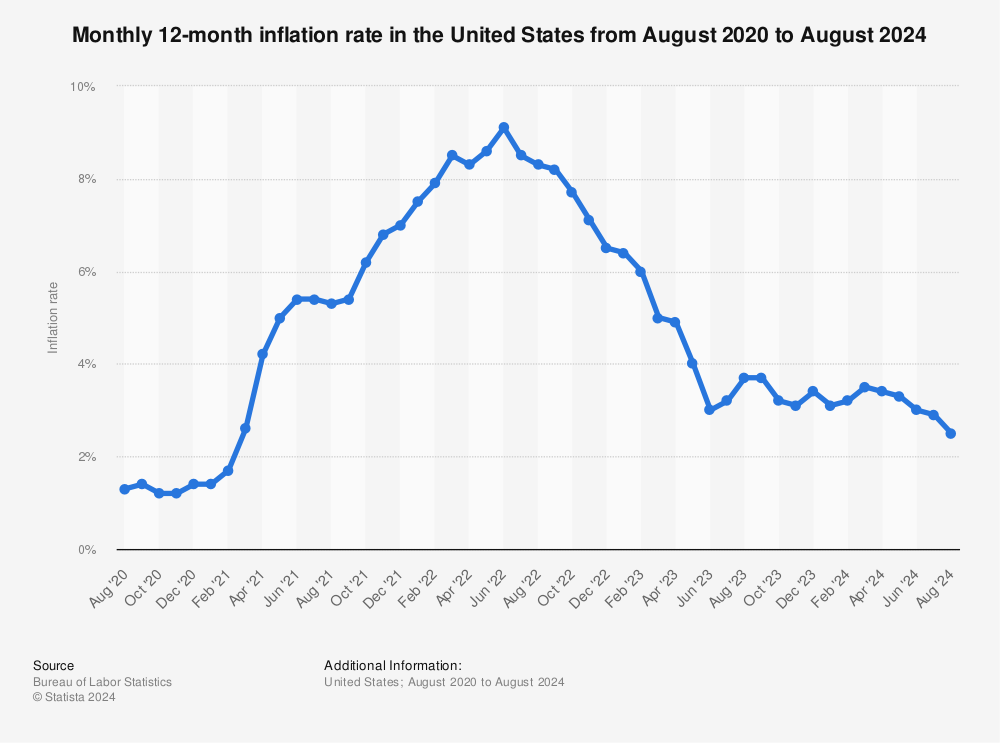
Last Thursday the Bureau of Labor Statistics announced that consumer price inflation, at an 8.2 percent annualized rate, was higher than expected through September.
The rate has been 7.9 percent or higher each month since last February and is the highest it's been in over 40 years. When Mr. Biden took office the rate was 2.5 percent. Mr. Biden sees no evil, however. Continetti writes that the White House...
...doesn’t see any troubles. According to President Biden, the most recent BLS data are superfluous. After all, everybody already knows that "Americans are squeezed by the cost of living: that’s been true for years, and they didn’t need today’s report to tell them that."

As a matter of fact, Biden said in a statement, rising costs are "a key reason I ran for President." And anyway, the situation is under control. "My policies—that Democrats delivered—directly tackles [sic] price pressures we saw in today’s report."
As is his inveterate habit, our Fabulist in Chief is spinning another yarn here. Continetti explains:
I don’t remember Biden staking his 2020 candidacy on inflation. He couldn’t have. The inflation hadn’t happened. It didn’t arrive until the spring of 2021. By which time Biden was living—during weekdays, at least—at 1600 Pennsylvania Avenue.

Nor do I recall Biden warning the country about the coming threat of rising prices. To the contrary: Varsity Joe was captain of "Team Transitory." The "temporary" inflation would subside, he and his teammates argued, as kinks in the supply chain got worked out and the Federal Reserve tightened the money supply.
Also as is his custom, the finger of blame gets pointed everywhere but at his own self:
By the winter of 2022, Biden was blaming high prices on corporate greed and "Putin’s price hike." Now he says inflation is the fault of the opposition party.

No reason is provided; this president isn’t into causality. "If Republicans take control of Congress," Biden warns, "everyday costs will go up—not down."
This is a very odd claim to make since gas averaged about $2.17 in 2020 before Democrats took over in January 2021 and prices soared.

Here's a chart showing the inflation rate over the last few years:

Statistic: Monthly 12-month inflation rate in the United States from January 2020 to August 2022 | Statista

Find more statistics at Statista.

What caused inflation to rise so fast and so far? Government spending and a policy of trying to strangle oil and gas production. Continetti explains President Biden's spending in more detail at the link.

It's ironic that Mr. Biden promised that no one earning under $400,000 will have their taxes increased, but inflation is a tax and it's hurting everyone, especially those on fixed incomes.

It's also ironic that the Biden administration has done everything it can to kill the fossil fuel industry, but they're outraged at the Saudis for not selling us cheaper gas. They've also decided that the Venezuelan tyrants are not such bad guys after all and are seeking to relax sanctions on Venezuela so that they'll sell us their petroleum.

Our energy policy certainly seems weird.

Saturday, October 15, 2022

The Quiet Epidemic

There's a silent epidemic stalking the U.S., but it's not one borne by a virus or bacterium. It's a psycho-social affliction that harms both the elderly and the young, especially young men.

It's a major cause of illness, suicide and other forms of early death among young men, and, according to Marisa G. Franco at The Economist, "is more fatal than a poor diet or lack of exercise and as corrosive as smoking fifteen cigarettes a day."

It's loneliness. One wouldn't think with all the social networking and opportunities for developing relationships in our culture that loneliness would be such a problem, but it apparently is.

In his book Bowling Alone Robert Putnam wrote that social capital - things like civic and political participation, religious participation, workplace networks, informal networks, mutual trust, and altruism - increased in the US until the 1970s and then suddenly decreased and has continued to decrease right up to the present.

The erosion of social capital has been accelerated by, among other things, the decline of church membership, the weakening of family ties, and a diminution of community involvement.

This is tragic given that human well-being depends on interpersonal interactions and relationships.

Prolonged loneliness is associated with an increased risk of depression, anxiety, dementia, stroke and heart disease, so it needs to be taken very seriously.

Part of the problem is that people today often live far from their families and the people they grew up with.

Once upon a time most people spent their whole lives in the community into which they were born, but that's no longer the case.

Many of us go off to school, or relocate across the country, or even overseas, chasing the available jobs and opportunities.

While this may be reasonable, perhaps even necessary, it means we often lack the ability, or opportunity, to ‘put down roots’, and thus build up a network of friends and relations that could be relied upon to counteract eventual loneliness.

It’s interesting, and maybe surprising that a 2018 survey of 20,000 Americans found fewer elderly people experienced loneliness than did younger people, even though older folks were less likely to be able to do anything about their loneliness.

Older teens and young adults, seem to be hit hardest by loneliness, and their sense of isolation became especially acute during the Covid pandemic.

It’s ironic, though, that in a world of social media so many young people are so lonely.

It’s also extremely dangerous. Hannah Arendt in her classic work The Origins of Totalitarianism writes that totalitarianism feeds on lonely people by giving them a sense of belonging to something greater than themselves.

The sense of belonging fills the void once occupied by family, religion and community.

She states that, “...terror can rule absolutely over men who are isolated against each other and that...one of the primary concerns of all tyrannical government is to bring that isolation about.”

Thus, it is the ambition of tyrants, especially tyrants on the left, to fragment the family, destroy the church, and eliminate a sense of community.

Arendt wrote that, “What prepares men for totalitarian domination...is the fact that loneliness...has become an everyday experience of the ever growing masses of our century.”

It's alarming that we see these same trends toward weakening the family, religion and community in many of the cultural trends and public policies that are occurring today.

Are we being set up for a serious assault on our freedom? Will the epidemic of loneliness make it easier for a totalitarian party to accomplish what tyrants have achieved in country after country ever since the French Revolution in 1789?

Friday, October 14, 2022

Putin's Folly and Russian Losses

The Russian invasion of Ukraine has taken an awful toll on Russian men and machines. According to Vodkapundit in PJ Media, reports coming out of Latvia claim that as many as 90,000 Russian troops are classified as "irrecoverable loss."

These are troops who have been killed or seriously wounded or went missing since hostilities began last February 23rd.

The numbers are based on a report from a Latvian web site called "iStories" founded by Russian journalists and whose sources include a former officer of the Russian special services, and an active FSB intelligence officer.

The loss amounts to almost half of the 190,000 men who were sent into Ukraine last winter.

This is an astonishingly high casualty rate, and the Kyiv Posts' figures for lost armaments are equally as shocking:
One wonders how long the Russian people, and Putin's intelligence officers, generals and members of his inner circle are going to tolerate this before they decide that Russia and Russian families have suffered enough in this pointless war.

Thursday, October 13, 2022

Understanding Darwinism and Believing in it

Keith Blanchard (who apparently has no particular expertise in biology) wrote a column for The Week a few years ago that gained some attention at the time and which perpetuates some common misunderstandings.

The ostensible purpose of his article was to exhort people to embrace evolution as science and not as a matter of faith. As Blanchard says, we should understand evolution, not believe in it.

If his point is simply that we can grasp the basic elements of evolutionary theory without making a doxastic commitment to them ourselves, well, then that seems a little banal, but if his point is that if you understand those elements you will presumably believe them to be true then his point is manifestly, glaringly, false.

There are many people who understand the main idea of Darwinian evolution perfectly well, but who reject it nonetheless. Many of those who reject evolution are not so much hostile to the idea of some kind of universal relationship among living things, but rather the way naturalistic metaphysics is smuggled in along with the less innocuous aspects of the evolutionary package.

I might add that I have no quarrel with evolution. It may in some sense be true for all I know.

My quarrel is with naturalism and naturalistic views of evolution which tell us that evolution is a blind, unguided, completely natural process. That's a claim that goes well beyond the empirical evidence.

In other words, human beings may have arrived here through some sort of descent through modification, but if so, there's much reason to believe that there was more to our developmental journey as a species than purely unintentional, unintelligent, physical processes like mutation and natural selection.

At any rate, Blanchard offers a summary of the basic claims of evolutionary theory which, were they correct, could apply to any kind of biological evolution, naturalistic or intelligently directed. The problem is, Blanchard's summary describes evolutionary theory as it stood about fifty years ago.

Few evolutionists accept Blanchard's view today as anything more than a heuristic for elementary school children.

Here's his summary with a few comments. For a much more extensive critique of Blanchard's essay go here.

Blanchard writes:
  • Genes, stored in every cell, are the body's blueprints; they code for traits like eye color, disease susceptibility, and a bazillion other things that make you you.
No doubt our genes code for many aspects of our physical body, but Blanchard does not say that they code for everything that makes us us and for good reason. There's no genetic explanation for some our most important traits. It's a mystery, for example, how genes could possibly produce human consciousness, or many behaviors in the animal kingdom.

How, after all, does something like an immaterial mind arise from material interactions of chemical compounds in the brain? Not only do we have no explanation for how conscious experience arises in individual persons, we have no explanation for how such a thing could ever have evolved by physical processes in the human species.

The same is true of behaviors. All birds of any particular species behave similarly, but how do genes, which code for proteins which in turn form structures or catalyze chemical reactions, produce a behavior?

It's no more clear how molecules of DNA can produce behavior than it is how molecules of sucrose can produce the sensation of sweet.
  • Reproduction involves copying and recombining these blueprints, which is complicated, and errors happen.
Yes, they do and those errors are almost always dysgenic. They detract from fitness not enhance it, just as an error in copying computer code is much more likely to cause a system to crash than it is to cause it to work better.
  • Errors are passed along in the code to future generations, the way a smudge on a photocopy will exist on all subsequent copies.
As I said above, a smudge is a flaw. As similar "smudges" accumulate the result is not a new and different picture of high quality, it's an increasingly weaker and useless representation of the old.
  • This modified code can (but doesn't always) produce new traits in successive generations: an extra finger, sickle-celled blood, increased tolerance for Miley Cyrus shenanigans.
These examples, particularly the last, are dysgenic to human beings. Polydactyly may not be dysgenic but neither does it confer a survival advantage. If it did it would spread through the population, but it hasn't.
  • When these new traits are advantageous (longer legs in gazelles), organisms survive and replicate at a higher rate than average, and when disadvantageous (brittle skulls in woodpeckers), they survive and replicate at a lower rate.
This is the selectionist theory of evolution, i.e. that natural selection, acting on genetic mutations, drives evolution. It is held today by few biologists because it's fraught with empirical difficulties. In order to finesse these difficulties biologists have adduced other mechanisms such as genetic drift to do the heavy lifting in evolution.

In fact, as Michael Behe pointed out in his book The Edge of Evolution, any theory based on fortuitous mutations defies probability. Many traits require several specific mutations occurring at almost the same time in an organism, and the chances of this happening are astronomically low.

I repeat, this might have happened through a long evolutionary process, but to say that the process was completely natural (a claim Blanchard doesn't make, by the way) is to go beyond empirical science and enter the realm of faith and metaphysics, and even the belief that it happened at all requires a considerable amount of blind faith.

We can understand the basic lineaments of evolutionary theory, but that doesn't mean that it's appropriate to believe that the process actually happened. To believe in it is to have faith that the theory is the true explanation for how we got to be here.

There are people who understand the theory and who believe it's true. There are people who understand the theory and don't believe it, and there are many who understand it and are agnostic, believing that the scientific evidence often conflicts with the theory, as Stephen Meyer has so powerfully shown in his first two books Signature in the Cell and Darwin's Doubt.

In my opinion, a humble agnosticism with respect to the actual mechanisms by which life originated and diversified is the most intellectually prudent course.

I'm far more confident, however, in the truth of the claim that however we came to exist as a species it's far more probable that it was the result of the purposeful agency of an engineering genius than that blind chance accomplished the equivalent of producing a library of information entirely unintentionally.

Wednesday, October 12, 2022

A Hopeless Bind

The late Robert Jastrow was a highly accomplished astronomer and an agnostic. He was also a materialist, i.e. he maintained that everything that exists can be explained in terms of matter and the laws which govern it. For a strict materialist there are no immaterial substances like minds, souls or God.

In the short video below Jastrow explains how his agnosticism and materialism combine to place him in a hopeless philosophical bind, and yet he refuses to relinquish them.

Here's the video:
If the universe came into existence, which it obviously did, then it must have had a cause. Whatever caused the universe must have not only transcended the universe - which means it must have transcended space, time and matter - but it must also have been incomprehensibly powerful and intelligent.

It's plausible, too, to think that the fine-tuning of the structure of matter on both the very tiny and the extraordinarily large scales, as well as the exquisitely precise values of the forces, parameters and constants of the universe, all suggest that this intelligent agent had a conscious purpose in creating a universe that could sustain life.

If it did have a conscious purpose then it was a personal agent since conscious purposes are attributes of personal beings.

So Jastrow's hopeless bind is that his agnostic materialism prevents him from acknowledging that there are any non-physical agents acting in or on the universe while his science tells him that there must be a transcendent, non-physical, personal cause that brought the universe into being.

One wonders if he carried that bind with him to the grave or if he finally resolved it.

Tuesday, October 11, 2022

Soul, Mind, Spirit and Immortality

Robert Lawrence Kuhn hosts a show titled Closer to the Truth. Kuhn's guests are thinkers from various disciplines who offer fascinating insights into their areas of expertise.

One recent episode featured an interview with Christian philosopher J.P.Moreland who has written extensively in the philosophy of mind.

In this 11 minute episode Kuhn and Moreland explore the relationship that Moreland believes exists between soul, mind and spirit.

Whether or not any or all of these faculties actually exist Moreland's articulation of them is certainly interesting.

Check it out: