In his book The Blind Watchmaker Richard Dawkins makes the claim that "biology is the study of complicated things which have the appearance of having been designed for a purpose." He goes on to argue, however, that the appearance is only illusory, a result of the blind tinkering of natural selection over eons of time. Maybe, but this has about it the sound of whistling past the graveyard.
As Michael Behe and others have noted, "If life gives the overpowering appearance of having been designed, then one is rationally justified in adhering to one's intuitions [that it is designed] unless and until a compelling reason is given to suggest that the appearance of design is only apparent."
So, is there a compelling reason to abandon one's belief that life is designed? Well, no. Some will argue, of course, that Darwin showed that design is a by-product of the purposeless process of evolution, but actually he did no such thing. What Darwin showed was that there are good reasons to think that evolution was the means by which living things diversify, he did not show that natural forces are ultimately responsible for the astonishing engineering and design that is ubiquitous in everything from living cells to the cosmos itself.
The argument of naturalists like Dawkins amounts to this: We know that the design in nature is only apparent because we know there is no intelligent designer. And we know there's no intelligent designer because there's no evidence that there one exists. And we know there's no evidence that an intelligent designer exists because the "overpowering appearance of purposeful design" that's cited as evidence is really only apparent. And we know it's only apparent because....Well, you get the picture.
The only way for the Darwinian naturalist to break out of this vicious cycle is to show that blind, purposeless forces can indeed create the appearance of complex purposeful design, but so far no one has been able to do this in a way that's convincing to anyone but those already committed to the belief that there is no intelligent designer.
If one is inclined to believe that an intelligent designer of the world exists there's no reason that any of the New Atheists have presented as to why that view should be given up. On the other hand, there are lots of examples in nature which confirm it. Maybe the simplest explanation for why nature has "the appearance of having been designed for a purpose" is because it has been.
Saturday, November 27, 2010
Defeating al Qaeda
Strategy Page has an interesting article on how U.S. forces discredited al Qaeda in the Islamic world and precipitated their defeat in Iraq:
Long term, the U.S. has found that you don't have to kill terrorist leaders to disable them. For example, when American troops drove al Qaeda and the Taliban out of Afghanistan in late 2001, they captured large quantities of records dealing with al Qaeda administration. This was revealing. The al Qaeda leadership was constantly being criticized by subordinates for stupid mistakes, while the leaders were constantly monitoring their people for stealing and malingering.Moderate Muslims in the West insist that Islamic terrorists are not "true" Muslims. Perhaps this message will catch on in the Middle East, and devout Muslims will stop financing the madrassas and mosques that teach and preach hate, jihad, and the glories of martyrdom. Until terrorism is discredited as an act of Islamic piety there's little chance that it will stop.
The U.S. made sure a lot of this dirty linen was leaked, and eventually the media in Moslem nations began reporting on it. This paid off when al Qaeda in Iraq, despite vigorous objections within the organization, increased attacks that killed lots of civilians. This played a major role in al Qaeda going from an admired, to a despised, organization within the Islamic world. American intelligence leaked captured documents that made clear how uncaring the terrorist leaders were about these civilian deaths. The dead Moslem women and children were called "involuntary martyrs." This did not go over well in the Moslem world.
As al Qaeda's popularity declined, so did donations from the Moslem world. This forced the terrorists to resort to crime to raise money. This was publicized, along with details via captured documents, by the Americans. As a result, Moslems began to regard Islamic terrorists as criminals, as well as thoughtless killers. This was in sharp contrast as al Qaeda propaganda that tried to portray them as selfless fighters for the protection of Islam. This made al Qaeda look like hypocrites.
The final blow came from the mouths of captured terrorists. Most of these men tended to speak freely once captured, and often complained about how hard life was as a terrorist. This was especially the case with suicide bombers, who often had to be persuaded to do the deed. Then there was the use of the mentally ill, very young children (10-12, or even younger) and grief stricken widows. In most Moslem countries, widows faced a hard life under any conditions, and suicide among them is common.
The details of these recruiting methods were released, and by 2007, the Moslem media couldn't get enough of it. The callous treatment of young Saudi men, volunteering to "fight for Islam" in Iraq, was particularly effective in cutting off this source of manpower. The Saudi volunteers usually had no military training, and the Iraqi terrorist groups used most of them as suicide bombers, or in similar combat operations that were pretty much suicidal. Details of these policies were passed on to Saudi media, and parents began to regard a trip to Iraq, or even Afghanistan, as a form of murder (of innocent civilians as well as their sons).


Droppers and Switchers
The conventional wisdom in the wake of the Democrats' electoral mugging three weeks ago was that much of their liberal base, minorities and young people, stayed home. The Wall Street Journal's Gerry Seib points to a number of studies, including research carried out by Democrat groups, that show that the conventional wisdom is not quite correct.
It turns out that what hurt the Democrats most of all was disaffection and lack of enthusiasm not among their base but among moderates:
Another reason this is significant is that it bodes ill for the President's reelection chances. Had his base among minorities and young people stayed home it could be assumed it was because he wasn't on the ticket and that they'd probably turn out when he is up again in 2012. The fact, however, that his base did show up and that it was independents who stayed home suggests that Mr. Obama's path to relection is going to be more difficult since it will be harder to woo back disaffected moderates than it would be to rouse his base.
It turns out that what hurt the Democrats most of all was disaffection and lack of enthusiasm not among their base but among moderates:
A more direct study of these 2010 no-shows was undertaken by Third Way, a think tank for moderate Democrats, and Lincoln Park Strategies, a Democratic polling firm. They surveyed 1,000 Obama voters who abandoned Democrats in 2010. Half of them were "switchers" who moved their votes to the Republicans this time, while the other half were "droppers" who simply dropped out of the voting this year.This is significant because it shapes how the Democrats will respond to their defeat over the next two years. If it had been the case that their voters stayed home because Congress and the President have not been liberal enough to suit them then we could expect the Democrats to move even further to the left to mollify their base's discontent. Since, however, they've lost the sympathies of moderate voters the party may move more to the center in the next couple of years to try to recapture their lost support among this group.
That survey found that, while the droppers were a bit more liberal than 2010 voters as a whole, they were split in almost precise thirds into liberals, moderates and conservatives. Moreover, just 42% identified themselves as Democrats, while 40% were independents and 8% were Republicans. Almost a quarter of them voted for Republican George W. Bush in 2004.
Nor were the droppers largely minority voters, as the popular stereotype might suggest. Eight in 10 were white, while just 7% were African-American and 5% Latino.
Another reason this is significant is that it bodes ill for the President's reelection chances. Had his base among minorities and young people stayed home it could be assumed it was because he wasn't on the ticket and that they'd probably turn out when he is up again in 2012. The fact, however, that his base did show up and that it was independents who stayed home suggests that Mr. Obama's path to relection is going to be more difficult since it will be harder to woo back disaffected moderates than it would be to rouse his base.
Friday, November 26, 2010
The Bottom of Their Shoe
It looks like there is a serious movement afoot to impeach Iranian President Mahmoud Ahmedinejad. Unfortunately, it seems that the impeachment may be for the wrong reasons. Reza Aslan reports on the story at The Daily Beast. One of the interesting aspects of his account is the utter economic shambles this oil rich country finds itself in:
In any event, here's another irony. We recently posted on a story which made the claim that American foreign policy under President Obama is pretty much the worst it has ever been, but according to Aslan much of Iran's economic difficulty is due to Obama's targeted sanctions on industries like carpet manufacturing. Perhaps our foreign policy isn't quite the muddled mess that it seems. It's tragic that ordinary Iranians are suffering, but it would certainly be a good thing, on balance, if our President were successful in getting Iranians to give the bottom of their shoe to Ahmadinejad and give up their nuclear ambitions before war breaks out in the region.
The latest row between the president and the parliament comes at a time in which Iran's economy, already reeling from the steady success of President Obama’s targeted sanctions policy, is bracing for what many predict will be catastrophic consequences of Ahmadinejad's plan to end government subsidies for fuel, food, energy, and basic goods like milk, cooking oil, and flour. For decades, Iran’s presidents—from Ali Akbar Hashemi Rafsanjani to Mohammad Khatami—have tried to amend the subsidies system, valued at about $100 billion a year.It's comforting, in a twisted sort of way, to know that Iran's economy is in worse shape than our own, at least for now.
But they were repeatedly deterred by the threat of massive protests. After all, in a country that has been isolated from the outside world for three decades, government subsidies are the sole means of survival for millions of poor and middle-class Iranians. According to a study by the International Monetary Fund, a typical Iranian household making about $3,600 a year receives an average of $4,000 a year in subsidies.
Although the subsidies program has yet to be fully terminated, the cost of basic goods and services in Iran already has skyrocketed. According to the Los Angeles Times, the price of a kilo of ground beef has jumped from $6, when Ahmadinejad began his first term as president, to $14.50 today. Meanwhile, as I reported last month, the cost of electricity has soared by as much as 1,000 percent for some Iranian households.
The irony is that Ahmadinejad is unquestionably doing the sensible thing in pushing ahead with the removal of government subsidies. Subsidies account for approximately 30 percent of Iran’s entire annual budget. That is simply untenable for an economy that just last month saw the value of its currency drop by a staggering 13 percent against the dollar. Iran’s oil industry, its most lucrative source of revenue, is in shambles after the recent departure of four oil companies— Shell, Total, ENI, and Statoil.
The carpet industry, once valued at $500 million, has disintegrated thanks to increased sanctions. The government claims that 22 percent of Iranians are unemployed (experts say the number is closer to 40 percent), three-quarters of them under the age of 30. Some 40 percent of Iranians live below the poverty line. Inflation is officially at 10 percent, though many economists believe it to be more like 24 percent. With the price of oil remaining stable and Iran’s international isolation increasing, the government simply cannot afford to keep paying out nearly a third of its entire budget in subsidies.
In any event, here's another irony. We recently posted on a story which made the claim that American foreign policy under President Obama is pretty much the worst it has ever been, but according to Aslan much of Iran's economic difficulty is due to Obama's targeted sanctions on industries like carpet manufacturing. Perhaps our foreign policy isn't quite the muddled mess that it seems. It's tragic that ordinary Iranians are suffering, but it would certainly be a good thing, on balance, if our President were successful in getting Iranians to give the bottom of their shoe to Ahmadinejad and give up their nuclear ambitions before war breaks out in the region.
First Thankful Thanksgiving
Robin of Berkeley is back with a meditation on her first thankful Thanksgiving. Robin is a psychotherapist and former leftist atheist who had an ideological epiphany several years ago and has written a number of columns on what it has been like for her to move from the left to the right.
In this column she reveals some details of another epiphany which has made this Thanksgiving especially meaningful for her. She opens with this lede:
In this column she reveals some details of another epiphany which has made this Thanksgiving especially meaningful for her. She opens with this lede:
Thanksgiving was never a favorite holiday of mine. Now that I think about it, I never cared for any of them: 4th of July, Christmas, or Columbus Day (which, by the way, Berkeley long ago renamed "Indigenous People's Day").Read the rest at the link. It's pretty interesting.
If I'm being completely honest here, my main activities during the holidays were ranting and raving. For instance: Why should we celebrate Thanksgiving when the holiday marks the slaughter of Native Americans? Why do these cashiers keep cheerfully extolling me to "have a Merry Christmas!"? And if I hear one more [censored] Christmas song, I will lose my frigging mind.
Of course, I was just one of the progressive pack, parroting the party line. Being a Leftist means honing in on every possible injustice. Never-ending gripes and grievances are the glue that keeps progressives cemented together.
But then, three years ago, the bottom fell out of my life. Slowly but surely, it dawned on me that everything I had held as sacrosanct was a lie. I woke up -- and now I behold the world with fresh eyes. Consequently, I am celebrating my First Thankful Thanksgiving.
Black Friday
Now that the day given to thanking God is over many will today be observing yet another, unofficial, festival known as Black Friday. It, too, is a religious observance albeit an exuberant, rather pagan celebration of the religion of consumerism during which the faithful feel impelled by the spirit of the day to spend oodles of cash on toys, trinkets, and other non-essentials for people who neither need nor want what's been purchased for them.
The extravagance, the prodigality, of it all is, for me at least, tawdry and dispiriting. Jim Wallis writes on his blog that:
My crotchety outlook on Black Friday notwithstanding, I have mixed feelings about the rite. The jobs of millions of people depend upon us wasting money today on things nobody really wants or needs. If people were to turn Black Friday into a buy-nothing-day it'd cause an enormous amount of hardship for those businesses and their employees who rely on our profligacy for their livelihoods.
Even so, I'm a non-combatant conscientious objector to the spectacle. Maybe there's a better way. Perhaps some of us could put a little perspective and meaning back into the Christmas season by sending a note to family members, friends, and co-workers, who are often stressed over trying to find a gift for someone who already has more than enough of life's goods, asking that no presents (or at least not as many presents) be bought for us this year, and that in lieu of the gift a donation be sent to a charity of our choosing. Perhaps the address of the charity could be appended to the note.
This would not only help avoid the embarrassment of being showered with items for which one has no need and can't use, but it would also be a gift to our loved ones inasmuch as it would take the pressure off them to come up with something meaningful to give us.
At our Christmas gatherings they might hand us a card saying that a gift has been donated in our name to the charity we requested. For some of us that would be the most wonderful gift we could receive, and it would be a step toward recovering, at least in our own circles, the original spirit and meaning of Christmas day.
The extravagance, the prodigality, of it all is, for me at least, tawdry and dispiriting. Jim Wallis writes on his blog that:
The pressure we feel [to buy] doesn’t just come from the ads we get in our inboxes or see on television. All of us have family and friends who are going to be doing a lot of shopping. If a friend goes out and spends money on us, we feel guilty if we don’t reciprocate at roughly the same level. What’s worse is if someone gets us a gift and we don’t get them anything at all. The problem is not giving gifts. Giving gifts becomes a problem when the exchange of stuff replaces building relationships.It also becomes a problem because we become preoccupied with material excess and often lose sight of why we celebrate Christmas in the first place. The day is simply the climax of an orgy of splurge shopping at malls which create their idea of an appropriately seasonal atmosphere by piping in music like Alvin and the Chipmunks and Grandma Got Run Over by a Reindeer. Everywhere we turn we're encouraged to shop till we drop. We're like a person being urged to sample not just one piece of chocolate in the box, but to plunge ahead and consume the whole thing. As we work through the selections the sweets cloy and after a while they just make us sick.
My crotchety outlook on Black Friday notwithstanding, I have mixed feelings about the rite. The jobs of millions of people depend upon us wasting money today on things nobody really wants or needs. If people were to turn Black Friday into a buy-nothing-day it'd cause an enormous amount of hardship for those businesses and their employees who rely on our profligacy for their livelihoods.
Even so, I'm a non-combatant conscientious objector to the spectacle. Maybe there's a better way. Perhaps some of us could put a little perspective and meaning back into the Christmas season by sending a note to family members, friends, and co-workers, who are often stressed over trying to find a gift for someone who already has more than enough of life's goods, asking that no presents (or at least not as many presents) be bought for us this year, and that in lieu of the gift a donation be sent to a charity of our choosing. Perhaps the address of the charity could be appended to the note.
This would not only help avoid the embarrassment of being showered with items for which one has no need and can't use, but it would also be a gift to our loved ones inasmuch as it would take the pressure off them to come up with something meaningful to give us.
At our Christmas gatherings they might hand us a card saying that a gift has been donated in our name to the charity we requested. For some of us that would be the most wonderful gift we could receive, and it would be a step toward recovering, at least in our own circles, the original spirit and meaning of Christmas day.
Thursday, November 25, 2010
Washington's Thanksgiving Proclamation
Here's the first Thanksgiving proclamation, issued by President George Washington in 1789. I said yesterday that it's hard to imagine a president making such a pronouncement in contemporary America. Read it and see what you think:
By the President of the United States of America, a Proclamation.
Whereas it is the duty of all Nations to acknowledge the providence of Almighty God, to obey his will, to be grateful for his benefits, and humbly to implore his protection and favor-- and whereas both Houses of Congress have by their joint Committee requested me to recommend to the People of the United States a day of public thanksgiving and prayer to be observed by acknowledging with grateful hearts the many signal favors of Almighty God especially by affording them an opportunity peaceably to establish a form of government for their safety and happiness.
Now therefore I do recommend and assign Thursday the 26th day of November next to be devoted by the People of these States to the service of that great and glorious Being, who is the beneficent Author of all the good that was, that is, or that will be-- That we may then all unite in rendering unto him our sincere and humble thanks--for his kind care and protection of the People of this Country previous to their becoming a Nation--for the signal and manifold mercies, and the favorable interpositions of his Providence which we experienced in the course and conclusion of the late war--for the great degree of tranquility, union, and plenty, which we have since enjoyed--for the peaceable and rational manner, in which we have been enabled to establish constitutions of government for our safety and happiness, and particularly the national One now lately instituted--for the civil and religious liberty with which we are blessed; and the means we have of acquiring and diffusing useful knowledge; and in general for all the great and various favors which he hath been pleased to confer upon us.
And also that we may then unite in most humbly offering our prayers and supplications to the great Lord and Ruler of Nations and beseech him to pardon our national and other transgressions-- to enable us all, whether in public or private stations, to perform our several and relative duties properly and punctually--to render our national government a blessing to all the people, by constantly being a Government of wise, just, and constitutional laws, discreetly and faithfully executed and obeyed--to protect and guide all Sovereigns and Nations (especially such as have shewn kindness unto us) and to bless them with good government, peace, and concord--To promote the knowledge and practice of true religion and virtue, and the encrease of science among them and us--and generally to grant unto all Mankind such a degree of temporal prosperity as he alone knows to be best.
Given under my hand at the City of New York the third day of October in the year of our Lord 1789.
Go: Washington
Wednesday, November 24, 2010
Special Day
Among all the holidays Americans observe, Thanksgiving is unique.
Unlike other national observances which honor and celebrate the contributions of famous people, groups, or critical events in our history, Thanksgiving celebrates an attitude - an attitude of appreciation and gratefulness for all the blessings we enjoy as Americans.
It's a celebration laden with religious overtones and expectations, but unlike other religiously-oriented holidays it's an integral part of our public life. It was first established by presidential decree (Abraham Lincoln) and subsequently declared by a joint resolution of Congress to be a national holiday, which fact no doubt displeases our secularist friends. Indeed, setting aside a day for prayer and thanksgiving to God could scarcely be imagined in today's politico-social climate.
Moreover, unlike other religious holidays (e.g. Christmas, Easter) Thanksgiving is non-sectarian. People of any faith can give thanks to God, although it's probably a bit awkward for atheists who find themselves expressing their gratitude to nothing in particular.
In any event, we at Viewpoint wish all our readers a great and grateful Thanksgiving day.
Unlike other national observances which honor and celebrate the contributions of famous people, groups, or critical events in our history, Thanksgiving celebrates an attitude - an attitude of appreciation and gratefulness for all the blessings we enjoy as Americans.
It's a celebration laden with religious overtones and expectations, but unlike other religiously-oriented holidays it's an integral part of our public life. It was first established by presidential decree (Abraham Lincoln) and subsequently declared by a joint resolution of Congress to be a national holiday, which fact no doubt displeases our secularist friends. Indeed, setting aside a day for prayer and thanksgiving to God could scarcely be imagined in today's politico-social climate.
Moreover, unlike other religious holidays (e.g. Christmas, Easter) Thanksgiving is non-sectarian. People of any faith can give thanks to God, although it's probably a bit awkward for atheists who find themselves expressing their gratitude to nothing in particular.
In any event, we at Viewpoint wish all our readers a great and grateful Thanksgiving day.
Smart Diplomacy
Michael Filozov surveys the world scene and asks if American foreign policy has ever been as "screwed up" as it is at present. Reading his article certainly causes one to wonder if indeed our management of foreign affairs isn't at a low ebb. As if to add an exclamation point to Filozov's question mark the New York Times revealed today that peace talks with the Taliban in Afghanistan have been conducted with an imposter and we've actually paid the guy.
From the Times' story:
President Obama campaigned on the promise that so far from following his predecessor's maladroit handling of foreign affairs his administration would usher in an era of "smart diplomacy". I'm not certain what that entails, but I'm pretty sure it should mean that we negotiate with actual representatives of the other side and not with whomever walks in off the street.
From the Times' story:
For months, the secret talks unfolding between Taliban and Afghan leaders to end the war appeared to be showing promise, if only because of the appearance of a certain insurgent leader at one end of the table: Mullah Akhtar Muhammad Mansour, one of the most senior commanders in the Taliban movement.In most parts of the world you can't even cash a check without confirming who you are, but apparently the current administration regards such formalities, when applied to those who are trying to kill us, to be unreasonable impositions.
But now, it turns out, Mr. Mansour was apparently not Mr. Mansour at all. In an episode that could have been lifted from a spy novel, United States and Afghan officials now say the Afghan man was an impostor, and high-level discussions conducted with the assistance of NATO appear to have achieved little.
“It’s not him,” said a Western diplomat in Kabul intimately involved in the discussions. “And we gave him a lot of money.”
American officials confirmed Monday that they had given up hope that the Afghan was Mr. Mansour, or even a member of the Taliban leadership.
NATO and Afghan officials said they held three meetings with the man, who traveled from Pakistan, where Taliban leaders have taken refuge.
President Obama campaigned on the promise that so far from following his predecessor's maladroit handling of foreign affairs his administration would usher in an era of "smart diplomacy". I'm not certain what that entails, but I'm pretty sure it should mean that we negotiate with actual representatives of the other side and not with whomever walks in off the street.
Full Moral Status
Philosopher Peter Singer maintains that a child does not achieve full "moral status" until it is about two years old. It does not have full status, he argues, until it can recognize itself in a mirror, at which point it is "self-aware" and deserving of being considered a fully human being.
Here's Professor Singer:
One would like to ask Professor Singer why self-awareness should be the criterion that confers "full moral status". Why not the ability to communicate, or to ratiocinate, or to do algebra? If self-awareness is to be used to separate persons from not-quite-persons are individuals in a coma sub-persons? If so, do they forfeit their right to life. If they do not, why not?
If the answer is that they have the potential to come out of the coma and be self-aware why does not the same apply to the unborn?
This is why advocates of an unrestricted abortion license long ago gave up trying to defend their position by arguments. They simply don't have any. All they have are slogans and the power, through the federal judiciary, to impose their will.
Here's Professor Singer:
My understanding is that it is not until after the first birthday, so somewhere between the first and second, I think, that they typically recognize the image in the mirror as themselves...Really, I think this is a gradual matter.This is the slippery slope onto which the liberal view of abortion rights leads us. Once we deny that an unborn child should be considered a person we soon lack any basis for holding that born children are persons - at least until they become self-aware - and if it is the mother's right to terminate the life of an unborn non-person, it will eventually become her right to terminate a born non-person. Just as we have unwanted pets put away, so, too, will there be a demand for the right to put away other unwanted non-persons. Where does it end?
If you are not talking about public policy or the law, but you are talking about when you really have the same moral status, I think that does develop gradually. There are various things that you could say that are sufficient to give some moral status after a few months, maybe six months or something like that, and you get perhaps to full moral status, really, only after two years. But I don’t think that should be the public policy criteria.
He doesn't think that this should be a public policy criterion because if it were there'd be no moral constraint on killing children up to two years old just as there's no constraint today on killing them while they remain in the womb. Even so, Singer does advocate making infanticide legal up until a child is about 30 days old.
One would like to ask Professor Singer why self-awareness should be the criterion that confers "full moral status". Why not the ability to communicate, or to ratiocinate, or to do algebra? If self-awareness is to be used to separate persons from not-quite-persons are individuals in a coma sub-persons? If so, do they forfeit their right to life. If they do not, why not?
If the answer is that they have the potential to come out of the coma and be self-aware why does not the same apply to the unborn?
This is why advocates of an unrestricted abortion license long ago gave up trying to defend their position by arguments. They simply don't have any. All they have are slogans and the power, through the federal judiciary, to impose their will.
Tuesday, November 23, 2010
Connections
Joseph Bosco makes some trenchant observations and poses some interesting questions to moderate Muslims in The Christian Science Monitor. Here are some excerpts:
American Muslims are uniquely positioned to lead an honest conversation and bridge the growing divide – if they will accept the challenge. Tarnishing all Muslims as terrorists is unjust and counterproductive – but so is accusing sincerely concerned Americans of doing that.Bosco asks several important questions in the balance of his essay. If over a million Muslims see themselves as mortal enemies of Western civilization then it behooves us to listen carefully to how those questions are answered.
Non-Muslims may not fully grasp the theological and political distinctions between Islam and Islamism, but they legitimately ask their Muslim fellow citizens just what the connection is between Islam and those who murder in its name.
While most Muslims are not terrorists, most terrorists are Muslims. There is reason to worry: If only 1/10th of 1 percent of the world's 1.6 billion Muslims are terrorists, that is 1.6 million killers acting in Allah's name.
Yet Muslim extremists have come from diverse national, cultural, educational, and socioeconomic backgrounds. So non-Muslims may be forgiven for asking: Is there something in Islam that makes it more susceptible to extremist interpretation than other religions?
Monday, November 22, 2010
The Ice Cream Has Run Out
There have been lots of analyses in the wake of the electoral disaster suffered by the Democrats three weeks ago. Many of them have forecast the demise of the party, just as they forecast the demise of the Republicans after 2006/2008. I'm disinclined to pay such predictions any heed, but a piece by Monty Pelerin in
The American Thinker makes a compelling case. Pelerin argues that the Republicans were tossed out in 2006 and 2008 because they had disregarded their principles, but that the Democrats were shown the door in 2010 because they adhered to theirs.
The problem is not so much President Obama or Nancy Pelosi, although their policies and the manner in which they have governed have certainly alienated many of the former supporters and hastened the party's approaching date with the political grim reaper. Rather, the problem is that the principles which animate the Democrat party are no longer feasible in a world beset by debt, recession, and a dearth of fiscal resources.
The Democrats have, since FDR, won elections on the promise of giving people more of everything, but that's a promise that everyone now recognizes is impossible to keep. The Democrats can no longer campaign on showering people with ever more goodies, but that's their whole raison d'etre. If they cannot offer the masses access to the public purse they have nothing else with which to entice the electorate.
Perelin asks us to imagine two third graders running for class president:
There's much more at the link. I don't know if Perelin is right, but his column is certainly provocative.
The problem is not so much President Obama or Nancy Pelosi, although their policies and the manner in which they have governed have certainly alienated many of the former supporters and hastened the party's approaching date with the political grim reaper. Rather, the problem is that the principles which animate the Democrat party are no longer feasible in a world beset by debt, recession, and a dearth of fiscal resources.
The Democrats have, since FDR, won elections on the promise of giving people more of everything, but that's a promise that everyone now recognizes is impossible to keep. The Democrats can no longer campaign on showering people with ever more goodies, but that's their whole raison d'etre. If they cannot offer the masses access to the public purse they have nothing else with which to entice the electorate.
Perelin asks us to imagine two third graders running for class president:
Johnny's platform includes a detailed program to improve various school matters and a commitment to work hard. His opponent, Mary, promises free ice cream for everyone. Mary is elected by an overwhelming margin.Perelin argues that after 80 years of the ice cream strategy the ice cream has run out and with it the only reason anyone had for voting for the Democrats has disappeared. Thus, the party has no viable future and will, within the next decade or so, morph into something else or be euthanized by the voters.
Johnny's election campaign is similar to Republicans', while Mary's is similar to Democrats'. Republican principles are not as effective in an election campaign when competing against free ice cream. Sacrifice, abstinence, and/or self-reliance are a form of political "root canal" when compared to "freebies."
The ice cream strategy was implemented by Franklin D. Roosevelt in the 1930s. Arguably, this strategy created the modern Democratic Party. It rescued a floundering party and enabled it to become dominant. From a political standpoint, the strategy was pure genius. From an economic standpoint, it produced a slower growth path for the country.
There's much more at the link. I don't know if Perelin is right, but his column is certainly provocative.
Christie Returns Fire
The speculation has already begun about who'll face Barack Obama in the presidential election in 2012. The left is panicked at the idea that it'll be Sarah Palin, as evidenced by MSNBC's "five minutes Palin hate" on every show in their daily lineup. Others are predicting Mitt Romney or Mike Huckabee. My preference is New Jersey Governor Chris Christie. Not only does he understand what the words fiscal responsibility mean, a qualification that puts him well ahead of the incumbent, but he's just so much fun to watch.
Recently, the head of the New Jersey Teachers' Union sent out an email urging the membership to pray for the Governor's death. A lot of GOP politicians might just ignore this kind of behavior, which is in any event not all that uncommon on the left*, but Governor Christie has demonstrated that he's not a man to be trifled with.
He discussed the episode in a recent speech: You'd think that after a while people would stop picking fights with the guy. Everytime they do they wind up looking like Wile E. Coyote after his latest attempt to dynamite the Roadrunner.
*Similar sentiments have been expressed about Clarence Thomas, Dick Cheney, George Bush, the late Henry Hyde, and, of course, Sarah Palin, just to name a few.
Recently, the head of the New Jersey Teachers' Union sent out an email urging the membership to pray for the Governor's death. A lot of GOP politicians might just ignore this kind of behavior, which is in any event not all that uncommon on the left*, but Governor Christie has demonstrated that he's not a man to be trifled with.
He discussed the episode in a recent speech: You'd think that after a while people would stop picking fights with the guy. Everytime they do they wind up looking like Wile E. Coyote after his latest attempt to dynamite the Roadrunner.
*Similar sentiments have been expressed about Clarence Thomas, Dick Cheney, George Bush, the late Henry Hyde, and, of course, Sarah Palin, just to name a few.
Saturday, November 20, 2010
The Character of Consciousness
David Chalmers is one of the leading philosophers working on what he has famously designated as the "hard problem" of consciousness. The easy, or soft, problem, relatively speaking, is to explain how the physical mechanisms of the brain work. The hard problem is explaining how we have phenomenal experience, or what a layman might call sensation. Chalmers has a new book out titled The Character of Consciousness in which he discusses the myriad of problems involved in trying to understand this most mysterious of human attributes. The book is reviewed at Conscious Entities. Here are a couple of excerpts from the review:
The problem of consciousness is one of the most important of the contemporary philosophical debates because it bears on the view we hold of the nature of human beings: Are we just material entities or are we some sort of composite of matter and mind (or soul)? If consciousness can ultimately be explained purely in terms of chemical reactions in the brain then materialism is probably true. If consciousness requires something more than matter to explain its character then materialism is probably false.
The book is not for beginners, and anyone who thinks they might be interested in the topics it addresses is advised to first read the review at Conscious Entities.
Chalmers begins by setting out again the Hard Problem (a term with which his name will forever be associated) of explaining phenomenal experience – why is it that ‘there is something it is like’ to experience colours, sound, anything? The key point is that experience is simply not amenable to the kind of reductive explanation which science has applied elsewhere; we’re not dealing with functions or capacities, so reduction can gain no traction. Chalmers notes – justly, I’m afraid – that many accounts which offer to explain the problem actually go on to consider one or other of the simpler problems instead.The zombie analogy is meant to show that it's perfectly possible that there could be beings exactly like us, but which are essentially blood and bone machines run by a brain that's an organic computer. Machines and computers don't experience sensations like color, flavor, etc., and since we do experience such things there must something more to us than just our material or physical hardware. There's something about us, the argument goes, that's immaterial and non-physical that's necessary to generate the phenomena of sensation, or what philosophers call qualia.
He now gives us a fuller account of the arguments in favour of qualia, the items of phenomenal experience, being a real problem for materialism, and categorises the positions typically taken (other views are of course possible).In the other camp we have non-materialist views:
- Type A Materialism denies the epistemic gap: all this stuff about phenomenal experience is so much nonsense.
- Type B Materialism accepts the epistemic gap, but thinks it can be dealt with within a materialist framework.
- Type C Materialism sees the epistemic gap as a grave problem, but holds that in the limit, when we understand things better, we’ll understand how it can be reconciled with materialism.
Finally we have the option that Chalmers appears to prefer:
- Type D dualism puts phenomenal experience outside the physical world, but gives it the power to influence material things,
- Type E Dualism, epiphenomenalism, also puts phenomenal experience outside the physical world, but denies that it can affect material things: it is a kind of passenger.
Chalmers concentrates on the conceivability argument: this is basically the point often dramatised with zombies, namely that we can conceive of a world, or people, identical to the ones we’re used to in all physical respects but completely without phenomenal experience. This shows that there is something over and above the physical account, so materialism is false.
- Type F monism (not labelled as a materialism, you notice, though arguably it is). This is the view that consciousness is constituted by the intrinsic properties of physical entities: Chalmers suggests it might be called Russellian monism.
The problem of consciousness is one of the most important of the contemporary philosophical debates because it bears on the view we hold of the nature of human beings: Are we just material entities or are we some sort of composite of matter and mind (or soul)? If consciousness can ultimately be explained purely in terms of chemical reactions in the brain then materialism is probably true. If consciousness requires something more than matter to explain its character then materialism is probably false.
The book is not for beginners, and anyone who thinks they might be interested in the topics it addresses is advised to first read the review at Conscious Entities.
Friday, November 19, 2010
Turn Up the Lights
Hard on the heels of a former government bureaucrat all but announcing that the Fourth Amendment (guaranteeing freedom from unreasonable search and seizure) will have to be ignored, we have Democratic Senator Jay Rockefeller launching the next round of attacks on our freedoms by complaining about the behavior of Fox and MSNBC, which he evidently thinks should be taken off the air:
It was telling that Senator Rockefeller said that if Fox and MSNBC were off the air Congress could get its work done. I'll bet they could. That's exactly why we need alternative media like cable news. They shine a light on the politicians, a light that many of them resent. Today's politicians are often just like the pompous politicos of Socrates' day who hated Socrates because he walked around Athens revealing to the public what buffoons they were. They resented being exposed so much that they eventually contrived a way to shut him up.
It's what those in power often do to those who shine a light on their stupidity and venality. What Senator Rockefeller might have said is that it's much easier for politicians to fool the people into thinking that they're an intellectually elite class - it's much easier for them to enrich themselves at the public trough - when no one can see what they're doing.
But here's the irony in suggestions like those of Senator Rockefeller that he'll turn out the lights on cable news (which he hasn't the authority to do anyway). General television programming has degenerated to the point that it's now a cultural cesspool, but this is not what has our politicians' attention. No, they're not concerned about the sleaze children are seeing and hearing on television. Their concern is that cable news is exposing their machinations in Washington, informing the public, and making it difficult for them to ram legislation through that they, in their wisdom, intend to ram down the throats of an unwilling populace - a populace they think should just shut up and remember their place.
Too bad, Senator. I say turn up the lights. If they're too bright, you're too corrupt.
Now I've said before that I don't care much for some of Fox's lineup - Bill O'Reilly and Sean Hannity are both very difficult to watch without yelling at the tv set - and I don't care at all for MSNBC's lineup, except for Morning Joe which I like once they've satisfied their daily need to express their contempt for Sarah Palin. But the programming on these networks is precisely the sort of speech that the first amendment was designed to protect. These shows, whatever one thinks of the hosts, are often very informative. Viewers learn things that they often don't read in their newspapers or hear on the evening news. Consequently, largely due to talk tv (plus talk radio and the internet), I think it fair to say that we probably have today the best informed public in the history of the nation.
It was telling that Senator Rockefeller said that if Fox and MSNBC were off the air Congress could get its work done. I'll bet they could. That's exactly why we need alternative media like cable news. They shine a light on the politicians, a light that many of them resent. Today's politicians are often just like the pompous politicos of Socrates' day who hated Socrates because he walked around Athens revealing to the public what buffoons they were. They resented being exposed so much that they eventually contrived a way to shut him up.
It's what those in power often do to those who shine a light on their stupidity and venality. What Senator Rockefeller might have said is that it's much easier for politicians to fool the people into thinking that they're an intellectually elite class - it's much easier for them to enrich themselves at the public trough - when no one can see what they're doing.
But here's the irony in suggestions like those of Senator Rockefeller that he'll turn out the lights on cable news (which he hasn't the authority to do anyway). General television programming has degenerated to the point that it's now a cultural cesspool, but this is not what has our politicians' attention. No, they're not concerned about the sleaze children are seeing and hearing on television. Their concern is that cable news is exposing their machinations in Washington, informing the public, and making it difficult for them to ram legislation through that they, in their wisdom, intend to ram down the throats of an unwilling populace - a populace they think should just shut up and remember their place.
Too bad, Senator. I say turn up the lights. If they're too bright, you're too corrupt.
Thursday, November 18, 2010
Captain of the Ship
In the wake of an historic electoral defeat two weeks ago congressional Democrats yesterday reelected Nancy Pelosi to be their leader in the next congress. Some people might have thought this was like giving the captain of the Titanic a vote of confidence, but, Ramirez asks, why shouldn't the Democrats stick with the captain of the ship?
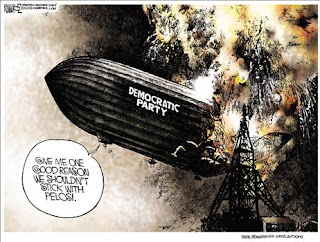
Republicans don't deserve to be this lucky, but it seems like everything, at least in the House of Representatives, is going their way. For now.

Republicans don't deserve to be this lucky, but it seems like everything, at least in the House of Representatives, is going their way. For now.
Scrooges
Susan Jacoby, an atheist and secular humanist (secular humanists are almost always atheists), wonders why secularists are such tightwads. She writes this:
Second, Christians, at least, give to others from of a sense of gratitude to God for what He has done for them in Christ. He has lavished an incomprehensible love upon us and asks only that we love what He loves. He loves people, especially the poor, so we should, too. For the secularist the poor are really losers in a Darwinian lottery of survival of the fittest. They drag the species down and there's no reason to help them continue to do it. People like Ms Jacoby might never think that way, but that is certainly one logical consequence of her atheism whether or not she realizes it. Just read Ayn Rand.
She continues:
If she wants to know why atheists are such scrooges the answer is that many of them simply live consistently, at least in this regard, with their fundamental assumptions that there is no God, there is no life after death, and there's no good reason why anyone should care about others, especially those who are in no position to return the favor.
Tis the season when snailmail and e-mail boxes are filled with exhortations to give to charitable causes of every kind. If you go to religious services at least once a week, you will probably add a donation to a secular nonprofit on top of what you have already given to your church. But if you have few ties to religion (whether you are an atheist or simply a lapsed churchgoer), this may well be the only time when you write checks to charities. Giving — unless a natural disaster catches your attention — is an annual event rather than a part of your everyday budget.Well, the answer is simple. Religious people have two motivations for helping people that secularists don't. First, they believe themselves morally obligated to care for the poor. A secularist has no moral obligation to do anything for anyone. They may choose to help someone because they just feel they should, but they have no real duty to do so.
As an atheist and secular humanist, I find this scenario basically accurate (although there are many exceptions) because it used to fit me perfectly. I have changed in recent years because, like many secularists, I became disturbed by the gap between my values and my erratic giving. There is no doubt — although the gap has been exaggerated by some on the religious right to support its view of secularists as morally inferior — that the nonreligious give less than religious Americans.
But even allowing for the fact that most Americans spend most of their charitable dollars close to home, the religious give a higher percentage of their income, and are about 25 percent more likely to give, than do secularists. Indeed, believers are 10 percent more likely than secularists to give to secular causes (although they do not support these programs as generously as they support religion).
The question is why.
Second, Christians, at least, give to others from of a sense of gratitude to God for what He has done for them in Christ. He has lavished an incomprehensible love upon us and asks only that we love what He loves. He loves people, especially the poor, so we should, too. For the secularist the poor are really losers in a Darwinian lottery of survival of the fittest. They drag the species down and there's no reason to help them continue to do it. People like Ms Jacoby might never think that way, but that is certainly one logical consequence of her atheism whether or not she realizes it. Just read Ayn Rand.
She continues:
Arthur C. Brooks, in a 2003 Policy Review essay on faith and charitable giving, connects liberal secular support for government programs with personal stinginess. Yet Brooks acknowledges that religious involvement, not political ideology, plays the dominant role. Religious liberals are 19 percentage points more likely to give than secular liberals, and religious conservatives 28 percent more likely than secular conservatives.Yes, we have a finite time to make an impact, but worrying about it only makes sense if what we do here in this world matters for eternity. If our impact doesn't last more than a generation or two beyond our demise then what difference does it make? What will it matter once we're dead whether we gave money to feed the hungry in some far-off country so that those poor unfortunates could live a few more years until they die of something else? Why should Ms Jacoby, or anyone, care about the impact she makes if her life is really no more than a footprint in the sand at the edge of the surf?
[B]ut the death of my longtime partner was a more powerful motivator. There is nothing like losing the person you love most to make you understand the truth of all of those clichés about the finite time we have to make an impact in this world.
If she wants to know why atheists are such scrooges the answer is that many of them simply live consistently, at least in this regard, with their fundamental assumptions that there is no God, there is no life after death, and there's no good reason why anyone should care about others, especially those who are in no position to return the favor.
Wednesday, November 17, 2010
Static Time
Mark Vernon contemplates the relationship between God and time at Big Questions Online. He writes:
If so, if we are at that point conscious beings which transcend the space-time manifold, would not all events in the history of the world be in our present? If that's so, then when we die every future event, including the future deaths of our loved ones, must happen simultaneously with our death. If that's so, when we die we could be immediately united with those who, on earth, still grieve our passing. But this would mean that our loved ones must have a kind of dual existence.
They would exist here on earth awaiting the future and simultaneously they'd exist in eternity where the future is in the present. In fact, if this is the case, all of us must have a dual existence, like quantum particles which can exist in more than one place at the same time. Perhaps the self that exists "there" is just as unaware of our existence "here" as our self here is unaware of our existence there.
Who knows? It seems to me, though, that if time is a block, an objective reality, and if there's some sense in which we survive physical death, there's no reason why this couldn't be the way things are.
Anyway, I better stop speculating about all this before you start to think that I'm dabbling with some mind-altering substance while sitting at my computer.
Augustine made one of the best known and most insightful comments about time. “What then is time?” he wondered. “If no one asks me, I know what it is. If I wish to explain it to him who asks, I do not know.”This is fascinating stuff, to be sure, but in my opinion it's even more fascinating to think that if it's true that the universe is a "block" and the distinction between past, present and future is an illusion what would happen if there really is life after death? Do we pass out of this "block universe" and into an eternal present where all of cosmic history falls simultaneously before our gaze, like taking in an entire page of a book at once?
He puzzled over this most fundamental, and yet mysterious, aspect of the human condition in his Confessions, and arrived at a notion that was similar to Plato’s: the ancient Greek sage had defined time as “the moving image of eternity.” That fitted with Augustine’s conception of God, who had created time when He created the universe. To ask what God was doing before that great act is simply meaningless.
It’s an idea that’s stuck. And to some, it is entirely commensurate with the way modern physics grapples with the mystery. Here, time is typically envisaged as a relationship between events. Einstein presented what is referred to as the “block universe” – the notion that all times exist equally. (For comparison, Augustine wrote: “In the Eternal nothing passeth away, but that the whole is present.”)
So, what you see just depends on what you set t to in any given equation. “The distinction between past, present and future is only an illusion, however persistent,” the genius of relativity mused. He was so clear about the illusory nature of time that the thought even provided him with comfort in the face of death.
If so, if we are at that point conscious beings which transcend the space-time manifold, would not all events in the history of the world be in our present? If that's so, then when we die every future event, including the future deaths of our loved ones, must happen simultaneously with our death. If that's so, when we die we could be immediately united with those who, on earth, still grieve our passing. But this would mean that our loved ones must have a kind of dual existence.
They would exist here on earth awaiting the future and simultaneously they'd exist in eternity where the future is in the present. In fact, if this is the case, all of us must have a dual existence, like quantum particles which can exist in more than one place at the same time. Perhaps the self that exists "there" is just as unaware of our existence "here" as our self here is unaware of our existence there.
Who knows? It seems to me, though, that if time is a block, an objective reality, and if there's some sense in which we survive physical death, there's no reason why this couldn't be the way things are.
Anyway, I better stop speculating about all this before you start to think that I'm dabbling with some mind-altering substance while sitting at my computer.
Insect Migration
Anyone who travels much by air knows that pilots try to ride the wind. Flights may even deviate substantially from the shortest-distance route if the wind is strong enough elsewhere. But of course the wind is not likely moving exactly toward your destination. Add to this the fact that the wind also varies with altitude, and the problem of designing the optimal route of flight becomes highly complex.
It is a problem in the calculus of variations (optimizing functionals rather than mere functions) and is analogous to the optics problem of predicting the path of light through a medium with variant refractive index. But this approach requires analytical wind fields, described with functions, rather than numerically derived winds described, for instance, on a grid. In practice the optimal routing problem is solved using various iterative methods. Amazingly, migratory insects also solve this type of problem.
Research using entomological radar has found that migratory insects such as butterflies and moths perform their own flight planning in order to optimize their flights across continents. They select the right time to ride the wind, and they determine the right altitude and flight heading to reach their destination (rather than where the wind is going). As one of the researchers explained:
"Migratory butterflies and moths have evolved an amazing capacity to use favourable tailwinds. By flying at the heights where the wind currents are fastest, migratory moths can travel between their summer and winter grounds in just a few nights."
 |
| Luna Moth Caterpillar |
 |
| Adult Luna Moth |
Tuesday, November 16, 2010
Un-PC
Taking a cue from a recent column by Denis Prager at NRO I venture here to list ten claims which I think are almost indisputably true but which people are very reluctant to discuss in polite politically correct society:
Each of these statements has important implications. If they are true we shouldn't shrink from discussing why they are true and what their truth means for public policy and education.
- People are not basically good.
- Men are generally superior to women in some ways and women are generally superior to men in others.
- African Americans are, in general, much better athletes than members of other groups.
- Black males are disproportionately responsible for violent crime in America.
- Jewish and Asian men are disproportionately successful over other groups in mathematics-related fields.
- Some ways of living are better for human flourishing than others.
- Many people are poor by choice.
- America was founded on principles derived from a Christian worldview.
- By almost any measure, America is the greatest nation in the history of the world.
- Americans are the most generous people in the history of the world.
Each of these statements has important implications. If they are true we shouldn't shrink from discussing why they are true and what their truth means for public policy and education.
Subscribe to:
Posts (Atom)