The Christian world prepares to celebrate this Sunday what much of the rest of the Western world finds literally incredible, the revivification of a man 2000 years ago who had been dead for several days. Modernity finds such an account simply unbelievable. It would be a miracle if such a thing happened, moderns tell us, and in a scientific age everyone knows that miracles don't happen.
If pressed to explain how, exactly, science has made belief in miracles obsolete and how the modern person knows that miracles don't happen, the skeptic will often fall back on an argument first articulated by the Scottish philosopher David Hume (d.1776). Hume wrote that miracles are a violation of the laws of nature and as a firm and unalterable experience tells us that there has never been a violation of the laws of nature it follows that any report of a miracle is most likely to be false. Thus, since we should always believe what is most probable, and since any natural explanation of an alleged miracle is more probable than that a law of nature was broken, we are never justified in believing that a miracle occurred.
It has often been pointed out that Hume's argument suffers from the circularity of basing the claim that reports of miracles are not reliable upon the belief that there's never been a reliable report of one. However, we can only conclude that there's never been a reliable report of one if we know a priori that all historical reports are false, and we can only know that if we know that miracles are impossible. But we can only know they're impossible if we know that all reports of miracles are unreliable.
But set that dizzying circularity aside. Set aside, too, the fact that one can say that miracles don't happen only if one can say with certainty that there is no God.
Let's look instead at the claim that miracles are prohibitively improbable because they violate the laws of nature.
A law of nature is simply a description of how nature operates whenever we observe it. The laws are often statistical. I.e. if a pot of hot water is added to a pot of of cold water the hot and cold molecules will eventually distribute themselves evenly throughout the container so that the water achieves a uniform temperature. It would be extraordinarily improbable, though not impossible, nor a violation of any law, for the hot molecules on one occasion to segregate themselves all on one side of the pot.
Similarly, miracles may not violate the natural order at all. Rather they may be highly improbable phenomena that would never be expected to happen in the regular course of events except for the intervention of Divine will. Like the segregation of warm water into hot and cold portions, the reversal of the process of bodily decomposition is astronomically improbable, but it's not impossible, and if it happened it wouldn't be a violation of any law.
The ironic thing about the skeptics' attitude toward the miracle of the resurrection of Christ is that they refuse to admit that there's good evidence for it because a miracle runs counter to their experience and understanding of the world. Yet they have no trouble believing other things that also run counter to their experience.
For example, modern skeptics have no trouble believing that living things arose from non-living chemicals, that the information-rich properties of life emerged by random chaos and chance, or that our extraordinarily improbable, highly-precise universe exists by fortuitous accident. They ground their belief in these things on the supposition that there could be an infinite number of different universes, none of which is observable, and in an infinite number of worlds even extremely improbable events are bound to happen.
Richard Dawkins, for example, rules out miracles because they are highly improbable, and then in the very next breath tells us that the naturalistic origin of life, which is at least as improbable, is almost inevitable, given the vastness of time and space.
Unlimited time and/or the existence of an infinite number of worlds make the improbable inevitable, he and others argue. There's no evidence of other worlds, unfortunately, but part of the faith commitment of the modern skeptic is to hold that these innumerable worlds must exist. The skeptic clings to this conviction because if it is not so then life and the universe we inhabit must have a personal, rather than a mechanistic, explanation and that admission would deal a considerable metaphysical shock to the skeptic's psyche.
Nevertheless, if infinite time and infinite worlds can be invoked to explain life and the cosmos, why can't they also be invoked to explain "miracles" as well? If there are a near-infinite series of universes, a multiverse, as has been proposed in order to avoid the problem of cosmic fine-tuning, then surely in all the zillions of universes of the multiverse landscape there has to be at least one in which a man capable of working miracles is born and himself rises from the dead. We just happen to be in the world in which it happens. Why should the multiverse hypothesis be able to explain the spectacularly improbable fine-tuning of the cosmos and the otherwise impossible origin of life but not a man rising from the dead?
For the person who relies on the multiverse explanation to account for the incomprehensible precision of the cosmic parameters and constants and for the origin of life from mere chemicals, the resurrection of a dead man should present no problem at all. Given enough worlds and enough time it's a cinch to happen.
No one who's willing to believe in a multiverse should be a skeptic about miracles. Indeed, no one who's willing to believe in the multiverse can think that anything at all is improbable. Given the multiverse everything that is not logically impossible must be inevitable.
Of course, the skeptic's real problem is not that a man rose from the dead but rather with the claim that God deliberately raised this particular man from the dead. That's what they find repugnant, but they can't admit that because in order to justify their rejection of the miracle of the Resurrection of Jesus of Nazareth they'd have to be able to prove that there is no God, or that God's existence is at least highly improbable, and that sort of proof is beyond anyone's ability to accomplish.
If, though, one is willing to assume the existence of an infinite number of universes in order to explain the properties of our universe, he should have no trouble accepting the existence of a Mind out there that's responsible for raising Jesus from the dead. After all, there's a lot more evidence for the latter than there is for the former.
Thursday, April 9, 2020
Wednesday, April 8, 2020
Kantian Man
Philosopher and novelist Iris Murdoch, in her book The Sovereignty of Good (1970) describes in vivid accents the modern man who prides himself in his rational approach to life unencumbered by the silly superstitions believed in by gullible religious people. The modern rational man, typified in her telling by someone like the 18th century philosophical icon Immanuel Kant, is a man who ...
He regards morality as an illusion. His reason affords him no basis for caring about the weak or the poor, no basis for human compassion, no particular point to conserving the earth's resources for future generations.
Whereas Kant thought that reason dictated the categorical imperative, i.e. the duty to treat others as ends in themselves and not merely as a means to one's own happiness, the fact is that reason, unfettered from any divine sanction, dictates only that each should look to his own interests.
In practice modern man may care about the well-being of others, but he must abandon his fealty to science and reason to do so because these provide no justification for any moral obligations whatsoever.
Indeed, the purely rational man is led by the logic of his naturalism to the conclusion that might makes right. The pursuit of power frequently becomes the driving force of his life. It injects his life with meaning. It leads him to build abattoirs like Auschwitz and Dachau to eliminate the less powerful and less human.
Would Kant have agreed with this bleak assessment. No, but then Kant wasn't quite in tune with the modern, rational man. Kant believed that in order to make sense of our lives as moral agents we have to assume that three things are true: We have to assume that God exists, that we have free will, and that there is life beyond the grave.
The modern man, of course, rejects all three, and in so doing he rejects the notion of objective moral value or obligation. That's why reason has led men to embrace ideologies that have produced vast tracts of corpses, and that's why, perhaps, Murdoch uses the name Lucifer to describe them.
...confronted even with Christ turns away to consider the judgement of his own conscience and to hear the voice of his own reason . . . . This man is with us still, free, independent, lonely, powerful, rational, responsible, brave, the hero of so many novels and books of moral philosophy. The raison d’être of this attractive but misleading creature is not far to seek . . . .Lucifer? Why such a harsh judgment? Perhaps because the modern, "rational" man believes only what science and his senses tell him. The rational man looks at himself and his fellows as little more than flesh and bone machines, animals, whose only real "purpose" is to reproduce, experience pleasure and avoid pain.
He is the ideal citizen of the liberal state, a warning held up to tyrants. He has the virtue which the age requires and admires, courage. It is not such a very long step from Kant to Nietzsche, and from Nietzsche to existentialism and the Anglo-Saxon ethical doctrines which in some ways closely resemble it.
In fact Kant’s man had already received a glorious incarnation nearly a century earlier in the work of Milton: his proper name is Lucifer.
He regards morality as an illusion. His reason affords him no basis for caring about the weak or the poor, no basis for human compassion, no particular point to conserving the earth's resources for future generations.
Whereas Kant thought that reason dictated the categorical imperative, i.e. the duty to treat others as ends in themselves and not merely as a means to one's own happiness, the fact is that reason, unfettered from any divine sanction, dictates only that each should look to his own interests.
In practice modern man may care about the well-being of others, but he must abandon his fealty to science and reason to do so because these provide no justification for any moral obligations whatsoever.
Indeed, the purely rational man is led by the logic of his naturalism to the conclusion that might makes right. The pursuit of power frequently becomes the driving force of his life. It injects his life with meaning. It leads him to build abattoirs like Auschwitz and Dachau to eliminate the less powerful and less human.
Would Kant have agreed with this bleak assessment. No, but then Kant wasn't quite in tune with the modern, rational man. Kant believed that in order to make sense of our lives as moral agents we have to assume that three things are true: We have to assume that God exists, that we have free will, and that there is life beyond the grave.
The modern man, of course, rejects all three, and in so doing he rejects the notion of objective moral value or obligation. That's why reason has led men to embrace ideologies that have produced vast tracts of corpses, and that's why, perhaps, Murdoch uses the name Lucifer to describe them.


Tuesday, April 7, 2020
The Origin of Life
Yesterday we took a brief look at a new book by physicist Paul Davies titled, The Demon in the Machine: How Hidden Webs of Information Are Solving the Mystery of Life. I observed in that post that Davies, an agnostic, occasionally walks right up to the brink of acknowledging that life must be the product of an intelligent designer but at the last moment veers away from drawing that conclusion.
Toward the end of this fascinating read he not only walks up to the line, he actually sticks his toe over it. Here's how:
On page 172 Davies replies to the question posed in the title of this post by exclaiming that, "The short answer is, nobody knows how life began!" He goes on to explain that nobody even has a plausible theory for how the enormous difficulties involved in generating even the simplest living cell could have been surmounted by natural processes.
Toward the end of this fascinating read he not only walks up to the line, he actually sticks his toe over it. Here's how:
On page 172 Davies replies to the question posed in the title of this post by exclaiming that, "The short answer is, nobody knows how life began!" He goes on to explain that nobody even has a plausible theory for how the enormous difficulties involved in generating even the simplest living cell could have been surmounted by natural processes.
He writes that, "An explanation for the origin of life as we know it has to include an explanation for the origin of...digital information management and - especially - the origin of the [genetic] code," as well as the entire translation system necessary for converting the information inscribed in DNA into proteins. The translation system is comprised of numerous kinds of proteins, but where did they come from before there was a DNA to code for them and a translation system to produce them and the information to choreograph the whole process?
In other words, this complex system had to pretty much exist in order to bring itself into existence. Davies states that this is the most formidable and perplexing problem in all of evolutionary biology.
Moreover, each step in the evolution of a living cell must somehow be conserved in a kind of ratchet effect which allows for its preservation before the next step occurs. What constituted the ratchet and where did it come from?
So many are the conditions that need to be satisfied to produce life that Davies and many other scientists are beginning to think that it may have arisen only once in the entire history of the universe. Contrary to what we often read in the popular media, the discovery by astronomers of an earth-sized planet in the habitable zone of some star is scarcely reason, by itself, to assume that life could exist there.
Davies voices his skepticism of the enthusiastic claims that often surround these discoveries:
Even if some day a researcher manages in a laboratory to synthesize a living organism from a residue of raw chemicals it would demonstrate only that life can be created by an intelligent researcher who can establish all the necessary, tightly controlled conditions in her laboratory. It would prove nothing about what could actually happen in nature in the absence of an intelligent scientist.
Davies again:
In other words, this complex system had to pretty much exist in order to bring itself into existence. Davies states that this is the most formidable and perplexing problem in all of evolutionary biology.
Moreover, each step in the evolution of a living cell must somehow be conserved in a kind of ratchet effect which allows for its preservation before the next step occurs. What constituted the ratchet and where did it come from?
So many are the conditions that need to be satisfied to produce life that Davies and many other scientists are beginning to think that it may have arisen only once in the entire history of the universe. Contrary to what we often read in the popular media, the discovery by astronomers of an earth-sized planet in the habitable zone of some star is scarcely reason, by itself, to assume that life could exist there.
Davies voices his skepticism of the enthusiastic claims that often surround these discoveries:
Suppose the transition from non-life to life involved a sequence of a hundred chemical reactions, each requiring a particular temperature range (for example, 5-10°C, for the first, 20-30°C, for the second, and so on). Perhaps the transition also demanded tightly constrained pressure, salinity and acidity ranges, not to mention a host of catalysts....habitability does not imply inhabited.And these conditions are just a few of the requirements that must be met for a planet, even one with water on its surface, to give rise to living things.
Even if some day a researcher manages in a laboratory to synthesize a living organism from a residue of raw chemicals it would demonstrate only that life can be created by an intelligent researcher who can establish all the necessary, tightly controlled conditions in her laboratory. It would prove nothing about what could actually happen in nature in the absence of an intelligent scientist.
Davies again:
To attain even the modest successes [creating life in the lab] announced so far requires special equipment and technicians, purified and refined substances, high fidelity control over physical conditions - and a big budget. But above all it needs an intelligent designer (aka a clever scientist).And that clever scientist must have a purpose or goal in mind toward which he is striving, but, he writes, "Astrobiologists want to know how life began without fancy equipment, purification procedures, environment-stabilizing systems and - most of all - without an intelligent designer." (p.179) (emphasis mine).
As Davies goes on to say, just because an intelligent agent can easily manufacture an artifact doesn't mean that nature could do it even given a billion or more years: "...organic chemists can readily make plastics, but we don't find them occurring naturally.
Even something as simple as a bow and arrow is straightforward for a child to make but would never be created by an inanimate process."
Indeed, but nevertheless many scientists have faith, a blind faith, that the unimaginably complex and purposive processes in the cell, plus both the material hardware and the informational software, have been created by just such an inanimate process.
And why do they believe that with such conviction? Not because there's evidence for it, but because they're committed to a naturalistic worldview, or at least a naturalistic methodology, that excludes apriori the possibility of the existence of an intelligent designer. If the possibility of a designer is automatically ruled out then some naturalistic theory, no matter how implausible, must be true.
And why do they believe that with such conviction? Not because there's evidence for it, but because they're committed to a naturalistic worldview, or at least a naturalistic methodology, that excludes apriori the possibility of the existence of an intelligent designer. If the possibility of a designer is automatically ruled out then some naturalistic theory, no matter how implausible, must be true.
Monday, April 6, 2020
Davies' Demon
Physicist Paul Davies is a prolific popularizer of science, having written numerous books on scientific topics, most of which are accessible to the layman. His most recent offering is titled The Demon in the Machine: How Hidden Webs of Information Are Solving the Mystery of Life and in it Davies makes a strong case for the emerging view among scientists and philosophers that the fundamental characteristic of life is not any of the biological processes that occur in living organisms, but rather information.
Davies discusses numerous cellular processes - the amazingly complex procedure by which the DNA code is translated into proteins, how signals are transmitted along neurons and many others - and argues that all of these marvels are choreographed, coordinated and controlled by information. If a cell is like a computer the molecular constituents are like the hardware and information is like the software.
In several places throughout the book the author pauses to remind us that all of these wonders as well as the information necessary for them to function are the product of eons of evolution, that mindless nature serves the same role in designing life as a computer engineer serves in designing a computer.
The analogy that Davies tacitly promotes, however, is of a computer that guides the development of its own hardware and software, from the fabrication of the substances used in the hardware components all the way to the construction of a functional PC and all without any input from an outside intelligence.
To continue the analogy, this computer starts out with minimal software capabilities but is able to develop more complexity with time, developing the ability to correct errors, repair itself, duplicate itself and program the increasingly complex computer to create more parts of itself as well as interface with peripherals. And all of that would be necessary just to produce the very first computer. There are no precursors.
That's somewhat analogous to what must have happened to get life started, but how does software, information, produce itself?
The primitive computer, would on Davies' telling, had to have had both foresight and knowledge (!) of its internal states, being able not only to sense when certain processes needed to be turned on and off, but also to both recognize damage to its organelles and sense threats to its well-being.
He acknowledges that this is not standard Darwinism, insisting that it's instead a "refinement" of standard evolutionary theory, but it seems that so far from being a refinement it's in fact a total falsification of the Darwinian hypothesis.
Regrettably, Davies never explains how evolution could have produced the wonders he describes. He never defends the theory. He simply waves a magic wand and declares it a fact.
He mentions that there are indeed mysteries along the evolutionary progression from prebiotic chemicals to human life. Scientists are at a loss, for example, to explain any of the following in standard Darwinian or naturalistic terms: The origin of life (abiogenesis), the origin of nucleated cells (eukaryogenesis), the origin of sexual reproduction, the origin of multicellularity and the origin of human consciousness.
We could add to this list the origin of metamorphosis, the link between genes and behavior and the origin of language, none of which has, as far as I'm aware, ever received a plausible Darwinian explanation.
It's also a mystery as to why humans haven't evolved longer life spans with longer periods of reproductive fertility. It would certainly would seem that both of these would be child's play for a process that has accomplished such astonishing wonders as metamorphosis and photosynthesis. The evolutionary selection pressure to extend human life spans and fecundity should've been immense, yet it's never happened to any significant extent. Why not?
Finally, he neglects to discuss the origin and source of biological information itself. Information is always generated by a mind. It doesn't arise by chance. Astrobiologists looking for extraterrestrial life have said that were they to find something as simple as a radio signal that repeated a sequence of prime numbers they would consider the information content of that signal to be dispositive evidence of an alien intelligence.
Yet whole libraries of information are found in even the simplest cells and are far more complex than a sequence of prime numbers, but that information is not considered to have an intelligent provenience. Why not?
Davies occasionally comes close to admitting that the wonders he describes must somehow have been the product of intelligent engineering. Several times he walks right up to that admission but at the last moment dances back away from it.
In fact, reading the book I had the feeling that Davies is either an undercover intelligent design provocateur seeking to undermine the Darwinian edifice from within or else he's a man who can look at the noonday sky on a clear summer's day and fail to see the sun.
Davies discusses numerous cellular processes - the amazingly complex procedure by which the DNA code is translated into proteins, how signals are transmitted along neurons and many others - and argues that all of these marvels are choreographed, coordinated and controlled by information. If a cell is like a computer the molecular constituents are like the hardware and information is like the software.
In several places throughout the book the author pauses to remind us that all of these wonders as well as the information necessary for them to function are the product of eons of evolution, that mindless nature serves the same role in designing life as a computer engineer serves in designing a computer.
The analogy that Davies tacitly promotes, however, is of a computer that guides the development of its own hardware and software, from the fabrication of the substances used in the hardware components all the way to the construction of a functional PC and all without any input from an outside intelligence.
To continue the analogy, this computer starts out with minimal software capabilities but is able to develop more complexity with time, developing the ability to correct errors, repair itself, duplicate itself and program the increasingly complex computer to create more parts of itself as well as interface with peripherals. And all of that would be necessary just to produce the very first computer. There are no precursors.
That's somewhat analogous to what must have happened to get life started, but how does software, information, produce itself?
The primitive computer, would on Davies' telling, had to have had both foresight and knowledge (!) of its internal states, being able not only to sense when certain processes needed to be turned on and off, but also to both recognize damage to its organelles and sense threats to its well-being.
He acknowledges that this is not standard Darwinism, insisting that it's instead a "refinement" of standard evolutionary theory, but it seems that so far from being a refinement it's in fact a total falsification of the Darwinian hypothesis.
Regrettably, Davies never explains how evolution could have produced the wonders he describes. He never defends the theory. He simply waves a magic wand and declares it a fact.
He mentions that there are indeed mysteries along the evolutionary progression from prebiotic chemicals to human life. Scientists are at a loss, for example, to explain any of the following in standard Darwinian or naturalistic terms: The origin of life (abiogenesis), the origin of nucleated cells (eukaryogenesis), the origin of sexual reproduction, the origin of multicellularity and the origin of human consciousness.
We could add to this list the origin of metamorphosis, the link between genes and behavior and the origin of language, none of which has, as far as I'm aware, ever received a plausible Darwinian explanation.
It's also a mystery as to why humans haven't evolved longer life spans with longer periods of reproductive fertility. It would certainly would seem that both of these would be child's play for a process that has accomplished such astonishing wonders as metamorphosis and photosynthesis. The evolutionary selection pressure to extend human life spans and fecundity should've been immense, yet it's never happened to any significant extent. Why not?
Finally, he neglects to discuss the origin and source of biological information itself. Information is always generated by a mind. It doesn't arise by chance. Astrobiologists looking for extraterrestrial life have said that were they to find something as simple as a radio signal that repeated a sequence of prime numbers they would consider the information content of that signal to be dispositive evidence of an alien intelligence.
Yet whole libraries of information are found in even the simplest cells and are far more complex than a sequence of prime numbers, but that information is not considered to have an intelligent provenience. Why not?
Davies occasionally comes close to admitting that the wonders he describes must somehow have been the product of intelligent engineering. Several times he walks right up to that admission but at the last moment dances back away from it.
In fact, reading the book I had the feeling that Davies is either an undercover intelligent design provocateur seeking to undermine the Darwinian edifice from within or else he's a man who can look at the noonday sky on a clear summer's day and fail to see the sun.
Saturday, April 4, 2020
Egoism at Shantung Compound
Langdon Gilkey was a theologian and philosopher who, as a young man with a degree from Harvard, went to China to teach English and philosophy. While he was there WWII broke out and the Japanese invaded China. Gilkey was detained and held in a facility with 2000 others under very trying conditions.
He writes about his experience in his 1966 memoir titled Shantung Compound. In the book he describes himself at the time as holding the belief that human reason would enable him and his fellow prisoners to transcend their conditions and build a community based on their common humanity and solidarity. He also believed that religion was a "frill" that wasn't necessary for people to seek to advance the common good, a goal that "any unbelieving naturalist (atheist) can easily avow."
For a while his optimistic humanism was affirmed, but as time wore on he began to experience disillusionment. His worldview, his view of his fellow man, suffered a series of blows, but one in particular was especially jarring.
Gilkey was chosen by his fellows to head up the committee in charge of housing. Conditions were extremely cramped and the closeness led to a lot of friction. One particular housing unit had eleven inmates in a room that could comfortably accommodate only half that number, and Gilkey learned that an adjacent unit of exactly the same size had only nine inmates. The unit with nine was crowded but not as badly as the unit with eleven.
Gilkey thought that there was an obvious and rational solution: Send one of the inmates from the more crowded unit to the less crowded unit and both would have ten inmates and be on equal terms. This was a just and moral solution, he thought, that any reasonable person would accept.
But he was disappointed to find that the less crowded unit refused to accept a tenth inmate. They told Gilkey in so many words that it was not in their self-interest to make their quarters more crowded than they already were. Gilkey argued passionately that they were being irrational and unfair, but his appeals fell on deaf ears. They even threatened Gilkey with physical violence if he persisted.
He concluded from this that if rationality conflicts with self-interest men will often choose self-interest. Rationality and logic were insufficient to move men to promote the greatest good for the greatest number.
In other words, although Gilkey doesn't put it in these terms, he was confronted with a conflict between utilitarianism and egoism, and he found to his dismay that egoism frequently prevailed, even among otherwise rational men.
I disagree, though, with his conclusion that these men were being irrational. I think they were acting perfectly rationally. Gilkey simply assumed that utilitarianism is the rational ethical stance, that we should always seek to promote the greatest good for all, but why should we? Why should anyone care about the well-being of others? Why is it not rational to promote the greatest good for oneself? This is indeed the default position in a secular society. In the absence of any transcendent source of moral imperatives the rational course is to look out for #1, to put one's own interests ahead of the interests of others.
This could only be wrong if there actually is a transcendent moral authority with the power to hold us accountable for our choices and who demands that we care about others at least as much as we care about ourselves. If no such authority exists then egoism makes perfect sense.
People who are repelled by this conclusion and who are convinced that we have a moral obligation to do what is fair for all are tacitly making a case, whether they realize it or not, for the existence of God because such an obligation can only exist if God imposes it upon us.
This is not to say that those who do not believe that God exists will necessarily be egoists. People can certainly choose arbitrarily to live any way they wish. What it means, though, is that there's nothing in atheism that requires one to care about the welfare of others. On atheism egoism is perfectly rational, and any other ethical outlook is purely a matter of subjective preference.
Atheists who think this repugnant should probably rethink their atheism.
He writes about his experience in his 1966 memoir titled Shantung Compound. In the book he describes himself at the time as holding the belief that human reason would enable him and his fellow prisoners to transcend their conditions and build a community based on their common humanity and solidarity. He also believed that religion was a "frill" that wasn't necessary for people to seek to advance the common good, a goal that "any unbelieving naturalist (atheist) can easily avow."
For a while his optimistic humanism was affirmed, but as time wore on he began to experience disillusionment. His worldview, his view of his fellow man, suffered a series of blows, but one in particular was especially jarring.
Gilkey was chosen by his fellows to head up the committee in charge of housing. Conditions were extremely cramped and the closeness led to a lot of friction. One particular housing unit had eleven inmates in a room that could comfortably accommodate only half that number, and Gilkey learned that an adjacent unit of exactly the same size had only nine inmates. The unit with nine was crowded but not as badly as the unit with eleven.
Gilkey thought that there was an obvious and rational solution: Send one of the inmates from the more crowded unit to the less crowded unit and both would have ten inmates and be on equal terms. This was a just and moral solution, he thought, that any reasonable person would accept.
But he was disappointed to find that the less crowded unit refused to accept a tenth inmate. They told Gilkey in so many words that it was not in their self-interest to make their quarters more crowded than they already were. Gilkey argued passionately that they were being irrational and unfair, but his appeals fell on deaf ears. They even threatened Gilkey with physical violence if he persisted.
He concluded from this that if rationality conflicts with self-interest men will often choose self-interest. Rationality and logic were insufficient to move men to promote the greatest good for the greatest number.
In other words, although Gilkey doesn't put it in these terms, he was confronted with a conflict between utilitarianism and egoism, and he found to his dismay that egoism frequently prevailed, even among otherwise rational men.
I disagree, though, with his conclusion that these men were being irrational. I think they were acting perfectly rationally. Gilkey simply assumed that utilitarianism is the rational ethical stance, that we should always seek to promote the greatest good for all, but why should we? Why should anyone care about the well-being of others? Why is it not rational to promote the greatest good for oneself? This is indeed the default position in a secular society. In the absence of any transcendent source of moral imperatives the rational course is to look out for #1, to put one's own interests ahead of the interests of others.
This could only be wrong if there actually is a transcendent moral authority with the power to hold us accountable for our choices and who demands that we care about others at least as much as we care about ourselves. If no such authority exists then egoism makes perfect sense.
People who are repelled by this conclusion and who are convinced that we have a moral obligation to do what is fair for all are tacitly making a case, whether they realize it or not, for the existence of God because such an obligation can only exist if God imposes it upon us.
This is not to say that those who do not believe that God exists will necessarily be egoists. People can certainly choose arbitrarily to live any way they wish. What it means, though, is that there's nothing in atheism that requires one to care about the welfare of others. On atheism egoism is perfectly rational, and any other ethical outlook is purely a matter of subjective preference.
Atheists who think this repugnant should probably rethink their atheism.
Friday, April 3, 2020
Christianity and the Abolition of Slavery
One of the peculiarities of our current cultural moment is that many African Americans, associating Christianity with slavery, repudiate their "Christian" name and adopt an Arabic or Islamic identity. I say this is peculiar because according to Rodney Stark in his book For the Glory of God, Africans suffered as badly, if not worse, from Islamic slavery as they did from the European variety.
This is especially true if Islamic slavery is compared to slavery as it was practiced in North America.
Muslim slave-trading began many centuries before Europeans discovered the New World and carried at least as many Africans into bondage, and probably more, as were eventually shipped across the Atlantic. By 1600 more than 7 million Africans had been transported to Islamic countries, and another 1.2 million more were transported there between 1800-1900.
These numbers only reflect the number of Africans who arrived at the destination. The death toll while being transported (by African slavers, it should be noted) from the interior to the African coast was somewhere between 20%-40%. Another 3%-10% died while waiting to be shipped, and 12%-16% died in transit on hellish slave ships. Altogether, of those initially taken as slaves, 35%-66% died before reaching the Islamic slave markets.

It's sometimes said that Africans were treated better by Muslims than they were in the West, but Stark argues that this is dubious. Although roughly equal numbers of Africans arrived in both the West and in the Islamic world there's no substantial black population today in the "land of Islam." This is attributed in large measure to very low fertility due to the practice of castrating black males and of killing any infants who show black ancestry. Castration not only meant that black males who survived it couldn't reproduce, it also created a very high mortality rate among males due to infection and blood loss.
Just as science arose only once, so too, did effective moral opposition to slavery, and, like science, it arose only in the West and by Christians. Slavery has existed in every society able to afford it, including Native American societies, but of all the world's religions only Christians developed the belief that slavery was a great sin and must be abolished.
Antislavery efforts began to appear in Christian theology soon after the decline of Rome and eventually led to its disappearance in all but the fringes of Christian Europe by the end of the 16th century. When Europeans subsequently instituted slavery in the New World they did so over strenuous papal opposition. Unfortunately, by this time in history Rome was too weak to exert its influence over slave-owners in the Western hemisphere.
It's an interesting detail that relatively few slaves were imported into North America. From 1626 to 1808 when it became illegal to import slaves in the U.S., the total number of imported African slaves was about 400,000. By contrast, 3.6 million went to Brazil, 1.6 million were imported by the Spanish colonies, and about 3.8 million wound up in the horrific Caribbean sugar plantations. Eventually, due to the efforts primarily of Quakers in North America, like William and Sarah Lay, and the Clapham Sect in England, most notably William Wilberforce, the slave trade was first abolished and then ultimately done away with in the West.
There was, however, no similar abolition movement in the Islamic world. Slavery was only ended in the Muslim world because of Western pressure to do so, but it persisted nevertheless well into the 20th century (Saudi Arabia banned it in 1962, Mauritania in 1981). The British navy embargoed Muslim slave ships and British and French colonial troops intercepted countless slave caravans, freeing the slaves and sometimes executing slave traders on the spot. In North America a catastrophic civil war was fought, primarily over the issue of slavery.
Stark notes how the people who finally ended the moral scourge were acting essentially altruistically. They themselves had nothing to gain from their efforts and some paid dearly for their commitment to the cause of blacks.
He concludes that although a Christian culture was certainly not a sufficient basis for ending slavery, it was nonetheless a necessary one since it was almost solely Christian thinkers and activists, working within the unique Judeo-Christian understanding of human rights and equality, who reached anti-slavery conclusions and influenced the larger culture to recognize that they were participating in a great evil.
Perhaps if this history were more widely known fewer African Americans would be inclined to reject their Christian heritage in favor of an Islamic one.
This is especially true if Islamic slavery is compared to slavery as it was practiced in North America.
Muslim slave-trading began many centuries before Europeans discovered the New World and carried at least as many Africans into bondage, and probably more, as were eventually shipped across the Atlantic. By 1600 more than 7 million Africans had been transported to Islamic countries, and another 1.2 million more were transported there between 1800-1900.
These numbers only reflect the number of Africans who arrived at the destination. The death toll while being transported (by African slavers, it should be noted) from the interior to the African coast was somewhere between 20%-40%. Another 3%-10% died while waiting to be shipped, and 12%-16% died in transit on hellish slave ships. Altogether, of those initially taken as slaves, 35%-66% died before reaching the Islamic slave markets.
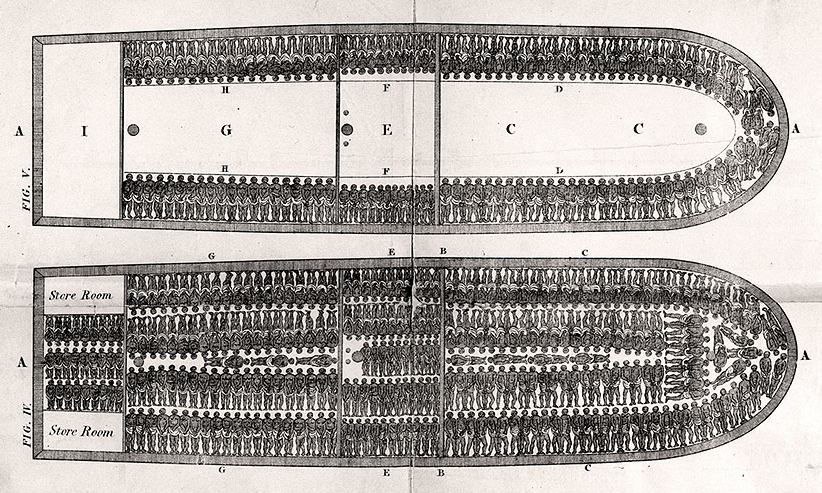 |
| This pic and the one below show the horrible conditions to which African slaves were subjected on slave ships. The filth, heat, and stench would've been overpowering. |

It's sometimes said that Africans were treated better by Muslims than they were in the West, but Stark argues that this is dubious. Although roughly equal numbers of Africans arrived in both the West and in the Islamic world there's no substantial black population today in the "land of Islam." This is attributed in large measure to very low fertility due to the practice of castrating black males and of killing any infants who show black ancestry. Castration not only meant that black males who survived it couldn't reproduce, it also created a very high mortality rate among males due to infection and blood loss.
Just as science arose only once, so too, did effective moral opposition to slavery, and, like science, it arose only in the West and by Christians. Slavery has existed in every society able to afford it, including Native American societies, but of all the world's religions only Christians developed the belief that slavery was a great sin and must be abolished.
Antislavery efforts began to appear in Christian theology soon after the decline of Rome and eventually led to its disappearance in all but the fringes of Christian Europe by the end of the 16th century. When Europeans subsequently instituted slavery in the New World they did so over strenuous papal opposition. Unfortunately, by this time in history Rome was too weak to exert its influence over slave-owners in the Western hemisphere.
It's an interesting detail that relatively few slaves were imported into North America. From 1626 to 1808 when it became illegal to import slaves in the U.S., the total number of imported African slaves was about 400,000. By contrast, 3.6 million went to Brazil, 1.6 million were imported by the Spanish colonies, and about 3.8 million wound up in the horrific Caribbean sugar plantations. Eventually, due to the efforts primarily of Quakers in North America, like William and Sarah Lay, and the Clapham Sect in England, most notably William Wilberforce, the slave trade was first abolished and then ultimately done away with in the West.
There was, however, no similar abolition movement in the Islamic world. Slavery was only ended in the Muslim world because of Western pressure to do so, but it persisted nevertheless well into the 20th century (Saudi Arabia banned it in 1962, Mauritania in 1981). The British navy embargoed Muslim slave ships and British and French colonial troops intercepted countless slave caravans, freeing the slaves and sometimes executing slave traders on the spot. In North America a catastrophic civil war was fought, primarily over the issue of slavery.
Stark notes how the people who finally ended the moral scourge were acting essentially altruistically. They themselves had nothing to gain from their efforts and some paid dearly for their commitment to the cause of blacks.
He concludes that although a Christian culture was certainly not a sufficient basis for ending slavery, it was nonetheless a necessary one since it was almost solely Christian thinkers and activists, working within the unique Judeo-Christian understanding of human rights and equality, who reached anti-slavery conclusions and influenced the larger culture to recognize that they were participating in a great evil.
Perhaps if this history were more widely known fewer African Americans would be inclined to reject their Christian heritage in favor of an Islamic one.
Thursday, April 2, 2020
Christianity and the Rise of Modern Science
Baylor historian and sociologist Rodney Stark is one of my favorite authors. His books are always both fascinating and contrarian. One of my favorites is his For the Glory of God which, as the subtitle states, is the story of how monotheism led to the Reformation, science, witch-burnings, and the end of slavery.
It's specifically about Christian monotheism and it's all very interesting, but one of the most interesting aspects of the book was how Stark debunks some of the enduring myths about the interplay and significance of Christianity for both the emergence of modern science and the abolition of slavery.
I'd like to briefly summarize some of what he says about the alleged science/religion conflict in this post and talk tomorrow about what he says about the role of Christianity in ending slavery.
Ever since the 17th century opponents of Christianity have sought to perpetuate the myth that religion and science have been locked in mortal combat. The myth culminated in the work of Andrew Dickson White, author of A History of the Warfare of Science with Theology in Christendom (1896), a book whose themes are still influential today even though they've been almost entirely discredited by subsequent scholarship.
Stark shows how White's account of Columbus being impeded by religious men in Spain who thought the world was flat is totally false, as is belief in an epoch of "Dark Ages" which descended upon Europe like a shroud over the minds of men.
There were no "Dark Ages," nor did anyone with any learning in Columbus' day think the world was flat. His proposal to sail across the Atlantic to India was resisted because it was believed, rightly, that Columbus had seriously underestimated the circumference of the globe and that he would never be able to make it to his destination.
Indeed, he would not have made it had he not serendipitously come upon the New World.
So, too, traditional accounts of the theories of Copernicus and the persecution of Galileo by the Church are often riddled with misinformation intended to make Christianity and Christians look like benighted fools and frame the founders of modern science as secular heroes struggling against an oppressive Church.
The facts are otherwise. As Stark points out, 50 of the 52 men who were most influential in the development of modern science in the 16th and 17th centuries were Christians, and over 60 percent of these were devoutly so, including some of the greatest names in the scientific pantheon: Boyle, Brahe, Descartes, Gassendi, Hooke, Huygens, Kepler, Leibniz, Newton, Pascal, Vesalius, et al.
Stark observes that so far from being inimical to science, the Church made it possible for science to flourish by building and staffing universities where men could pursue learning centuries before the "Enlightenment," but perhaps even more important than centers of scholarship was the pervading worldview in Europe that gave rise to modern science.
The theological assumptions that the cosmos had been created by an intelligent being, that it was logical, law-like and designed, and that its secrets could be unlocked through the application of human reason, all provided the impetus to explore and investigate the world and led to the burgeoning of scientific discovery.
This, Stark argues, is why "science arose only once in history - in medieval Europe - because only there was found a culture dominated by a belief in a rational, conscious, all-powerful Creator," and only in Christian Europe were men free to investigate nature and to "think God's thoughts after Him."
It's specifically about Christian monotheism and it's all very interesting, but one of the most interesting aspects of the book was how Stark debunks some of the enduring myths about the interplay and significance of Christianity for both the emergence of modern science and the abolition of slavery.
I'd like to briefly summarize some of what he says about the alleged science/religion conflict in this post and talk tomorrow about what he says about the role of Christianity in ending slavery.
Ever since the 17th century opponents of Christianity have sought to perpetuate the myth that religion and science have been locked in mortal combat. The myth culminated in the work of Andrew Dickson White, author of A History of the Warfare of Science with Theology in Christendom (1896), a book whose themes are still influential today even though they've been almost entirely discredited by subsequent scholarship.
Stark shows how White's account of Columbus being impeded by religious men in Spain who thought the world was flat is totally false, as is belief in an epoch of "Dark Ages" which descended upon Europe like a shroud over the minds of men.
There were no "Dark Ages," nor did anyone with any learning in Columbus' day think the world was flat. His proposal to sail across the Atlantic to India was resisted because it was believed, rightly, that Columbus had seriously underestimated the circumference of the globe and that he would never be able to make it to his destination.
Indeed, he would not have made it had he not serendipitously come upon the New World.
So, too, traditional accounts of the theories of Copernicus and the persecution of Galileo by the Church are often riddled with misinformation intended to make Christianity and Christians look like benighted fools and frame the founders of modern science as secular heroes struggling against an oppressive Church.
The facts are otherwise. As Stark points out, 50 of the 52 men who were most influential in the development of modern science in the 16th and 17th centuries were Christians, and over 60 percent of these were devoutly so, including some of the greatest names in the scientific pantheon: Boyle, Brahe, Descartes, Gassendi, Hooke, Huygens, Kepler, Leibniz, Newton, Pascal, Vesalius, et al.
Stark observes that so far from being inimical to science, the Church made it possible for science to flourish by building and staffing universities where men could pursue learning centuries before the "Enlightenment," but perhaps even more important than centers of scholarship was the pervading worldview in Europe that gave rise to modern science.
The theological assumptions that the cosmos had been created by an intelligent being, that it was logical, law-like and designed, and that its secrets could be unlocked through the application of human reason, all provided the impetus to explore and investigate the world and led to the burgeoning of scientific discovery.
This, Stark argues, is why "science arose only once in history - in medieval Europe - because only there was found a culture dominated by a belief in a rational, conscious, all-powerful Creator," and only in Christian Europe were men free to investigate nature and to "think God's thoughts after Him."
Wednesday, April 1, 2020
Martyrdom, Modern and Ancient
Raymond Ibrahim at PJMedia.com notes that it was five years last February since 21 young men were taken by Muslim fanatics onto a beach and beheaded. They were all of them Christians, 20 Egyptian Copts and one Ghanian, and their captors, members of ISIS, had pressured them to renounce their faith and convert to Islam, but they steadfastly and courageously refused.
Their faithfulness to Jesus Christ, even at the cost of their lives, is an inspiration to everyone who reads about it.
Ibrahim's article goes on to explain that this persecution of Christians by Muslims is not something that began the day before yesterday. It has been going on for 1200 years or more. Ibrahim recounts an episode that occured in the 9th century as an illustration of this jihad against Christianity: They've become well-known and books have been written about them and their ordeal (see below), as well there should be, but thousands of others are courageously suffering similar fates every year in Muslim controlled areas in Africa and the Middle East, and they're suffering in anonymity.
 We should never cease to remember them even if we don't know their names.
Their faithfulness to Jesus Christ, even at the cost of their lives, is an inspiration to everyone who reads about it.
Ibrahim's article goes on to explain that this persecution of Christians by Muslims is not something that began the day before yesterday. It has been going on for 1200 years or more. Ibrahim recounts an episode that occured in the 9th century as an illustration of this jihad against Christianity:
In 838, Caliph al-Mu‘tasim—at the head of eighty thousand slave-soldiers—burst into Amorium, one of the Eastern Roman Empire’s largest and most important cities. They burned and razed it to the ground and slaughtered countless; everywhere there were “bodies heaped up in piles,” recalled a chronicler.Here's a famous screen shot of the 21 young Christians just before they were butchered.
The invaders locked those who sought sanctuary inside their churches and set the buildings aflame; trapped Christians could be heard crying kyrie eleison — “Lord have mercy!” in Greek — while being roasted alive.
Hysterical “women covered their children, like chickens, so as not to be separated from them, either by sword or slavery.”
About half of the city’s seventy thousand citizens were slaughtered, the rest hauled off in chains. There was such a surplus of human booty that when the caliph came across four thousand male prisoners he ordered them executed on the spot.
Because there “were so many women’s convents and monasteries” in this populous Christian city, “over a thousand virgins were led into captivity, not counting those that had been slaughtered. They were given to the Moorish and Turkish slaves, so as to assuage their lust,” laments the chronicler.
When the young emperor, Theophilus (r. 829–842), heard about the sack of Amorium—his hometown, chosen by the caliph for that very reason, to make the sting hurt all the more—he fell ill and died three years later, aged 28, reportedly from sorrow.
Meanwhile, the Muslim poet Abu Tammam (805‐845) celebrated the caliph’s triumph, since “You have left the fortunes of the sons of Islam in the ascendant, and the polytheists [Christians] and the abode of polytheism in decline.”
Among the many captives carted off to Iraq were forty-two notables, mostly from the military and clerical classes. Due to their prestigious status and in order to make them trophies of Islam, they were repeatedly pressured to convert:During the seven years of their imprisonment, their captors tried in vain to persuade them to renounce Christianity and accept Islam. The captives stubbornly resisted all their seductive offers and bravely held out against terrible threats. After many torments that failed to break the spirit of the Christian soldiers, they condemned them to death, hoping to shake the determination of the saints before executing them. The martyrs remained steadfast…One, Theodore, a Christian cleric who fought in defense of Amorium, was goaded as follows: “We know that you forsook the priestly office, became a soldier and shed blood [of Muslims] in battle. You can have no hope in Christ, whom you abandoned voluntarily, so accept Mohammed.”
Theodore replied: “You do not speak truthfully when you say that I abandoned Christ. Moreover, I left the priesthood because of my own unworthiness. Therefore, I must shed my blood for the sake of Christ, so that He might forgive the sins that I have committed against Him.”
In the end, none would recant; and so, on March 6, 845, after seven years of torture and temptation failed to make them submit to Muhammad, all 42 Christians were — like their 21 spiritual descendants, the Egyptian/Ghanaian martyrs—also marched to a body of water, the Euphrates River, ritually beheaded, and their bodies dumped into the river.


Tuesday, March 31, 2020
How Scientism Refutes Itself
Philosopher J.P.Moreland has written a fine book titled Scientism and Secularism (2018) from which some of what follows has been borrowed. Scientism is not to be confused with science, but scientists, particularly naturalist or materialist scientists, are often proponents of scientism. Scientism is actually a philosophical view which holds, paradoxically, that science is the only reliable means of apprehending truth.
The late cosmologist Stephen Hawking famously declared in a book he co-authored with Leonard Mlodinow titled The Grand Design (2010) that "philosophy is dead" and that all the answers to life's important questions, at least those that can be known, are to be answered henceforth by science.
Hawking is here giving expression to his scientism, the view that all the important questions can either be answered by science or not answered at all, and that the methodologies of science are the only valid path to truth and knowledge. All other ways of knowing must give way to the supreme authority of science, especially the natural, or "hard" sciences like physics and chemistry.
Scientism is a common view, but not only does it have some serious liabilities, the notion that science supersedes philosophy is surely false.
There are at least three things wrong with scientism:
Nor can science be the only way of knowing since there are many other things we can know with at least the same level of certainty as we know any of the deliverances of science.
For example, which do you know with stronger certitude, that atoms are the basic building blocks of matter or that torturing children for fun is evil? The latter is not a scientific claim at all, it's a metaphysical claim, yet most of us are far more sure of its truth than we are of the truth of the claim about atoms.
There are other examples of things we know that do not lend themselves at all to scientific demonstration. For example, I can know: that I took a walk on my last birthday, that I hold certain beliefs about science and philosophy, that I have an itch in my foot, that sunsets are beautiful, that justice is good; and I can know the basic laws of math and logic, e.g. I know that 2 + 2 = 4, and I know that if a proposition (P) entails another proposition (Q) then if P is true so must Q be true.
Not only do we all know such things, we know them with far more certainty than we know the truth of the claims of scientists about, say, global warming, atomic theory or Darwinian evolution.
Moreover, science depends for its very existence upon a series of assumptions, none of which are themselves scientific. All of them are philosophical, so if philosophy is dead where does that leave science?
Here are some examples: The law of cause and effect (Every effect has a cause), the law of sufficient reason (everything that exists has a sufficient explanation for its existence), the principle of uniformity (The laws that prevail in our neighborhood of the universe prevail everywhere in the universe), the belief that explanations which exhibit elegance and simplicity are superior to those which don't, the belief that the world is objectively real and intelligible, the belief that our senses are reliable and that our reason is trustworthy. All of these are philosophical assumptions that cannot be demonstrated scientifically to be true.
Scientism is a bid by some materialists to assert epistemological hegemony over our intellectual lives and especially over the disciplines of philosophy and theology. However, just as similar attempts in the 20th century, such as positivism and verificationism, fell victim to self-referential incoherence, so, too, does scientism.
The claim that science is uniquely authoritative and that we should all recognize and bow to its supremacy is quite simply false.
The late cosmologist Stephen Hawking famously declared in a book he co-authored with Leonard Mlodinow titled The Grand Design (2010) that "philosophy is dead" and that all the answers to life's important questions, at least those that can be known, are to be answered henceforth by science.
Hawking is here giving expression to his scientism, the view that all the important questions can either be answered by science or not answered at all, and that the methodologies of science are the only valid path to truth and knowledge. All other ways of knowing must give way to the supreme authority of science, especially the natural, or "hard" sciences like physics and chemistry.
Scientism is a common view, but not only does it have some serious liabilities, the notion that science supersedes philosophy is surely false.
There are at least three things wrong with scientism:
- It's self-refuting.
- It's false that science is the only sure way of knowing truth.
- It's false that philosophy is dead. If it were then science would be impossible.
Nor can science be the only way of knowing since there are many other things we can know with at least the same level of certainty as we know any of the deliverances of science.
For example, which do you know with stronger certitude, that atoms are the basic building blocks of matter or that torturing children for fun is evil? The latter is not a scientific claim at all, it's a metaphysical claim, yet most of us are far more sure of its truth than we are of the truth of the claim about atoms.
There are other examples of things we know that do not lend themselves at all to scientific demonstration. For example, I can know: that I took a walk on my last birthday, that I hold certain beliefs about science and philosophy, that I have an itch in my foot, that sunsets are beautiful, that justice is good; and I can know the basic laws of math and logic, e.g. I know that 2 + 2 = 4, and I know that if a proposition (P) entails another proposition (Q) then if P is true so must Q be true.
Not only do we all know such things, we know them with far more certainty than we know the truth of the claims of scientists about, say, global warming, atomic theory or Darwinian evolution.
Moreover, science depends for its very existence upon a series of assumptions, none of which are themselves scientific. All of them are philosophical, so if philosophy is dead where does that leave science?
Here are some examples: The law of cause and effect (Every effect has a cause), the law of sufficient reason (everything that exists has a sufficient explanation for its existence), the principle of uniformity (The laws that prevail in our neighborhood of the universe prevail everywhere in the universe), the belief that explanations which exhibit elegance and simplicity are superior to those which don't, the belief that the world is objectively real and intelligible, the belief that our senses are reliable and that our reason is trustworthy. All of these are philosophical assumptions that cannot be demonstrated scientifically to be true.
Scientism is a bid by some materialists to assert epistemological hegemony over our intellectual lives and especially over the disciplines of philosophy and theology. However, just as similar attempts in the 20th century, such as positivism and verificationism, fell victim to self-referential incoherence, so, too, does scientism.
The claim that science is uniquely authoritative and that we should all recognize and bow to its supremacy is quite simply false.
Monday, March 30, 2020
True Heroes
One silver lining to the Covid-19 pandemic is that everyday we're seeing real heroes, not the spurious Hollywood heroes on our movie screens, but men and women risking, and sometimes losing, their lives to save the lives of others. They are genuinely wonderful people.
What motivates them to do it? An individual's motivation arises from many sources, of course, but what are the deep-rooted tacit assumptions that impel a man or a woman to do what medical professionals are doing today as they seek to mitigate the misery of so many sufferers around the world?
I can't prove it, but I believe that the impetus that drives these men and women all across the globe can be traced back to a passage in the Gospel of Matthew, chapter 25, verses 35-40 where Jesus instructs His followers as to how He wants them to treat the sick, the weak and the poor:
The desire to meet this obligation toward "the least of these" provided the motivation for hospitals, orphanages, almshouses, child labor laws, state welfare, charitable organizations, human rights, etc., all of which eventually emerged first in the Christian West.
In the Graeco-Roman world, by contrast, the poor and weak were often treated with contempt. It was a brutal existence in which human life was very cheap, and the life of the weak and defenseless cheaper still.
In a world which has no concept of the Judeo-Christian God it makes sense to see life this way. This is why nations which officially adopt atheism - communist and fascist - are often murderous and cruel. In the absence of God men are just ciphers, animals to be herded, manipulated and exploited in whatever way benefits those who have power over them.
The 19th century atheist Friedrich Nietzsche saw this clearly. He admired the Roman pagans for their cruelty and their love of greatness and power. He wrote that,
Nietzsche correctly recognized that no secular philosophy offers its adherents any warrant for empathy, kindness and sympathy, especially when directed toward the weak and the poor.
Most secular people, for instance, accept the evolutionary account of man's origin, but evolution is all about survival of the fittest, not the survival of the weak and sickly. Darwin himself was troubled by the recognition that caring for the weak was not in the best interest of the human species. It enhanced neither fitness nor survival.
Secular folk might choose to care for the unfortunate, to be sure, but doing so is simply a matter of personal preference. There’s no duty to do so, no obligation. If they were to treat the sick, weak and poor cruelly there’s nothing in their worldview to tell them that they’re doing anything wrong.
If they do think it’s wrong they’re actually piggy-backing on Christian assumptions about human worth. Nothing in the atheistic worldview obligates one to care for the sick, and nothing in atheism condemns one's refusal to care for them.
Christians care for the weak, the poor and the oppressed because, they believe, every person carries the image of Christ. To care for the sick is to care for Christ.
According to historian Tom Holland writing in his best-selling book Dominion, when a plague broke out in Rome in 165-180 A.D., possibly smallpox, many fled the city leaving the sick to fend for themselves. The Romans were astonished that many Christians stayed behind to nurse those who suffered, some also contracting the disease.
The amazing thing to the Romans was that the Christians were complete strangers to those they cared for.
A century later another pestilence spread from Africa throughout the Mediterranean world. On Easter Sunday in 260 AD, Bishop Dionysius of Corinth praised the efforts of the Christians, many of whom had died while caring for others during the outbreak. He said:
Basil become bishop of Caesarea in what is today eastern Turkey, and, in the midst of an awful famine in 369, built what was essentially the first hospital. It was actually a small city, and the poor were welcomed and treated by Basil himself who gave refuge and care, even to lepers, greeting them with a kiss.
No matter how disgusting and abject the sufferers were, Basil said, Christ was in them.
His brother Gregory became bishop of Nyssa, also in present-day Turkey, and became one of the strongest opponents of slavery in the ancient world.
Among the ancients it was an accepted and common practice to simply abandon unwanted babies by the roadside, leave them on garbage piles, or to dump them down drains. Some people would rescue the infants to raise them as slaves. Females were often raised to be sold to brothels.
The practice was taken for granted, except in Jewish enclaves, until the emergence of Christianity.
One of the most influential adversaries of the practice was the elder sister of Basil and Gregory, a woman named Macrina, who would rescue the abandoned girls and take them home to raise as her own daughters.
The standard toward the sick, the poor, the slave and the defenseless reinforced by Basil, Gregory and Macrina was incomprehensible to their pagan contemporaries, but it was how Christians acted because they saw every person as bearing the image of Christ.
As Christianity gradually spread throughout the West, the Christian attitude toward the sick and poor spread as well. Even those like the atheist surgeon Dr. Rieux, the hero of Albert Camus' novel The Plague, who in the story strives at great personal cost to himself to help Algerians victimized by an outbreak of bubonic plague, are living off the capital of a Christian understanding of the human person. Nothing in Rieux's atheism provided any ground for his devotion to the dying.
Those who today are giving so much, risking so much, to help the victims of Covid-19 are following in the train of centuries of Christians who were themselves animated by Christ's words in Matthew 25. Even if some of today's healers consider themselves secular or atheistic, even if they are personally hostile to Christianity, they have still, perhaps without realizing it, adopted for themselves an attitude toward the distressed and sick which is Christianity's gift to the world.
But whether or not they realize where their roots lie these men and women are indeed true heroes.
What motivates them to do it? An individual's motivation arises from many sources, of course, but what are the deep-rooted tacit assumptions that impel a man or a woman to do what medical professionals are doing today as they seek to mitigate the misery of so many sufferers around the world?
I can't prove it, but I believe that the impetus that drives these men and women all across the globe can be traced back to a passage in the Gospel of Matthew, chapter 25, verses 35-40 where Jesus instructs His followers as to how He wants them to treat the sick, the weak and the poor:
[For] I was hungry, and you gave me something to eat; I was thirsty, and you gave Me drink; I was a stranger and you invited Me in; naked, and you clothed Me; I was sick, and you visited Me; I was in prison, and you came to Me. Then the righteous will answer Him, saying, 'Lord, when did we see you hungry and feed You, or thirsty and give You drink? And when did we see You a stranger and invite you in, or naked, and clothe You? And when did we see You sick, or in prison, and come to You?' And the King [Jesus] will answer and say to them, 'Truly, I say to you, to the extent that you did it to ... even the least of these, you did it to Me.'This was a revolutionary way to see one's responsibility to other people in antiquity. Other than among some Jews, there really was nothing like it in any ancient society. The idea that anyone had a moral obligation to the “least of these” was a uniquely Christian idea rooted in the teaching of Jesus Christ.
The desire to meet this obligation toward "the least of these" provided the motivation for hospitals, orphanages, almshouses, child labor laws, state welfare, charitable organizations, human rights, etc., all of which eventually emerged first in the Christian West.
In the Graeco-Roman world, by contrast, the poor and weak were often treated with contempt. It was a brutal existence in which human life was very cheap, and the life of the weak and defenseless cheaper still.
In a world which has no concept of the Judeo-Christian God it makes sense to see life this way. This is why nations which officially adopt atheism - communist and fascist - are often murderous and cruel. In the absence of God men are just ciphers, animals to be herded, manipulated and exploited in whatever way benefits those who have power over them.
The 19th century atheist Friedrich Nietzsche saw this clearly. He admired the Roman pagans for their cruelty and their love of greatness and power. He wrote that,
To see others suffer does one good, to make others suffer even more: this is a hard saying but an ancient, mighty, human, all-too-human principle .... Without cruelty there is no festival.and this:
Those who are cruel enjoy the highest gratification of the feeling of power.Nietzsche disdained Christian morality, calling it "slave morality." He admired what he called "master morality" which differed from slave morality in that master morality values power and pride whereas slave morality values qualities such as empathy, kindness, and sympathy.
Nietzsche correctly recognized that no secular philosophy offers its adherents any warrant for empathy, kindness and sympathy, especially when directed toward the weak and the poor.
Most secular people, for instance, accept the evolutionary account of man's origin, but evolution is all about survival of the fittest, not the survival of the weak and sickly. Darwin himself was troubled by the recognition that caring for the weak was not in the best interest of the human species. It enhanced neither fitness nor survival.
Secular folk might choose to care for the unfortunate, to be sure, but doing so is simply a matter of personal preference. There’s no duty to do so, no obligation. If they were to treat the sick, weak and poor cruelly there’s nothing in their worldview to tell them that they’re doing anything wrong.
If they do think it’s wrong they’re actually piggy-backing on Christian assumptions about human worth. Nothing in the atheistic worldview obligates one to care for the sick, and nothing in atheism condemns one's refusal to care for them.
Christians care for the weak, the poor and the oppressed because, they believe, every person carries the image of Christ. To care for the sick is to care for Christ.
According to historian Tom Holland writing in his best-selling book Dominion, when a plague broke out in Rome in 165-180 A.D., possibly smallpox, many fled the city leaving the sick to fend for themselves. The Romans were astonished that many Christians stayed behind to nurse those who suffered, some also contracting the disease.
The amazing thing to the Romans was that the Christians were complete strangers to those they cared for.
A century later another pestilence spread from Africa throughout the Mediterranean world. On Easter Sunday in 260 AD, Bishop Dionysius of Corinth praised the efforts of the Christians, many of whom had died while caring for others during the outbreak. He said:
Most of our brother Christians showed unbounded love and loyalty, never sparing themselves, and thinking only of one another. Heedless of danger, they took charge of the sick, attending to their every need and ministering to them in Christ, and with them departed this life serenely happy; for they were infected by others with the disease, drawing on themselves the sickness of their neighbors and cheerfully accepting their pains.The Roman Emperor Julian, a 4th century ruler who despised Christianity and who yearned to restore the ancient pagan rites in Rome, was bewildered by the devotion to the poor manifested by the Christians:
How apparent to everyone it is, and how shameful, that our own people lack support from us, when no Jew ever has to beg, and the impious Galileans [Christians] support not only their own poor, but ours as well.Julian perhaps had in mind people like Basil and Gregory of Nyssa, two wealthy, well-educated brothers in the 4th century who dedicated their lives to helping the poor.
Basil become bishop of Caesarea in what is today eastern Turkey, and, in the midst of an awful famine in 369, built what was essentially the first hospital. It was actually a small city, and the poor were welcomed and treated by Basil himself who gave refuge and care, even to lepers, greeting them with a kiss.
No matter how disgusting and abject the sufferers were, Basil said, Christ was in them.
His brother Gregory became bishop of Nyssa, also in present-day Turkey, and became one of the strongest opponents of slavery in the ancient world.
Among the ancients it was an accepted and common practice to simply abandon unwanted babies by the roadside, leave them on garbage piles, or to dump them down drains. Some people would rescue the infants to raise them as slaves. Females were often raised to be sold to brothels.
The practice was taken for granted, except in Jewish enclaves, until the emergence of Christianity.
One of the most influential adversaries of the practice was the elder sister of Basil and Gregory, a woman named Macrina, who would rescue the abandoned girls and take them home to raise as her own daughters.
The standard toward the sick, the poor, the slave and the defenseless reinforced by Basil, Gregory and Macrina was incomprehensible to their pagan contemporaries, but it was how Christians acted because they saw every person as bearing the image of Christ.
As Christianity gradually spread throughout the West, the Christian attitude toward the sick and poor spread as well. Even those like the atheist surgeon Dr. Rieux, the hero of Albert Camus' novel The Plague, who in the story strives at great personal cost to himself to help Algerians victimized by an outbreak of bubonic plague, are living off the capital of a Christian understanding of the human person. Nothing in Rieux's atheism provided any ground for his devotion to the dying.
Those who today are giving so much, risking so much, to help the victims of Covid-19 are following in the train of centuries of Christians who were themselves animated by Christ's words in Matthew 25. Even if some of today's healers consider themselves secular or atheistic, even if they are personally hostile to Christianity, they have still, perhaps without realizing it, adopted for themselves an attitude toward the distressed and sick which is Christianity's gift to the world.
But whether or not they realize where their roots lie these men and women are indeed true heroes.
Saturday, March 28, 2020
Biden and Kavanaugh
In late summer of 2018 Supreme Court nominee Brett Kavanaugh was accused by a woman named Christine Blasey Ford of having jumped on top of her when he was in his late teens. The media talked about nothing else. Kavanaugh was presumed guilty by virtually the entire left-wing media because, as people like Joe Biden were saying, a woman who brings such charges against a man should always be believed.
Kavanaugh's career hung by a very tenuous thread, and his reputation was in tatters.
Now comes word that the same Joe Biden who sternly reproached anyone who would doubt a woman's allegation of sexual assault is himself being accused of an even worse assault than was Kavanaugh.
Caution: The following excerpt may strike some readers as gratuitously crude. Please don't read it if you think you might be offended.
It will be interesting to see where this goes.
Will now the same media forces who were mobilized to destroy Brett Kavanaugh mobilize once again to destroy Joe Biden, or was the outrage directed at Kavanaugh really an empty pose undertaken purely for political purposes? Will the media try to bury Ms Reade's allegations under a mountain of Covid-19 reporting or will they strive to be consistent and fair and pursue the charges against Mr. Biden with the same ferocity as they pursued the charges made against Mr. Kavanaugh?
We'll know the answers to those questions soon enough, but if I had to guess I'd say that the media will do everything they can to find something else to talk about. To date few news sources have even mentioned this latest scandal:
It'll also be interesting to see the response of those who said they could never vote for Mr. Trump because of his well-documented past treatment of women. Will they now insist that they would never vote for Joe Biden for the same reason? We'll see.
The following video provides more background to this sordid story:
Kavanaugh's career hung by a very tenuous thread, and his reputation was in tatters.
Now comes word that the same Joe Biden who sternly reproached anyone who would doubt a woman's allegation of sexual assault is himself being accused of an even worse assault than was Kavanaugh.
Caution: The following excerpt may strike some readers as gratuitously crude. Please don't read it if you think you might be offended.
Former Vice President Joe Biden has been accused of sexual assaulting a former staffer in 1993 in his Senate office. Tara Reade, who worked in Biden’s office in 1993, accused Biden of touching her, kissing her and penetrating her with his fingers without consent.There's more to this story at the link.
Reade made her claims in an interview with Katie Halper, a writer and podcast host, released Wednesday.
“We were alone, and it was the strangest thing. There was no, like, exchange really, he just had me up against the wall,” Reade said.
“His hands were on me and underneath my clothes. And then, he went, he went down my skirt and then up inside it, and he penetrated me with his fingers… and um… He was kissing me at the same time and he was saying something to me,” she also told Halper.
“He got finished doing what he was doing and I, how I was pulled back and he said, ‘Come on man, I heard you liked me.’ And that phrase stayed with me because I kept thinking what I might have said. And I can’t remember exactly if he said ‘I thought’ or if ‘I heard.’ It’s like he implied that I had done this.”
Reade said that she told her mother and brother about the assault. She also told a friend, who she says advised her not to come forward and face a public firestorm. Her mother, who has since passed, told her to report the incident, but her brother also discouraged her from doing so.
The Daily Caller reached out to Biden’s campaign about the allegation Wednesday and has received no response.
It will be interesting to see where this goes.
Will now the same media forces who were mobilized to destroy Brett Kavanaugh mobilize once again to destroy Joe Biden, or was the outrage directed at Kavanaugh really an empty pose undertaken purely for political purposes? Will the media try to bury Ms Reade's allegations under a mountain of Covid-19 reporting or will they strive to be consistent and fair and pursue the charges against Mr. Biden with the same ferocity as they pursued the charges made against Mr. Kavanaugh?
We'll know the answers to those questions soon enough, but if I had to guess I'd say that the media will do everything they can to find something else to talk about. To date few news sources have even mentioned this latest scandal:
The reaction to this allegation has largely been muted in major media outlets. As of Friday afternoon, searches of the New York Times, CNN.com, the Los Angeles Times and many other outlets show no articles on the allegations. Additionally, a keyword search of cable news channels turns up no results on major networks like CNN, MSNBC, Fox News or CNBC.There are some similarities between the Ford and the Reade allegations, but the latter seem much more credible inasmuch as this is not the first time that evidence has come forward of Mr. Biden's general creepiness. See here, here and here.
It'll also be interesting to see the response of those who said they could never vote for Mr. Trump because of his well-documented past treatment of women. Will they now insist that they would never vote for Joe Biden for the same reason? We'll see.
The following video provides more background to this sordid story:
Friday, March 27, 2020
Cuomo's Surprise
At a press briefing Tuesday New York Governor Andrew Cuomo delivered himself of something of a shocker. In making the case that the government should spend whatever it takes to mitigate the Covid-19 crisis he stated emphatically that,
Of course, "health of the mother" is a very elastic term which means whatever the mother and her doctor want it to mean. If a mother will be deeply upset if she has to carry the baby to term that could be construed by a sympathetic doctor as a mental health rationale for terminating the pregnancy. The New York law, called the Reproductive Health Act, essentially permits abortion on demand at any time in a pregnancy.
This is also the same governor who in 2014 declared that anyone who believes that human life is not disposable and that cost should not be a concern in saving human lives is not welcome in the state of New York. He referred to such people as "extreme" conservatives because they hold to the inarguable biological position that an unborn child is both human and alive.
Cuomo considers these folks extreme because they believe that those human lives deserve prima facie protection, just like Cuomo believes the life of his octogenarian mother deserves prima facie protection.
In the mind of Andrew Cuomo, some human life is evidently more expendable than other human life.
My mother is not expendable, your mother is not expendable and our brothers and sisters are not expendable, and we’re not going to accept the premise that human life is disposable, and we’re not going to put a dollar figure on human life. The first order of business is to save lives, period. Whatever it costs.The governor, a Democrat (and a Catholic, no less), apparently defines human life as something that magically commences at birth because he certainly isn't very concerned about pre-natal human life. This is the governor who last year signed legislation allowing for babies to be aborted up to the time of birth if the health of the mother was at risk.
Of course, "health of the mother" is a very elastic term which means whatever the mother and her doctor want it to mean. If a mother will be deeply upset if she has to carry the baby to term that could be construed by a sympathetic doctor as a mental health rationale for terminating the pregnancy. The New York law, called the Reproductive Health Act, essentially permits abortion on demand at any time in a pregnancy.
This is also the same governor who in 2014 declared that anyone who believes that human life is not disposable and that cost should not be a concern in saving human lives is not welcome in the state of New York. He referred to such people as "extreme" conservatives because they hold to the inarguable biological position that an unborn child is both human and alive.
Cuomo considers these folks extreme because they believe that those human lives deserve prima facie protection, just like Cuomo believes the life of his octogenarian mother deserves prima facie protection.
In the mind of Andrew Cuomo, some human life is evidently more expendable than other human life.
Thursday, March 26, 2020
Amazing Embryos
Ever since I was an undergraduate biology major I have been intrigued by the mystery of how a zygote (a fertilized egg) develops from a single cell into a multi-cellular embryo and from there to a complete organism.
The reason this is such a profound mystery is that the initial cell somehow "knows" to divide and the daughter cells somehow "know" to form different kinds of cells which somehow "know" to migrate around the embryo and form different kinds of tissue which somehow "know" to integrate with other kinds of tissues to form organs, and so on.
So, how do cells with no brains "know" how to do all this? Where are the instructions located which choreograph this astonishing process and tell all the parts what to do and how to do it, and how are those instructions communicated?
The information is not to be found in either the genome or the epigenome, apparently, so where is it, what is its storage medium, and how is it stored and accessed? What mechanisms control it so that the entire assembly unfolds in a flawless sequence with each step occurring precisely when it must in order to successfully construct an adult organism? And how, exactly, does the zygote "know" to produce, say, a flower rather than a fish, or a bird, or a human?
These questions are fascinating and they emerge again in an article at Uncommon Descent that quotes geneticist Michael Denton:
Denton continues:
If they follow different pathways then there must be a different set of assembly instructions for the development of these "homologs," and thus all of the above questions arise again.
There is in the organism from the time it's just a single cell until it's fully developed, a massive amount of information that programs its development.
The locus, nature, and modus operandi of this information are unknown, but one thing I think can be inferred: If information of such astonishing sophistication controls the progression of the cell's development, it seems very unlikely that that information is the product of blind, impersonal, random processes.
Complex information such as we find in computer code or architectural blueprints are never the product of random processes like genetic mutation, but are always, insofar as we've ever experienced it, the product of a mind.
I leave it to the reader to draw his or her own conclusions. Meanwhile, here's a very good animation of human embryo formation and development:
The reason this is such a profound mystery is that the initial cell somehow "knows" to divide and the daughter cells somehow "know" to form different kinds of cells which somehow "know" to migrate around the embryo and form different kinds of tissue which somehow "know" to integrate with other kinds of tissues to form organs, and so on.
So, how do cells with no brains "know" how to do all this? Where are the instructions located which choreograph this astonishing process and tell all the parts what to do and how to do it, and how are those instructions communicated?
The information is not to be found in either the genome or the epigenome, apparently, so where is it, what is its storage medium, and how is it stored and accessed? What mechanisms control it so that the entire assembly unfolds in a flawless sequence with each step occurring precisely when it must in order to successfully construct an adult organism? And how, exactly, does the zygote "know" to produce, say, a flower rather than a fish, or a bird, or a human?
These questions are fascinating and they emerge again in an article at Uncommon Descent that quotes geneticist Michael Denton:
The earliest events leading from the first division of the egg cell to the blastula stage in amphibians, reptiles and mammals are illustrated in figure 5.4 (in his book Evolution: A Theory in Crisis). Even to the untrained zoologist it is obvious that neither the blastula itself, nor the sequence of events that lead to its formation, is identical in any of the vertebrate classes shown.The blastula stage is an early step in embryogenesis when the zygote divides several times to produce a ball of cells. When those cells then evaginate and begin to take on the form of the early embryo biologists call that the gastrula stage.
Denton continues:
The differences become even more striking in the next major phase of embryo formation – gastrulation. This involves a complex sequence of cell movements whereby the cells of the blastula rearrange themselves, eventually resulting in the transformation of the blastula into the intricate folded form of the early embryo, or gastrula, which consists of three basic germ cell layers: the ectoderm, which gives rise to the skin and the nervous system; the mesoderm, which gives rise to muscle and skeletal tissues; and the endoderm, which gives rise to the lining of the alimentary tract as well as to the liver and pancreas....This is surprising. Different types of animals follow different pathways in building morphological structures such as the arm of a man, the foreleg of a horse, the wing of a bird, and the pectoral fin of a fish, that are otherwise believed to be evolutionarily "related."
In some ways the egg cell, blastula, and gastrula stages in the different vertebrate classes are so dissimilar that, were it not for the close resemblance in the basic body plan of all adult vertebrates, it seems unlikely that they would have been classed as belonging to the same phylum.
There is no question that, because of the great dissimilarity of the early stages of embryogenesis in the different vertebrate classes, organs and structures considered homologous in adult vertebrates cannot be traced back to homologous cells or regions in the earliest stages of embryogenesis. In other words, homologous structures are arrived at by different routes.
If they follow different pathways then there must be a different set of assembly instructions for the development of these "homologs," and thus all of the above questions arise again.
There is in the organism from the time it's just a single cell until it's fully developed, a massive amount of information that programs its development.
The locus, nature, and modus operandi of this information are unknown, but one thing I think can be inferred: If information of such astonishing sophistication controls the progression of the cell's development, it seems very unlikely that that information is the product of blind, impersonal, random processes.
Complex information such as we find in computer code or architectural blueprints are never the product of random processes like genetic mutation, but are always, insofar as we've ever experienced it, the product of a mind.
I leave it to the reader to draw his or her own conclusions. Meanwhile, here's a very good animation of human embryo formation and development:
Wednesday, March 25, 2020
Is Inequality Wrong?
Some time ago the science magazine New Scientist ran a story (paywall) that was titled Inequality: How Our Brains Evolved to Love it, Even Though We Know it's Wrong. Because the article requires a subscription I didn't read it so it'd be unfair to assume too much about it, but the title itself is puzzling.

Even though I don't want to assume too much, I am going to assume that the editors of New Scientist, or at least many of their readers, lean metaphysically in the direction of naturalistic materialism. That is, I'm going to assume they hold to the view that nature is all there is and that all of nature is ultimately explicable solely in terms of matter and the laws which govern its behavior.
If I'm wrong in my assumption, I apologize at the outset. But assuming that I'm correct, I have a couple of questions for New Scientist's editors.
Doubtless they explain in the article what they mean by inequality, but whatever is meant by it, how do we know it's wrong? In order to know that X is wrong there must be some objective moral frame of reference to which we can compare X to see if it conforms to that standard. On naturalistic materialism, however, there are no objective moral reference frames, there are only subjective preferences and biases.
On naturalism when someone says, for example, that racism, murder, or political corruption are wrong all they're doing is emoting. They're saying something like, "I really don't like racism, murder or political corruption."
Moreover, inequality is the natural, expected outcome of the evolutionary process. Evolution by its very nature generates inequalities of all sorts. Why should anyone think that one evolutionary by-product, inequality among humans, is any more or less wrong than any other unless those by-products are being compared to some higher level moral standard? How can we say that kindness is right and cruelty is wrong if both are simply the products of impersonal processes like random mutation and natural selection?
If our fondness for inequality is merely a product of evolution then to declare that it's wrong is a lot like declaring that our fondness for sweet tasting foods is wrong. Nothing that has resulted from a blind, impersonal process like evolution can be either right or wrong. It just is.
We like to think, of course, that the evolution of sympathy or kindness is good and the evolution of greed, racism and aggressiveness is bad, but how can we justify such an assessment in the absence of an objective moral standard? And, to repeat, on naturalism there is no higher moral standard. At bottom, everything is just atoms jiggling in the void, and jiggling atoms are neither moral nor immoral.

Even though I don't want to assume too much, I am going to assume that the editors of New Scientist, or at least many of their readers, lean metaphysically in the direction of naturalistic materialism. That is, I'm going to assume they hold to the view that nature is all there is and that all of nature is ultimately explicable solely in terms of matter and the laws which govern its behavior.
If I'm wrong in my assumption, I apologize at the outset. But assuming that I'm correct, I have a couple of questions for New Scientist's editors.
Doubtless they explain in the article what they mean by inequality, but whatever is meant by it, how do we know it's wrong? In order to know that X is wrong there must be some objective moral frame of reference to which we can compare X to see if it conforms to that standard. On naturalistic materialism, however, there are no objective moral reference frames, there are only subjective preferences and biases.
On naturalism when someone says, for example, that racism, murder, or political corruption are wrong all they're doing is emoting. They're saying something like, "I really don't like racism, murder or political corruption."
Moreover, inequality is the natural, expected outcome of the evolutionary process. Evolution by its very nature generates inequalities of all sorts. Why should anyone think that one evolutionary by-product, inequality among humans, is any more or less wrong than any other unless those by-products are being compared to some higher level moral standard? How can we say that kindness is right and cruelty is wrong if both are simply the products of impersonal processes like random mutation and natural selection?
If our fondness for inequality is merely a product of evolution then to declare that it's wrong is a lot like declaring that our fondness for sweet tasting foods is wrong. Nothing that has resulted from a blind, impersonal process like evolution can be either right or wrong. It just is.
We like to think, of course, that the evolution of sympathy or kindness is good and the evolution of greed, racism and aggressiveness is bad, but how can we justify such an assessment in the absence of an objective moral standard? And, to repeat, on naturalism there is no higher moral standard. At bottom, everything is just atoms jiggling in the void, and jiggling atoms are neither moral nor immoral.
Tuesday, March 24, 2020
Truth or Consequences
Jim Geraghty at National Review has published a timeline that documents all of the lies told by Chinese authorities and their lackeys at the World Health Organization about Covid-19 from its onset in early December through January of this year.
The timeline is too long and detailed to reproduce here, but here are a few salient excerpts. Geraghty has links to all of his claims at the OP:
Meanwhile, the West needs to get over its foolish obsession with political correctness and our inordinate fear of offending someone whose ethnicity differs from our own. Bickering over whether it's racist to call the Chinese virus the Chinese virus is asinine. So are sentiments like this:
It's not "prejudice" to avoid those who might be infected. If it were then many of us today are prejudiced against our co-workers, friends and even our families.
Nor is it prejudice, or more precisely, ethnic bigotry, to condemn the handling of this disease by the Chinese authorities and to criticize them for stifling and perhaps punishing (executing?) the heroic doctors and other medical personnel who tried to get the truth out to the world.
The long-suffering Chinese people have for over 70 years been cruelly oppressed by communist despots. It's time the world stopped fawning over them and started telling the truth about them.
The timeline is too long and detailed to reproduce here, but here are a few salient excerpts. Geraghty has links to all of his claims at the OP:
December 31: The Wuhan Municipal Health Commission declares, “The investigation so far has not found any obvious human-to-human transmission and no medical staff infection.” This is the opposite of the belief of the doctors working on patients in Wuhan, and two doctors were already suspected of contracting the virus.Had the Chinese authorities acted appropriately and honestly we might have avoided most of the suffering and most of the economic misery we're likely to incur from the quarantines we're undergoing. The Chinese need to pay a price for what, through their mendacity and irresponsibility, they've unleashed on the world.
January 1: The Wuhan Public Security Bureau issued a summons to Dr. Li Wenliang, accusing him of “spreading rumors.” Two days later, at a police station, Dr. Li signed a statement acknowledging his “misdemeanor” and promising not to commit further “unlawful acts.” Seven other people are arrested on similar charges and their fate is unknown.
Also that day, “after several batches of genome sequence results had been returned to hospitals and submitted to health authorities, an employee of one genomics company received a phone call from an official at the Hubei Provincial Health Commission, ordering the company to stop testing samples from Wuhan related to the new disease and destroy all existing samples.”
According to a New York Times study of cellphone data from China, 175,000 people left Wuhan that day. According to global travel data research firm OAG, 21 countries had direct flights to Wuhan. In the first quarter of 2019 for comparison, 13,267 air passengers traveled from Wuhan, China, to destinations in the United States, or about 4,422 per month. The U.S. government would not bar foreign nationals who had traveled to China from entering the country for another month.
January 3: The Chinese government continued efforts to suppress all information about the virus: “China’s National Health Commission, the nation’s top health authority, ordered institutions not to publish any information related to the unknown disease, and ordered labs to transfer any samples they had to designated testing institutions, or to destroy them.”
January 10: After unknowingly treating a patient with the Wuhan coronavirus, Dr. Li Wenliang started coughing and developed a fever. He was hospitalized on January 12. In the following days, Li’s condition deteriorated so badly that he was admitted to the intensive care unit and given oxygen support.
The New York Times quoted the Wuhan City Health Commission’s declaration that “there is no evidence the virus can spread among humans.” Chinese doctors continued to find transmission among family members, contradicting the official statements from the city health commission.
January 18: HHS Secretary Azar had his first discussion about the virus with President Trump....Despite the fact that Wuhan doctors know the virus is contagious, city authorities allow 40,000 families to gather and share home-cooked food in a Lunar New Year banquet.
January 21: The CDC announced the first U.S. case of coronavirus in a Snohomish County, Wash., resident who returning from China six days earlier.
By this point, millions of people had left Wuhan, carrying the virus all around China and into other countries.
January 22: WHO director general Tedros Adhanom Ghebreyesus continued to praise China’s handling of the outbreak.
January 24: The U.S reported its second case in Chicago. Within two days, new cases were reported in Los Angeles, Orange County, and Arizona. The virus was by now in several locations in the United States, and the odds of preventing an outbreak were dwindling to zero.
Meanwhile, the West needs to get over its foolish obsession with political correctness and our inordinate fear of offending someone whose ethnicity differs from our own. Bickering over whether it's racist to call the Chinese virus the Chinese virus is asinine. So are sentiments like this:
On February 4th Mayor of Florence, Italy, Dario Nardella, urged residents to hug Chinese people to encourage them in the fight against the novel coronavirus. Meanwhile, a member of Associazione Unione Giovani Italo Cinesi, a Chinese society in Italy aimed at promoting friendship between people in the two countries, called for respect for novel coronavirus patients during a street demonstration. “I’m not a virus. I’m a human. Eradicate the prejudice.”Maybe that explains, at least in part, why the people of northern Italy are suffering so much today from this contagion.
It's not "prejudice" to avoid those who might be infected. If it were then many of us today are prejudiced against our co-workers, friends and even our families.
Nor is it prejudice, or more precisely, ethnic bigotry, to condemn the handling of this disease by the Chinese authorities and to criticize them for stifling and perhaps punishing (executing?) the heroic doctors and other medical personnel who tried to get the truth out to the world.
The long-suffering Chinese people have for over 70 years been cruelly oppressed by communist despots. It's time the world stopped fawning over them and started telling the truth about them.
Monday, March 23, 2020
Varieties of Ethical Subjectivism
A commenter at Uncommon Descent, in defense of the view that morality has no objective grounding, inasmuch as it's rooted in our evolutionary development, delivers himself of this head-scratcher:
On evolutionary terms, of course, there is no objective referent. About that the commenter is correct. On evolution morality is all man-made and therefore purely subjective.
If it's objected that civilizational thriving can serve as a measure of whether their moral practices are good or bad we might ask whether the Aztecs and other civilizations which presumably thrived for hundreds, maybe thousands, of years after they introduced human and child sacrifice were doing something good by slaughtering helpless victims by the tens of thousands.
The post at the link cites Lewis Vaughn's Doing Ethics: Moral Reasoning and Contemporary Issues which provides an excellent explanation of the differences between relativism, which Vaughn avers can be subjective or cultural, and emotivism. Some might want to quibble with his terminology, but it's very helpful nonetheless. He writes this:
Moreover, there can only be an objective moral foundation if there is a moral authority which transcends human fallibility and weakness. In other words, unless there is a God there can be no objective moral values or obligations on anyone.
This is why moral claims made by non-theists don't make sense. They wish to deny the existence of God and yet implicitly hold views about morality that can be true only if God exists.
Since the moral fabric is man made, all we are doing is seeing it change, as it has done over the centuries. Sometimes history shows that the change has been for the good, and sometimes for the bad. But since civilization is thriving, it is reasonable to conclude that we have had more wins than losses.What's puzzling about this is that if morality is man-made then what's the standard by which we can tell whether any change is good or bad? Doesn't this comment tacitly assume that there's an objective reference point, a moral horizon, as it were, by which we can tell whether we're flying upside down or right side up?
On evolutionary terms, of course, there is no objective referent. About that the commenter is correct. On evolution morality is all man-made and therefore purely subjective.
If it's objected that civilizational thriving can serve as a measure of whether their moral practices are good or bad we might ask whether the Aztecs and other civilizations which presumably thrived for hundreds, maybe thousands, of years after they introduced human and child sacrifice were doing something good by slaughtering helpless victims by the tens of thousands.
The post at the link cites Lewis Vaughn's Doing Ethics: Moral Reasoning and Contemporary Issues which provides an excellent explanation of the differences between relativism, which Vaughn avers can be subjective or cultural, and emotivism. Some might want to quibble with his terminology, but it's very helpful nonetheless. He writes this:
Subjective relativism is the view that an action is morally right if one approves of it. A person’s approval makes the action right. This doctrine (as well as cultural relativism) is in stark contrast to moral objectivism, the view that some moral principles are valid for everyone.I'd probably want to say that all three of these can be subsumed under the heading of subjectivism, i.e. the view that moral judgments are based on individual preferences and feelings and that cultural relativism is simply subjectivism writ large. In any case, the important point is that any moral assertion not based on an objective foundation is purely illusory. It's just a rhetorical vehicle for expressing one's individual tastes and biases and has no binding force on anyone else.
Subjective relativism, though, has some troubling implications. It implies that each person is morally infallible and that individuals can never have a genuine moral disagreement.
Cultural relativism is the view that an action is morally right if one’s culture approves of it. The argument for this doctrine is based on the diversity of moral judgments among cultures: because people’s judgments about right and wrong differ from culture to culture, right and wrong must be relative to culture, and there are no objective moral principles.
This argument is defective, however, because the diversity of moral views does not imply that morality is relative to cultures. In addition, the alleged diversity of basic moral standards among cultures may be only apparent, not real.
Societies whose moral judgments conflict may be differing not over moral principles but over non-moral facts.
Some think that tolerance is entailed by cultural relativism. But there is no necessary connection between tolerance and the doctrine. Indeed, the cultural relativist cannot consistently advocate tolerance while maintaining his relativist standpoint. To advocate tolerance is to advocate an objective moral value. But if tolerance is an objective moral value, then cultural relativism must be false, because it says that there are no objective moral values.
Like subjective relativism, cultural relativism has some disturbing consequences. It implies that cultures are morally infallible, that social reformers can never be morally right, that moral disagreements between individuals in the same culture amount to arguments over whether they disagree with their culture, that other cultures cannot be legitimately criticized, and that moral progress is impossible.
Emotivism is the view that moral utterances are neither true nor false but are expressions of emotions or attitudes. It leads to the conclusion that people can disagree only in attitude, not in beliefs. People cannot disagree over the moral facts, because there are no moral facts. Emotivism also implies that presenting reasons in support of a moral utterance is a matter of offering non-moral facts that can influence someone’s attitude.
It seems that any non-moral facts will do, as long as they affect attitudes. Perhaps the most far-reaching implication of emotivism is that nothing is actually good or bad. There simply are no properties of goodness and badness. There is only the expression of favorable or unfavorable emotions or attitudes toward something.
Moreover, there can only be an objective moral foundation if there is a moral authority which transcends human fallibility and weakness. In other words, unless there is a God there can be no objective moral values or obligations on anyone.
This is why moral claims made by non-theists don't make sense. They wish to deny the existence of God and yet implicitly hold views about morality that can be true only if God exists.
Saturday, March 21, 2020
A Ray of Hope?
You've probably heard about this by now, but in case you haven't there's some reason for hope amidst all the doom and gloom in our news about the Coronavirus. At President Trump's press briefing Thursday he mentioned that there are a couple of pharmaceuticals already on the market which may be effective in mitigating the symptoms of COVID-19. One of these is an anti-malarial drug called hydroxychloroquine:
According to Gregory Rigano, the project lead on clinical trials for COVID-19 prevention, a recent controlled clinical study has shown that 100% of patients treated with a combination of HCQ and Azithromycin were "virologically cured" within six days of treatment (see the previous link).
If this is not a false hope but rather a genuine breakthrough it could be one of the greatest blessings God has ever bestowed upon this country, not only in terms of lives saved but in terms of the devastating economic consequences of a prolonged shutdown of so much of this country's - and the world's - large and small businesses.
We should know soon enough whether the president's optimism is justified, but we should certainly hope and pray that it is. It's hard to imagine the consequences of continuing on like this for several more months.
President Donald Trump confirmed during a news conference Thursday that the FDA has rapidly approved hydroxychloroquine, a drug commonly used to treat malaria, to be prescribed to help treat Coronavirus.There's some confusion about whether the FDA has "rapidly approved" the use of hydroxychoroquine, but it's already on the market to treat malaria and will doubtless soon be prescribed for COVID-19. If it is effective it may shorten the length of time we're held hostage to this disease.
Following the news conference, Trump campaign national press secretary Kayleigh McEnany tweeted, "President Donald Trump announces HUGE news!! Hydroxychloroquine, a drug used to treat malaria, has shown encouraging early results against the coronavirus. By eliminating red tape, President Trump will be able to make this drug available almost immediately."
According to Gregory Rigano, the project lead on clinical trials for COVID-19 prevention, a recent controlled clinical study has shown that 100% of patients treated with a combination of HCQ and Azithromycin were "virologically cured" within six days of treatment (see the previous link).
If this is not a false hope but rather a genuine breakthrough it could be one of the greatest blessings God has ever bestowed upon this country, not only in terms of lives saved but in terms of the devastating economic consequences of a prolonged shutdown of so much of this country's - and the world's - large and small businesses.
We should know soon enough whether the president's optimism is justified, but we should certainly hope and pray that it is. It's hard to imagine the consequences of continuing on like this for several more months.
Friday, March 20, 2020
Where Relativism Leads
I've posted this from time to time in the past but since my classes are talking (remotely, unfortunately) about ethical relativism I thought it'd be appropriate to run it again:
Denyse O'Leary passes on a story told by a Canadian high school philosophy teacher named Stephen Anderson. Anderson recounts what happened when he tried to show students what can happen to women in a culture with no tradition of treating women as human beings:
At 18 she fled the abuse but was caught by police, jailed for five months, and returned to her family. Her father returned her to her husband's family. To take revenge on her escape, her father-in-law, husband, and three other family members took Aisha into the mountains, cut off her nose and her ears, and left her to die. After crawling to her grandfather’s house, she was saved by a nearby American hospital.
Anderson continues:
 This is a picture of Bibi Aisha before undergoing a series of reconstructive surgeries at Bethesda Naval Hospital in Washington, D.C. She was deliberately mutilated by family members because she did not want to stay in a marriage to which she did not consent and in which she was treated like livestock. Anyone who would do this to another human being is evil. Any culture which condones it is degenerate, and any persons who cannot bring themselves to acknowledge this, or to sympathize with her suffering, are morally stunted.
The regrettable prevalence of moral relativism in our culture should not surprise us, however. Once a society jettisons its Judeo-Christian heritage it no longer has any non-subjective basis for making moral judgments. Its moral sense is stunted, warped and diminished because it's based on nothing more than one's own subjective feelings. Since no one can say that his feelings are superior to the feelings of the people who did this to Bibi Aisha we not infrequently hear insipidities like, "If it's right for them then it's right," or "It's wrong to judge other cultures."
These are symptoms of moral paralysis, and that paralysis is the legacy of modernity and the secular Enlightenment.
Denyse O'Leary passes on a story told by a Canadian high school philosophy teacher named Stephen Anderson. Anderson recounts what happened when he tried to show students what can happen to women in a culture with no tradition of treating women as human beings:
I was teaching my senior Philosophy class. We had just finished a unit on Metaphysics and were about to get into Ethics, the philosophy of how we make moral judgments. The school had also just had several social-justice-type assemblies—multiculturalism, women’s rights, anti-violence and gay acceptance. So there was no shortage of reference points from which to begin.Anderson decided to open the discussion by simply displaying, without comment, the photo of Bibi Aisha (see below). Aisha was an Afghani teenager whose mother had died and who was forced at the age of 14 into an abusive marriage with a Taliban fighter who abused her and kept her with his animals.
At 18 she fled the abuse but was caught by police, jailed for five months, and returned to her family. Her father returned her to her husband's family. To take revenge on her escape, her father-in-law, husband, and three other family members took Aisha into the mountains, cut off her nose and her ears, and left her to die. After crawling to her grandfather’s house, she was saved by a nearby American hospital.
Anderson continues:
I felt quite sure that my students, seeing the suffering of this poor girl of their own age, would have a clear ethical reaction, from which we could build toward more difficult cases.
The picture is horrific. Aisha’s beautiful eyes stare hauntingly back at you above the mangled hole that was once her nose. Some of my students could not even raise their eyes to look at it. I could see that many were experiencing deep emotions, but I was not prepared for their reaction.
I had expected strong aversion; but that’s not what I got. Instead, they became confused. They seemed not to know what to think. They spoke timorously, afraid to make any moral judgment at all. They were unwilling to criticize any situation originating in a different culture.
They said, “Well, we might not like it, but maybe over there it’s okay.” One student said, “I don’t feel anything at all; I see lots of this kind of stuff.” Another said (with no consciousness of self-contradiction), “It’s just wrong to judge other cultures.”
While we may hope some are capable of bridging the gap between principled morality and this ethically vacuous relativism, it is evident that a good many are not. For them, the overriding message is “never judge, never criticize, never take a position.”

The regrettable prevalence of moral relativism in our culture should not surprise us, however. Once a society jettisons its Judeo-Christian heritage it no longer has any non-subjective basis for making moral judgments. Its moral sense is stunted, warped and diminished because it's based on nothing more than one's own subjective feelings. Since no one can say that his feelings are superior to the feelings of the people who did this to Bibi Aisha we not infrequently hear insipidities like, "If it's right for them then it's right," or "It's wrong to judge other cultures."
These are symptoms of moral paralysis, and that paralysis is the legacy of modernity and the secular Enlightenment.
Thursday, March 19, 2020
The Secularist's Moral Confusion
A few years ago Susan Jacoby wrote a piece in the New York Times about a book by Phil Zuckerman titled Living the Secular Life: New Answers to Old Questions. Her review serves up several examples of how to miss the point. As an atheist herself, Jacoby is eager to defend Zuckerman's thesis that one can live a life that's just as morally good, or better, than that of any theist. Belief in God, both Jacoby and Zuckerman aver, is not necessary for the moral life. She writes:
Anyway, after some more irrelevant filler she eventually arrives at the nub of Zuckerman's book:
Just because I, or Susan Jacoby, feel strongly that such behaviors are wrong that surely doesn't make them wrong. Jacoby seems to unaware of the difficulty, however:
Second, the fact that someone can choose to live by the GR is not to the point. Anyone can live by whatever values he or she chooses. The problem for the atheist is that she cannot say that if someone disdains the GR and chooses to live selfishly or cruelly that that person is doing anything that is objectively wrong. In a Godless world values are like selections on a restaurant menu. The atheist can choose whatever she wants that suits her taste, but if her companion chooses something she doesn't like that doesn't make him wrong.
Third, Jacoby seems to imply that belief in God doesn't make one good, and in fact makes it hard to be good. This is again beside the point. One can believe in God and not know what's right. One can believe in God and not do what's right. The point, though, is that unless there is a God there is no objective moral right nor wrong. There are merely subjective preferences people have to which they are bound only by their own arbitrary will.
Morality requires a transcendent, objective, morally authoritative foundation, a foundation which has the right to impose moral strictures and the ability to enforce them. That is, it requires a personal being. If no such being exists then debates about right and wrong behavior are like debates about the prettiest color. They're no more than expressions of personal taste and preference.
Jacoby unwittingly supplies us with an interesting example from which to elaborate on the point:
At this point some people might reply that it's wrong to hurt others because it just is, but at this point the individual has abandoned reason and is resorting to dogmatic asseverations of faith in the correctness of their own moral intuitions - sort of like some of those obnoxious fundamentalists might do.
The unfortunate fact of the matter is, though, that, on atheism, if those kids can hurt Tonya's children and get away with it, it's not wrong, it's only behavior Jacoby doesn't like, and we're back to right and wrong being measured by one's personal feelings.
It's a common error but an error nonetheless when non-theists like Jacoby and Zuckerman seek to defend the possibility of moral values while denying any transcendent basis for them, and it's peculiar that Jacoby feels insulted when she's asked to explain how she can do this.
Another atheist, Robert Tracinski at The Federalist, makes a related mistake in an otherwise fine discussion of the thought of Ayn Rand. Tracinski explicitly acknowledges that most thoughtful atheists, at least those on the left, embrace moral subjectivism. He writes:
Tracinski, then says that:
Those beliefs may be augmented by a belief in special revelation and by the whole edifice of the Christian (or Jewish, or Islamic) tradition, but the core belief in the existence of the God of classical theism is not by itself "religious" at all. That core belief may not by itself be a sufficient condition for an objective morality but it is necessary for it.
Which is why people ask the question Jacoby finds so insulting. Put a different way, it's the question how an atheist can avoid making right and wrong merely a matter of personal taste. If that sort of subjectivity is what the secular life entails then its votaries really have nothing much to say, or at least nothing much worth listening to, about matters of right and wrong.
Many years ago, when I was an innocent lamb making my first appearance on a right-wing radio talk show, the host asked, “If you don’t believe in God, what’s to stop you from committing murder?” I blurted out, “It’s never actually occurred to me to murder anyone.”In addition to the usual tendentious use of the word "right-wing" whenever a progressive is referring to anything to the right of the mid-line on the ideological highway, her answer to the question is a non-sequitur. The host is obviously asking her what, in her worldview, imposes any moral constraint on her. To answer that it never occurred to her to do such a thing as murder is to duck the question. The question is on what grounds would she have thought murder to be morally wrong if it had occurred to her to commit such a deed? She continues her evasions when she says this:
Nonreligious Americans are usually pressed to explain how they control their evil impulses with the more neutral, albeit no less insulting, “How can you have morality without religion?”We might want to pause here to ask why Ms Jacoby feels insulted that someone might ask her what she bases her moral values and decisions upon. Is it insulting because she's being asked a question for which she has no good answer?
Anyway, after some more irrelevant filler she eventually arrives at the nub of Zuckerman's book:
[Zuckerman] extols a secular morality grounded in the “empathetic reciprocity embedded in the Golden Rule, accepting the inevitability of our eventual death, navigating life with a sober pragmatism grounded in this world.”Very well, but why is it right to embrace the principle that we should treat others the way we want to be treated but wrong to adopt the principle that we should put our own interests ahead of the interests of others? Is it just that it feels right to Zuckerman to live this way? If so, then all the author is saying is that everyone should live by his own feelings. In other words, morality is rooted in each person's own subjective behavioral preferences, but if that's so then no one can say that anyone else is wrong about any moral matter. If what's right is what I feel to be right then the same holds true for everyone, and how can I say that others are wrong if they feel they should be selfish, greedy, racist, dishonest, or violent?
Just because I, or Susan Jacoby, feel strongly that such behaviors are wrong that surely doesn't make them wrong. Jacoby seems to unaware of the difficulty, however:
The Golden Rule (who but a psychopath could disagree with it?) is a touchstone for atheists if they feel obliged to prove that they follow a moral code recognizable to their religious compatriots. But this universal ethical premise does not prevent religious Americans (especially on the right) from badgering atheists about goodness without God — even though it would correctly be seen as rude for an atheist to ask her religious neighbors how they can be good with God.This paragraph is unfortunate for at least three reasons. First, Jacoby's insinuation that only a moral pervert would reject the Golden Rule (GR) is a case of begging the question. She's assuming the GR is an objective moral principle and then asks how anyone could not see it as such, but the notion that there are objective moral principles is exactly what atheism disallows. Indeed, as indicated above, it's what Zuckerman and Jacoby both implicitly deny.
Second, the fact that someone can choose to live by the GR is not to the point. Anyone can live by whatever values he or she chooses. The problem for the atheist is that she cannot say that if someone disdains the GR and chooses to live selfishly or cruelly that that person is doing anything that is objectively wrong. In a Godless world values are like selections on a restaurant menu. The atheist can choose whatever she wants that suits her taste, but if her companion chooses something she doesn't like that doesn't make him wrong.
Third, Jacoby seems to imply that belief in God doesn't make one good, and in fact makes it hard to be good. This is again beside the point. One can believe in God and not know what's right. One can believe in God and not do what's right. The point, though, is that unless there is a God there is no objective moral right nor wrong. There are merely subjective preferences people have to which they are bound only by their own arbitrary will.
Morality requires a transcendent, objective, morally authoritative foundation, a foundation which has the right to impose moral strictures and the ability to enforce them. That is, it requires a personal being. If no such being exists then debates about right and wrong behavior are like debates about the prettiest color. They're no more than expressions of personal taste and preference.
Jacoby unwittingly supplies us with an interesting example from which to elaborate on the point:
Tonya Hinkle (a pseudonym) is a mother of three who lives in a small town in Mississippi....Her children were harassed at school after it became known that the Hinkles did not belong to a church. When Tonya’s first-grade twins got off the school bus crying, she learned that “this one girl had stood up on the bus and screamed — right in their faces — that they were going to HELL. That they were going to burn in all eternity because they didn’t go to church.”Jacoby thinks this was awful, as do I, but why does Jacoby think that what these children did to Tonya's children was wrong - not factually wrong but morally wrong? She might reply that it hurt the little girl, and so it did, but on atheism why is it wrong to hurt people? Jacoby, falling back on the GR, might say that those kids wouldn't want someone to hurt them. Surely not, but why is that a reason why it's wrong to hurt others? How, exactly, does one's desire not to be hurt make it wrong to hurt others? All an atheist can say by way of reply is that it violates the GR, but then she's spinning in a circle. Where does the GR get its moral authority from in a Godless universe? Is it from social consensus? Human evolution? How can either of these make any act morally wrong?
At this point some people might reply that it's wrong to hurt others because it just is, but at this point the individual has abandoned reason and is resorting to dogmatic asseverations of faith in the correctness of their own moral intuitions - sort of like some of those obnoxious fundamentalists might do.
The unfortunate fact of the matter is, though, that, on atheism, if those kids can hurt Tonya's children and get away with it, it's not wrong, it's only behavior Jacoby doesn't like, and we're back to right and wrong being measured by one's personal feelings.
It's a common error but an error nonetheless when non-theists like Jacoby and Zuckerman seek to defend the possibility of moral values while denying any transcendent basis for them, and it's peculiar that Jacoby feels insulted when she's asked to explain how she can do this.
Another atheist, Robert Tracinski at The Federalist, makes a related mistake in an otherwise fine discussion of the thought of Ayn Rand. Tracinski explicitly acknowledges that most thoughtful atheists, at least those on the left, embrace moral subjectivism. He writes:
Probably the most important category [Rand] defied is captured in the expression, “If God is dead, all things are permitted.” Which means: if there is no religious basis for morality, then everything is subjective. The cultural left basically accepts this alternative and sides with subjectivism (when they’re not overcompensating by careening back toward their own neo-Puritan code of political correctness).This is mostly correct except that I'd quibble with his use of the term "religious basis." Morality doesn't require a religious basis, it requires a basis that possesses the characteristics enumerated above: It must be rooted in an objectively existing moral authority - personal, transcendent and capable of holding human beings responsible for their choices. The existence and will of such a being - God - may or may not be an essential element of a particular religion.
Tracinski, then says that:
The religious right responds by saying that the only way to stem the tide of “anything goes” is to return to that old time religion.It's not necessarily a return to "old time religion," or any religion, for that matter, which is needful for eliminating the subjectivity of moral judgments. It's a return to a belief that the world is the product of a morally perfect being who has established His moral will in the human heart and who insists that we follow it, i.e. that we treat others with justice and compassion.
Those beliefs may be augmented by a belief in special revelation and by the whole edifice of the Christian (or Jewish, or Islamic) tradition, but the core belief in the existence of the God of classical theism is not by itself "religious" at all. That core belief may not by itself be a sufficient condition for an objective morality but it is necessary for it.
Which is why people ask the question Jacoby finds so insulting. Put a different way, it's the question how an atheist can avoid making right and wrong merely a matter of personal taste. If that sort of subjectivity is what the secular life entails then its votaries really have nothing much to say, or at least nothing much worth listening to, about matters of right and wrong.
Subscribe to:
Posts (Atom)