American Muslims are uniquely positioned to lead an honest conversation and bridge the growing divide – if they will accept the challenge. Tarnishing all Muslims as terrorists is unjust and counterproductive – but so is accusing sincerely concerned Americans of doing that.Bosco asks several important questions in the balance of his essay. If over a million Muslims see themselves as mortal enemies of Western civilization then it behooves us to listen carefully to how those questions are answered.
Non-Muslims may not fully grasp the theological and political distinctions between Islam and Islamism, but they legitimately ask their Muslim fellow citizens just what the connection is between Islam and those who murder in its name.
While most Muslims are not terrorists, most terrorists are Muslims. There is reason to worry: If only 1/10th of 1 percent of the world's 1.6 billion Muslims are terrorists, that is 1.6 million killers acting in Allah's name.
Yet Muslim extremists have come from diverse national, cultural, educational, and socioeconomic backgrounds. So non-Muslims may be forgiven for asking: Is there something in Islam that makes it more susceptible to extremist interpretation than other religions?
Tuesday, November 23, 2010
Connections
Joseph Bosco makes some trenchant observations and poses some interesting questions to moderate Muslims in The Christian Science Monitor. Here are some excerpts:


Monday, November 22, 2010
The Ice Cream Has Run Out
There have been lots of analyses in the wake of the electoral disaster suffered by the Democrats three weeks ago. Many of them have forecast the demise of the party, just as they forecast the demise of the Republicans after 2006/2008. I'm disinclined to pay such predictions any heed, but a piece by Monty Pelerin in
The American Thinker makes a compelling case. Pelerin argues that the Republicans were tossed out in 2006 and 2008 because they had disregarded their principles, but that the Democrats were shown the door in 2010 because they adhered to theirs.
The problem is not so much President Obama or Nancy Pelosi, although their policies and the manner in which they have governed have certainly alienated many of the former supporters and hastened the party's approaching date with the political grim reaper. Rather, the problem is that the principles which animate the Democrat party are no longer feasible in a world beset by debt, recession, and a dearth of fiscal resources.
The Democrats have, since FDR, won elections on the promise of giving people more of everything, but that's a promise that everyone now recognizes is impossible to keep. The Democrats can no longer campaign on showering people with ever more goodies, but that's their whole raison d'etre. If they cannot offer the masses access to the public purse they have nothing else with which to entice the electorate.
Perelin asks us to imagine two third graders running for class president:
There's much more at the link. I don't know if Perelin is right, but his column is certainly provocative.
The problem is not so much President Obama or Nancy Pelosi, although their policies and the manner in which they have governed have certainly alienated many of the former supporters and hastened the party's approaching date with the political grim reaper. Rather, the problem is that the principles which animate the Democrat party are no longer feasible in a world beset by debt, recession, and a dearth of fiscal resources.
The Democrats have, since FDR, won elections on the promise of giving people more of everything, but that's a promise that everyone now recognizes is impossible to keep. The Democrats can no longer campaign on showering people with ever more goodies, but that's their whole raison d'etre. If they cannot offer the masses access to the public purse they have nothing else with which to entice the electorate.
Perelin asks us to imagine two third graders running for class president:
Johnny's platform includes a detailed program to improve various school matters and a commitment to work hard. His opponent, Mary, promises free ice cream for everyone. Mary is elected by an overwhelming margin.Perelin argues that after 80 years of the ice cream strategy the ice cream has run out and with it the only reason anyone had for voting for the Democrats has disappeared. Thus, the party has no viable future and will, within the next decade or so, morph into something else or be euthanized by the voters.
Johnny's election campaign is similar to Republicans', while Mary's is similar to Democrats'. Republican principles are not as effective in an election campaign when competing against free ice cream. Sacrifice, abstinence, and/or self-reliance are a form of political "root canal" when compared to "freebies."
The ice cream strategy was implemented by Franklin D. Roosevelt in the 1930s. Arguably, this strategy created the modern Democratic Party. It rescued a floundering party and enabled it to become dominant. From a political standpoint, the strategy was pure genius. From an economic standpoint, it produced a slower growth path for the country.
There's much more at the link. I don't know if Perelin is right, but his column is certainly provocative.
Christie Returns Fire
The speculation has already begun about who'll face Barack Obama in the presidential election in 2012. The left is panicked at the idea that it'll be Sarah Palin, as evidenced by MSNBC's "five minutes Palin hate" on every show in their daily lineup. Others are predicting Mitt Romney or Mike Huckabee. My preference is New Jersey Governor Chris Christie. Not only does he understand what the words fiscal responsibility mean, a qualification that puts him well ahead of the incumbent, but he's just so much fun to watch.
Recently, the head of the New Jersey Teachers' Union sent out an email urging the membership to pray for the Governor's death. A lot of GOP politicians might just ignore this kind of behavior, which is in any event not all that uncommon on the left*, but Governor Christie has demonstrated that he's not a man to be trifled with.
He discussed the episode in a recent speech: You'd think that after a while people would stop picking fights with the guy. Everytime they do they wind up looking like Wile E. Coyote after his latest attempt to dynamite the Roadrunner.
*Similar sentiments have been expressed about Clarence Thomas, Dick Cheney, George Bush, the late Henry Hyde, and, of course, Sarah Palin, just to name a few.
Recently, the head of the New Jersey Teachers' Union sent out an email urging the membership to pray for the Governor's death. A lot of GOP politicians might just ignore this kind of behavior, which is in any event not all that uncommon on the left*, but Governor Christie has demonstrated that he's not a man to be trifled with.
He discussed the episode in a recent speech: You'd think that after a while people would stop picking fights with the guy. Everytime they do they wind up looking like Wile E. Coyote after his latest attempt to dynamite the Roadrunner.
*Similar sentiments have been expressed about Clarence Thomas, Dick Cheney, George Bush, the late Henry Hyde, and, of course, Sarah Palin, just to name a few.
Saturday, November 20, 2010
The Character of Consciousness
David Chalmers is one of the leading philosophers working on what he has famously designated as the "hard problem" of consciousness. The easy, or soft, problem, relatively speaking, is to explain how the physical mechanisms of the brain work. The hard problem is explaining how we have phenomenal experience, or what a layman might call sensation. Chalmers has a new book out titled The Character of Consciousness in which he discusses the myriad of problems involved in trying to understand this most mysterious of human attributes. The book is reviewed at Conscious Entities. Here are a couple of excerpts from the review:
The problem of consciousness is one of the most important of the contemporary philosophical debates because it bears on the view we hold of the nature of human beings: Are we just material entities or are we some sort of composite of matter and mind (or soul)? If consciousness can ultimately be explained purely in terms of chemical reactions in the brain then materialism is probably true. If consciousness requires something more than matter to explain its character then materialism is probably false.
The book is not for beginners, and anyone who thinks they might be interested in the topics it addresses is advised to first read the review at Conscious Entities.
Chalmers begins by setting out again the Hard Problem (a term with which his name will forever be associated) of explaining phenomenal experience – why is it that ‘there is something it is like’ to experience colours, sound, anything? The key point is that experience is simply not amenable to the kind of reductive explanation which science has applied elsewhere; we’re not dealing with functions or capacities, so reduction can gain no traction. Chalmers notes – justly, I’m afraid – that many accounts which offer to explain the problem actually go on to consider one or other of the simpler problems instead.The zombie analogy is meant to show that it's perfectly possible that there could be beings exactly like us, but which are essentially blood and bone machines run by a brain that's an organic computer. Machines and computers don't experience sensations like color, flavor, etc., and since we do experience such things there must something more to us than just our material or physical hardware. There's something about us, the argument goes, that's immaterial and non-physical that's necessary to generate the phenomena of sensation, or what philosophers call qualia.
He now gives us a fuller account of the arguments in favour of qualia, the items of phenomenal experience, being a real problem for materialism, and categorises the positions typically taken (other views are of course possible).In the other camp we have non-materialist views:
- Type A Materialism denies the epistemic gap: all this stuff about phenomenal experience is so much nonsense.
- Type B Materialism accepts the epistemic gap, but thinks it can be dealt with within a materialist framework.
- Type C Materialism sees the epistemic gap as a grave problem, but holds that in the limit, when we understand things better, we’ll understand how it can be reconciled with materialism.
Finally we have the option that Chalmers appears to prefer:
- Type D dualism puts phenomenal experience outside the physical world, but gives it the power to influence material things,
- Type E Dualism, epiphenomenalism, also puts phenomenal experience outside the physical world, but denies that it can affect material things: it is a kind of passenger.
Chalmers concentrates on the conceivability argument: this is basically the point often dramatised with zombies, namely that we can conceive of a world, or people, identical to the ones we’re used to in all physical respects but completely without phenomenal experience. This shows that there is something over and above the physical account, so materialism is false.
- Type F monism (not labelled as a materialism, you notice, though arguably it is). This is the view that consciousness is constituted by the intrinsic properties of physical entities: Chalmers suggests it might be called Russellian monism.
The problem of consciousness is one of the most important of the contemporary philosophical debates because it bears on the view we hold of the nature of human beings: Are we just material entities or are we some sort of composite of matter and mind (or soul)? If consciousness can ultimately be explained purely in terms of chemical reactions in the brain then materialism is probably true. If consciousness requires something more than matter to explain its character then materialism is probably false.
The book is not for beginners, and anyone who thinks they might be interested in the topics it addresses is advised to first read the review at Conscious Entities.
Friday, November 19, 2010
Turn Up the Lights
Hard on the heels of a former government bureaucrat all but announcing that the Fourth Amendment (guaranteeing freedom from unreasonable search and seizure) will have to be ignored, we have Democratic Senator Jay Rockefeller launching the next round of attacks on our freedoms by complaining about the behavior of Fox and MSNBC, which he evidently thinks should be taken off the air:
It was telling that Senator Rockefeller said that if Fox and MSNBC were off the air Congress could get its work done. I'll bet they could. That's exactly why we need alternative media like cable news. They shine a light on the politicians, a light that many of them resent. Today's politicians are often just like the pompous politicos of Socrates' day who hated Socrates because he walked around Athens revealing to the public what buffoons they were. They resented being exposed so much that they eventually contrived a way to shut him up.
It's what those in power often do to those who shine a light on their stupidity and venality. What Senator Rockefeller might have said is that it's much easier for politicians to fool the people into thinking that they're an intellectually elite class - it's much easier for them to enrich themselves at the public trough - when no one can see what they're doing.
But here's the irony in suggestions like those of Senator Rockefeller that he'll turn out the lights on cable news (which he hasn't the authority to do anyway). General television programming has degenerated to the point that it's now a cultural cesspool, but this is not what has our politicians' attention. No, they're not concerned about the sleaze children are seeing and hearing on television. Their concern is that cable news is exposing their machinations in Washington, informing the public, and making it difficult for them to ram legislation through that they, in their wisdom, intend to ram down the throats of an unwilling populace - a populace they think should just shut up and remember their place.
Too bad, Senator. I say turn up the lights. If they're too bright, you're too corrupt.
Now I've said before that I don't care much for some of Fox's lineup - Bill O'Reilly and Sean Hannity are both very difficult to watch without yelling at the tv set - and I don't care at all for MSNBC's lineup, except for Morning Joe which I like once they've satisfied their daily need to express their contempt for Sarah Palin. But the programming on these networks is precisely the sort of speech that the first amendment was designed to protect. These shows, whatever one thinks of the hosts, are often very informative. Viewers learn things that they often don't read in their newspapers or hear on the evening news. Consequently, largely due to talk tv (plus talk radio and the internet), I think it fair to say that we probably have today the best informed public in the history of the nation.
It was telling that Senator Rockefeller said that if Fox and MSNBC were off the air Congress could get its work done. I'll bet they could. That's exactly why we need alternative media like cable news. They shine a light on the politicians, a light that many of them resent. Today's politicians are often just like the pompous politicos of Socrates' day who hated Socrates because he walked around Athens revealing to the public what buffoons they were. They resented being exposed so much that they eventually contrived a way to shut him up.
It's what those in power often do to those who shine a light on their stupidity and venality. What Senator Rockefeller might have said is that it's much easier for politicians to fool the people into thinking that they're an intellectually elite class - it's much easier for them to enrich themselves at the public trough - when no one can see what they're doing.
But here's the irony in suggestions like those of Senator Rockefeller that he'll turn out the lights on cable news (which he hasn't the authority to do anyway). General television programming has degenerated to the point that it's now a cultural cesspool, but this is not what has our politicians' attention. No, they're not concerned about the sleaze children are seeing and hearing on television. Their concern is that cable news is exposing their machinations in Washington, informing the public, and making it difficult for them to ram legislation through that they, in their wisdom, intend to ram down the throats of an unwilling populace - a populace they think should just shut up and remember their place.
Too bad, Senator. I say turn up the lights. If they're too bright, you're too corrupt.
Thursday, November 18, 2010
Captain of the Ship
In the wake of an historic electoral defeat two weeks ago congressional Democrats yesterday reelected Nancy Pelosi to be their leader in the next congress. Some people might have thought this was like giving the captain of the Titanic a vote of confidence, but, Ramirez asks, why shouldn't the Democrats stick with the captain of the ship?
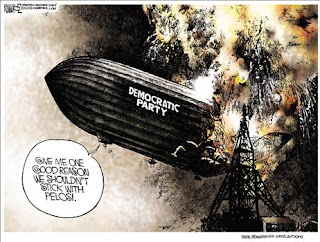
Republicans don't deserve to be this lucky, but it seems like everything, at least in the House of Representatives, is going their way. For now.

Republicans don't deserve to be this lucky, but it seems like everything, at least in the House of Representatives, is going their way. For now.
Scrooges
Susan Jacoby, an atheist and secular humanist (secular humanists are almost always atheists), wonders why secularists are such tightwads. She writes this:
Second, Christians, at least, give to others from of a sense of gratitude to God for what He has done for them in Christ. He has lavished an incomprehensible love upon us and asks only that we love what He loves. He loves people, especially the poor, so we should, too. For the secularist the poor are really losers in a Darwinian lottery of survival of the fittest. They drag the species down and there's no reason to help them continue to do it. People like Ms Jacoby might never think that way, but that is certainly one logical consequence of her atheism whether or not she realizes it. Just read Ayn Rand.
She continues:
If she wants to know why atheists are such scrooges the answer is that many of them simply live consistently, at least in this regard, with their fundamental assumptions that there is no God, there is no life after death, and there's no good reason why anyone should care about others, especially those who are in no position to return the favor.
Tis the season when snailmail and e-mail boxes are filled with exhortations to give to charitable causes of every kind. If you go to religious services at least once a week, you will probably add a donation to a secular nonprofit on top of what you have already given to your church. But if you have few ties to religion (whether you are an atheist or simply a lapsed churchgoer), this may well be the only time when you write checks to charities. Giving — unless a natural disaster catches your attention — is an annual event rather than a part of your everyday budget.Well, the answer is simple. Religious people have two motivations for helping people that secularists don't. First, they believe themselves morally obligated to care for the poor. A secularist has no moral obligation to do anything for anyone. They may choose to help someone because they just feel they should, but they have no real duty to do so.
As an atheist and secular humanist, I find this scenario basically accurate (although there are many exceptions) because it used to fit me perfectly. I have changed in recent years because, like many secularists, I became disturbed by the gap between my values and my erratic giving. There is no doubt — although the gap has been exaggerated by some on the religious right to support its view of secularists as morally inferior — that the nonreligious give less than religious Americans.
But even allowing for the fact that most Americans spend most of their charitable dollars close to home, the religious give a higher percentage of their income, and are about 25 percent more likely to give, than do secularists. Indeed, believers are 10 percent more likely than secularists to give to secular causes (although they do not support these programs as generously as they support religion).
The question is why.
Second, Christians, at least, give to others from of a sense of gratitude to God for what He has done for them in Christ. He has lavished an incomprehensible love upon us and asks only that we love what He loves. He loves people, especially the poor, so we should, too. For the secularist the poor are really losers in a Darwinian lottery of survival of the fittest. They drag the species down and there's no reason to help them continue to do it. People like Ms Jacoby might never think that way, but that is certainly one logical consequence of her atheism whether or not she realizes it. Just read Ayn Rand.
She continues:
Arthur C. Brooks, in a 2003 Policy Review essay on faith and charitable giving, connects liberal secular support for government programs with personal stinginess. Yet Brooks acknowledges that religious involvement, not political ideology, plays the dominant role. Religious liberals are 19 percentage points more likely to give than secular liberals, and religious conservatives 28 percent more likely than secular conservatives.Yes, we have a finite time to make an impact, but worrying about it only makes sense if what we do here in this world matters for eternity. If our impact doesn't last more than a generation or two beyond our demise then what difference does it make? What will it matter once we're dead whether we gave money to feed the hungry in some far-off country so that those poor unfortunates could live a few more years until they die of something else? Why should Ms Jacoby, or anyone, care about the impact she makes if her life is really no more than a footprint in the sand at the edge of the surf?
[B]ut the death of my longtime partner was a more powerful motivator. There is nothing like losing the person you love most to make you understand the truth of all of those clichés about the finite time we have to make an impact in this world.
If she wants to know why atheists are such scrooges the answer is that many of them simply live consistently, at least in this regard, with their fundamental assumptions that there is no God, there is no life after death, and there's no good reason why anyone should care about others, especially those who are in no position to return the favor.
Wednesday, November 17, 2010
Static Time
Mark Vernon contemplates the relationship between God and time at Big Questions Online. He writes:
If so, if we are at that point conscious beings which transcend the space-time manifold, would not all events in the history of the world be in our present? If that's so, then when we die every future event, including the future deaths of our loved ones, must happen simultaneously with our death. If that's so, when we die we could be immediately united with those who, on earth, still grieve our passing. But this would mean that our loved ones must have a kind of dual existence.
They would exist here on earth awaiting the future and simultaneously they'd exist in eternity where the future is in the present. In fact, if this is the case, all of us must have a dual existence, like quantum particles which can exist in more than one place at the same time. Perhaps the self that exists "there" is just as unaware of our existence "here" as our self here is unaware of our existence there.
Who knows? It seems to me, though, that if time is a block, an objective reality, and if there's some sense in which we survive physical death, there's no reason why this couldn't be the way things are.
Anyway, I better stop speculating about all this before you start to think that I'm dabbling with some mind-altering substance while sitting at my computer.
Augustine made one of the best known and most insightful comments about time. “What then is time?” he wondered. “If no one asks me, I know what it is. If I wish to explain it to him who asks, I do not know.”This is fascinating stuff, to be sure, but in my opinion it's even more fascinating to think that if it's true that the universe is a "block" and the distinction between past, present and future is an illusion what would happen if there really is life after death? Do we pass out of this "block universe" and into an eternal present where all of cosmic history falls simultaneously before our gaze, like taking in an entire page of a book at once?
He puzzled over this most fundamental, and yet mysterious, aspect of the human condition in his Confessions, and arrived at a notion that was similar to Plato’s: the ancient Greek sage had defined time as “the moving image of eternity.” That fitted with Augustine’s conception of God, who had created time when He created the universe. To ask what God was doing before that great act is simply meaningless.
It’s an idea that’s stuck. And to some, it is entirely commensurate with the way modern physics grapples with the mystery. Here, time is typically envisaged as a relationship between events. Einstein presented what is referred to as the “block universe” – the notion that all times exist equally. (For comparison, Augustine wrote: “In the Eternal nothing passeth away, but that the whole is present.”)
So, what you see just depends on what you set t to in any given equation. “The distinction between past, present and future is only an illusion, however persistent,” the genius of relativity mused. He was so clear about the illusory nature of time that the thought even provided him with comfort in the face of death.
If so, if we are at that point conscious beings which transcend the space-time manifold, would not all events in the history of the world be in our present? If that's so, then when we die every future event, including the future deaths of our loved ones, must happen simultaneously with our death. If that's so, when we die we could be immediately united with those who, on earth, still grieve our passing. But this would mean that our loved ones must have a kind of dual existence.
They would exist here on earth awaiting the future and simultaneously they'd exist in eternity where the future is in the present. In fact, if this is the case, all of us must have a dual existence, like quantum particles which can exist in more than one place at the same time. Perhaps the self that exists "there" is just as unaware of our existence "here" as our self here is unaware of our existence there.
Who knows? It seems to me, though, that if time is a block, an objective reality, and if there's some sense in which we survive physical death, there's no reason why this couldn't be the way things are.
Anyway, I better stop speculating about all this before you start to think that I'm dabbling with some mind-altering substance while sitting at my computer.
Insect Migration
Anyone who travels much by air knows that pilots try to ride the wind. Flights may even deviate substantially from the shortest-distance route if the wind is strong enough elsewhere. But of course the wind is not likely moving exactly toward your destination. Add to this the fact that the wind also varies with altitude, and the problem of designing the optimal route of flight becomes highly complex.
It is a problem in the calculus of variations (optimizing functionals rather than mere functions) and is analogous to the optics problem of predicting the path of light through a medium with variant refractive index. But this approach requires analytical wind fields, described with functions, rather than numerically derived winds described, for instance, on a grid. In practice the optimal routing problem is solved using various iterative methods. Amazingly, migratory insects also solve this type of problem.
Research using entomological radar has found that migratory insects such as butterflies and moths perform their own flight planning in order to optimize their flights across continents. They select the right time to ride the wind, and they determine the right altitude and flight heading to reach their destination (rather than where the wind is going). As one of the researchers explained:
"Migratory butterflies and moths have evolved an amazing capacity to use favourable tailwinds. By flying at the heights where the wind currents are fastest, migratory moths can travel between their summer and winter grounds in just a few nights."
 |
| Luna Moth Caterpillar |
 |
| Adult Luna Moth |
Tuesday, November 16, 2010
Un-PC
Taking a cue from a recent column by Denis Prager at NRO I venture here to list ten claims which I think are almost indisputably true but which people are very reluctant to discuss in polite politically correct society:
Each of these statements has important implications. If they are true we shouldn't shrink from discussing why they are true and what their truth means for public policy and education.
- People are not basically good.
- Men are generally superior to women in some ways and women are generally superior to men in others.
- African Americans are, in general, much better athletes than members of other groups.
- Black males are disproportionately responsible for violent crime in America.
- Jewish and Asian men are disproportionately successful over other groups in mathematics-related fields.
- Some ways of living are better for human flourishing than others.
- Many people are poor by choice.
- America was founded on principles derived from a Christian worldview.
- By almost any measure, America is the greatest nation in the history of the world.
- Americans are the most generous people in the history of the world.
Each of these statements has important implications. If they are true we shouldn't shrink from discussing why they are true and what their truth means for public policy and education.
Signature
A little over a year ago philosopher of science Stephen Meyer came out with a book that has completely reoriented the Darwinism/ID debate. The book was titled Signature in the Cell and it presented a massive amount of evidence in favor of the proposition that living cells, even the most primitive, contain massive amounts of information. It further argued that information is not a feature of blind random processes such as those which are believed to have produced the first living things.
Touchstone magazine has an article on Meyer's book which, inter alia, says this:
From that basic conviction, though, it's argued that, since there's no divine intervention into the natural world, however life arose it must have been through exclusively natural processes and any theory that denies this must be wrong because it contradicts the basic conviction. If you sense that this has about it the odor of a circular argument you wouldn't be wrong.
It's ironic that the theory that is everywhere hailed as scientific - naturalistic evolution - is at bottom religious (and circular). Yet this theory, based as it is upon theological assumptions about God, can be taught in public schools but Intelligent Design, which does not require any assumptions about God, cannot. Why is that?
Thanks to Evolution News and Views for the tip.
Touchstone magazine has an article on Meyer's book which, inter alia, says this:
Signature in the Cell has been the subject of intense controversy, mostly in what is known as the blogosphere, meaning electronic publications on the Internet. In a way, the attacks are only to be expected, because another thing we know from our uniform experience is that Darwinists tend to be bitterly resentful of any thinker who challenges the fundamental theory on which their careers have been built.This last paragraph shines a light on the way many people think about evolution. They work from a basic theological assumption, i.e. either God doesn't exist or, if He does, He doesn't meddle with the natural world. This, it should be noted, is not a conclusion that science is qualified to render. It's not based on empirical evidence. It's a purely theological assumption about the existence and nature of God.
In another way, however, it is peculiar that there is such a furious and often ill-informed objection to a learned volume that isn’t even about the theory of biological evolution. The book advances well-reasoned arguments based on solid evidence about a prior problem—the origin of the cell’s information content—concerning which most scientists would concede that they know very little.
The one thing that many of these scientists think they do know for certain is that, however the cell may have originated, the process could only have involved natural (i.e., unintelligent) causes. But this conclusion is not something these scientists know from the evidence. On the contrary, it is something they know—or rather, think they know— regardless of the evidence. For a long time, it has been the rule in evolutionary science that, if the evidence does not support a fully naturalistic theory about both the origin of life and its subsequent development, then there must be something wrong with the evidence rather than with the theory or its underlying philosophy.
From that basic conviction, though, it's argued that, since there's no divine intervention into the natural world, however life arose it must have been through exclusively natural processes and any theory that denies this must be wrong because it contradicts the basic conviction. If you sense that this has about it the odor of a circular argument you wouldn't be wrong.
It's ironic that the theory that is everywhere hailed as scientific - naturalistic evolution - is at bottom religious (and circular). Yet this theory, based as it is upon theological assumptions about God, can be taught in public schools but Intelligent Design, which does not require any assumptions about God, cannot. Why is that?
Thanks to Evolution News and Views for the tip.
Monday, November 15, 2010
Doing Good and Feeling Good
Last week we did a couple of posts on helping the poor. I subsequently came across this article in The Globe and Mail by Margaret Wente titled Is Humanitarian Aid Bad For Africa? Here are a couple of key passages:
A growing number of humanitarian and development experts – including former true believers – argue that aid money frequently prolongs wars, props up dictators, impedes democracy, aids oppression and stifles human rights. Nowhere, they say, is this chain of unintended consequences more apparent than in Ethiopia.Let's do all we can to help the hungry and the sick, but let's make sure that the aid we send is getting to the people who need it and not being used to erect opulent palaces for the tyrants who run the country and crush their people.
The starving children of Ethiopia were not the victims of drought, as most people believed at the time. They were the victims of politics. The government of the time was using famine as an instrument of war, and the rebels were more interested in defeating the government than in feeding famine victims. As William Easterly, a leading aid skeptic, puts it, “It’s not the rains, it’s the rulers.” Political famines attract the food aid industry, with the consequence that governments or rebel groups are able to feed their own armies and divert resources to buy more weapons.
Most of us believe that humanitarian aid is a morally pure way to respond to suffering in the world. But what if our good intentions are just a newer version of colonialism? That’s what Mr. Gill thinks. “The colonial mindset of ‘we-know-best’ has surely persisted,” he writes. The trouble is that we haven’t learned the difference between doing good and feeling good. Until we do, many of our aid efforts will be worse than useless.
Et Tu, Brute?
Morning Joe's Joe Scarborough, on the very liberal MSNBC mind you, reveals that the most powerful Democrats in the Senate are disenchanted with the President and criticizing him behind his back to media people like himself. This can't be good for the White House. If the President has his allies stabbing him in the back (It recalls to mind Shakespeare's Julius Caesar) how can there be anything but turmoil between the administration and the Congress for the next two years:
Thanks to Hot Air for the video.
* After I wrote this I came across this editorial. Prescience.
If it's true that the President has lost the confidence and loyalty of the Democrat committee chairs he may well be a lame duck with two years left in his first term. Indeed, there'll probably be a movement afoot to challenge him in the primary or to persuade him not to run*. Has a sitting president ever lost a primary challenge? Mr. Obama may be a historic president in ways he never imagined.
Thanks to Hot Air for the video.
* After I wrote this I came across this editorial. Prescience.
Saturday, November 13, 2010
Gross Out
A couple of years ago, in one of the local parades hosted by the small city near which I reside, a local pastor marched with signs featuring photos of what happens to a fetus when it's aborted. The pictures were gruesome and repellant, which they were intended to be, and there was much tut-tutting by the local commentariat about the tastelessness and vulgarity displayed by the pastor. Children, after all, saw those signs and being too innocent to realize that it's okay to dismember unborn babies, they were upset.
Now comes word that HHS is considering requiring tobacco companies to put gross pictures of dead people on cigarette packs to try to discourage people from smoking.
Never mind the problem of having government insist on telling you what's good for you and compelling a legal business to incur the cost of packaging their product in such a way as to deter people from buying it. What I'd like to know is why it's okay to show photos of corpses on cigarette cartons to dissuade people from smoking, but it's over-the-line offensive to show people what happens to a baby in an abortion. Might the acceptability of the photos depend on the interest group which is being targeted?
If tobacco companies are forced to put these photos on their products shouldn't Planned Parenthood be obliged to put photos of aborted children in their brochures and on their walls? If not, why not?
Now comes word that HHS is considering requiring tobacco companies to put gross pictures of dead people on cigarette packs to try to discourage people from smoking.
Never mind the problem of having government insist on telling you what's good for you and compelling a legal business to incur the cost of packaging their product in such a way as to deter people from buying it. What I'd like to know is why it's okay to show photos of corpses on cigarette cartons to dissuade people from smoking, but it's over-the-line offensive to show people what happens to a baby in an abortion. Might the acceptability of the photos depend on the interest group which is being targeted?
If tobacco companies are forced to put these photos on their products shouldn't Planned Parenthood be obliged to put photos of aborted children in their brochures and on their walls? If not, why not?
The Free Exchange of Ideas
I was talking with a colleague the other day about what I think is an interesting aspect of paradigm shifts. It seems that when a new idea is struggling to gain a hearing its youthful defenders are wholly committed to the free exchange of ideas, open-mindedness, thinking outside the box, questioning authority, etc. but once the idea has been established as the new orthodoxy its now older advocates treat any alternative ideas which rise up to challenge it as heresies to be stifled, strangled, and crushed.
For example, in my undergraduate days, the Left was very big on freedom of speech. The dictum attributed to Voltaire that he may not agree with what you say but would fight to the death for your right to say it was on every young revolutionary's lips. The counterculture largely won the debate back then, and the notion that speech, any speech, might be censored, that some ideas be suppressed, was roundly repudiated. My hirsute classmates shaved, got a haircut (or went bald), donned a tie and percolated upward through academic and governmental hierarchies.
Now these former zealots for free speech comprise much of the "establishment", but somewhere along the road to power many of them have forsaken their idealistic reverence for the intellectual values they cherished as youths. Today those who challenge the reigning orthodoxies are often shouted down, denied tenure, or fired from NPR, by some of the same people who condemned the establishment forty years ago for being closed-minded, intolerant, and dogmatic.
In the back of my mind during the conversation with my colleague was a post I had read just the day before about the reaction of an evolutionary biologist named Jerry Coyne to an essay in NewScientist. An evolutionist named Ken Bennett who has, like a lot of other biologists, grown skeptical of the ability of natural selection to work the magic the Darwinian faithful believe it capable of, voiced his doubts in the new NewScientist article. Bennett's deviation from the Darwinian consensus didn't sit well with Professor Coyne who rent his garments and, like a character straight out of Ray Bradbury's Fahrenheit 451, called for a boycott of NewScientist for the sin of publishing Professor Bennett's rather modest heresy.
When biologists were fighting to get evolution taught in schools back in the 1920s they argued that students should be able to hear ideas that challenge their religious beliefs, that this is the best way to sharpen young minds, etc. Now that the Darwinian paradigm is solidly ensconced in the academy all that talk of open minds and the free exchange of ideas is discarded like used tissues. Now the orthodox faith must be preserved and protected at all costs, freedom to express and consider contrary opinions is no longer useful and must be snuffed out. Books and journals that carry those opinions must be burned, or at least their publishers should be driven out of business.
Somebody should send Mr. Coyne a copy of John Stuart Mill's classic work On Liberty, or at least this excerpt:
For example, in my undergraduate days, the Left was very big on freedom of speech. The dictum attributed to Voltaire that he may not agree with what you say but would fight to the death for your right to say it was on every young revolutionary's lips. The counterculture largely won the debate back then, and the notion that speech, any speech, might be censored, that some ideas be suppressed, was roundly repudiated. My hirsute classmates shaved, got a haircut (or went bald), donned a tie and percolated upward through academic and governmental hierarchies.
Now these former zealots for free speech comprise much of the "establishment", but somewhere along the road to power many of them have forsaken their idealistic reverence for the intellectual values they cherished as youths. Today those who challenge the reigning orthodoxies are often shouted down, denied tenure, or fired from NPR, by some of the same people who condemned the establishment forty years ago for being closed-minded, intolerant, and dogmatic.
In the back of my mind during the conversation with my colleague was a post I had read just the day before about the reaction of an evolutionary biologist named Jerry Coyne to an essay in NewScientist. An evolutionist named Ken Bennett who has, like a lot of other biologists, grown skeptical of the ability of natural selection to work the magic the Darwinian faithful believe it capable of, voiced his doubts in the new NewScientist article. Bennett's deviation from the Darwinian consensus didn't sit well with Professor Coyne who rent his garments and, like a character straight out of Ray Bradbury's Fahrenheit 451, called for a boycott of NewScientist for the sin of publishing Professor Bennett's rather modest heresy.
When biologists were fighting to get evolution taught in schools back in the 1920s they argued that students should be able to hear ideas that challenge their religious beliefs, that this is the best way to sharpen young minds, etc. Now that the Darwinian paradigm is solidly ensconced in the academy all that talk of open minds and the free exchange of ideas is discarded like used tissues. Now the orthodox faith must be preserved and protected at all costs, freedom to express and consider contrary opinions is no longer useful and must be snuffed out. Books and journals that carry those opinions must be burned, or at least their publishers should be driven out of business.
Somebody should send Mr. Coyne a copy of John Stuart Mill's classic work On Liberty, or at least this excerpt:
"When a creed becomes hereditary, and is received passively, not actively - when the mind is no longer compelled, in the same degree as when the creed was new, to exercise it's vital powers on the questions which its belief presents to it, there is a progressive tendency to ... give it a dull and torpid assent ... until it almost ceases to connect itself at all with the inner life of teh human being....The creed remains as it were outside the mind, incrusting and petrifying it against all other influences...manifesting its power by not suffering any fresh and living convictions to get in, but itself doing nothing for the mind or heart, except standing sentinel over them to keep them vacant."You can read more about the brouhaha over Bennett's article at Telic Thoughts.
Friday, November 12, 2010
Bush Approved Waterboarding
We've talked about this topic in dozens of previous posts (as the results of typing the word "torture" into our search feature will show), but the release of former President George W. Bush's new book gives us occasion to bring it up again. Here's an excerpt from the Washington Post article on the book:
But was Bush's decision wrong? Let's leave to the lawyers the question of its legality and focus instead on its morality. Pundits an several shows this week have asserted the immorality of waterboarding Kalid Sheik Mohammed as if it were self-evident that doing what is illegal is ipso facto immoral, but I'm not sure they're right.
Surely it is morally wrong to torture someone for the reasons that many thugs use torture around the world today. To torture someone for revenge, for punishment, for amusement, even for routine interrogation purposes, is simply evil.
But the assumption that is being made when the pundits say it is morally wrong is that it is absolutely wrong, that there is no circumstance, nor can there be, in which it would ever be justified. If they really believe this, however, then I question whether they have thought the matter through.
About a year and a half ago I did a post in which I argued that if we love people there may be circumstances, in this fallen world we inhabit, in which torture is morally right. That sounds paradoxical, I know, so let me share with you what I wrote and then you can tell me where my error lies:
Human rights experts have long pressed the administration of former president George W. Bush for details of who bore ultimate responsibility for approving the simulated drownings of CIA detainees, a practice that many international legal experts say was illicit torture.The human rights community and a lot of other people are aghast that Americans would have used "torture" on a terrorist, and even more appalled, perhaps, that Bush would seem so unrepentant about it, but I've never been sure why. Before I explain, I think it's noteworthy that no one did anything to Mohammed until it was approved at the highest levels. "Enhanced interrogation" was not undertaken lightly by American interrogators. Whether to use such methods was considered a matter of the utmost gravity.
In a memoir due out Tuesday, Bush makes clear that he personally approved the use of that coercive technique against alleged Sept. 11 plotter Khalid Sheik Mohammed, an admission the human rights experts say could one day have legal consequences for him.
In his book, titled "Decision Points," Bush recounts being asked by the CIA whether it could proceed with waterboarding Mohammed, who Bush said was suspected of knowing about still-pending terrorist plots against the United States. Bush writes that his reply was "Damn right" and states that he would make the same decision again to save lives, according to a someone close to Bush who has read the book.
But was Bush's decision wrong? Let's leave to the lawyers the question of its legality and focus instead on its morality. Pundits an several shows this week have asserted the immorality of waterboarding Kalid Sheik Mohammed as if it were self-evident that doing what is illegal is ipso facto immoral, but I'm not sure they're right.
Surely it is morally wrong to torture someone for the reasons that many thugs use torture around the world today. To torture someone for revenge, for punishment, for amusement, even for routine interrogation purposes, is simply evil.
But the assumption that is being made when the pundits say it is morally wrong is that it is absolutely wrong, that there is no circumstance, nor can there be, in which it would ever be justified. If they really believe this, however, then I question whether they have thought the matter through.
About a year and a half ago I did a post in which I argued that if we love people there may be circumstances, in this fallen world we inhabit, in which torture is morally right. That sounds paradoxical, I know, so let me share with you what I wrote and then you can tell me where my error lies:
In my philosophy class we talk about love, distinguishing the sort of love we have for our fellow man from eros or romantic love. We define the former as treating people with dignity, respect, and kindness.The question to pose to those who condemn Mr. Bush is, do they really think torture is absolutely wrong in the moral sense or was it just wrong in the circumstances in which it was used against Kalid Mohammed. If the answer is the latter then we should ask what it was about those circumstances that made it wrong in that case. For my part I think it would be very difficult to provide a compelling answer to that question.
With that background I was asked the other day by a student how I reconcile the notion that we owe that kind of love to others with my belief that torture is not absolutely wrong.
This is a fair question and deserved an answer. Here's how, had I had the time, I would have replied:
Our obligation to love is a prima facie obligation. By that I mean that we owe respect and kindness to every individual until such time as the obligation to treat one person with love comes in conflict with our obligation to others who also have a claim, perhaps a greater claim, on our love.
When a man threatens the lives of others, particularly those I have a special obligation to protect and for whom I have a special bond of love, then it would be unloving to fail to do everything in my power to stop him. He has nullified my obligation to treat him with respect and kindness and forced me to choose between loving him and loving those he threatens. The moral course in such a circumstance, the course that I believe is demanded by the obligation to love, is to protect the innocent and to stop those who would harm them.
If stopping the guilty entails doing him harm then so be it, but the harm done should, whenever possible, be never greater than what's necessary to remove the threat. Nor should it ever be something one feels good about inflicting. A government which feels compelled to use "torture" (I use quotes because the definition of torture is so broad as to include almost any kind of incivility - a fact which really renders the word almost meaningless) to save the lives of its people is justified in doing so as long as that's the only reason it's used and so long as it's never continued beyond the point where it accomplishes its purpose.
Love is not a warm feeling toward other people, nor is it sentimentality. Sometimes, as in the case of a surgeon operating in a Civil War field hospital without anesthetics, doing the right thing means causing great pain. Sometimes, as in dealing with modern terrorism, doing the right thing for one person entails causing pain to another.
Perhaps you disagree and would argue that "torture" is absolutely wrong, that there's never any justification for it. Before you commit to such a view, though, ask yourself whether you would condemn a man who saved the life of your child by causing her abductor pain in order to coax him to reveal where his accomplices were holding her (cf. the movie Taken).
Before you say that the man was wrong to do this, imagine looking your child in the eyes after she has been rescued from people who were abusing her and preparing to murder her or sell her into child slavery or the sex trade, and telling her that you would rather she not have been rescued than for her rescue to have entailed that pain be inflicted on the man who kidnapped, molested and planned to kill her.
Perhaps you could say that to your child, but if not, then you agree that torture is not absolutely wrong. If that's your position then the question that next needs to be answered is not "should we torture?" but rather, "how should we define torture?" and "under what circumstances is torture morally justified?" The sooner we have that debate the better off we'll be as a nation.
Thursday, November 11, 2010
Values and Duties
Frans de Waal has a follow up at The Opinionator to his post last month titled Morals Without God about which we commented here. Apparently de Waal has received a lot of angry emails from atheists taking him to task for being insufficiently hostile to religion.
His response affords an occasion to emphasize more explicitly than I perhaps did in the earlier post what I think is an important distinction in the discussion of whether God is necessary for morality.
Atheists will often insist that they can be, and often are, just as morally good as anyone else and that God is not necessary for them to be so. What they mean by this, I take it, is that they can hold the same values as does any believer without the concomitant belief in God. An atheist can be just as kind, generous, peaceful, gentle, loving, etc. as anyone else.
My argument is that this is certainly true, but it's entirely beside the point. The debate is not over whether an atheist can hold a particular set of moral values, the debate is over whether an atheist is constrained by any moral obligation to abide by one set of values rather than another. In other words, if atheism is true can there be moral duty?
The answer to that, it seems to me, is no. If there is no transcendent moral authority to impose an obligation on us to, say, care for the poor, then there is no such obligation. It might be objected that the individual himself can impose the obligation, but a self-imposed obligation is an illusion. If someone sets himself up as his own moral authority and imposes an obligation upon himself then he surely has the authority to rescind the obligation whenever it suits him. An obligation that can be repudiated whenever the person who is under the obligation chooses to cast it off is no obligation at all.
An atheist can choose to be kind and generous, but if he's right about God his choice simply reflects an arbitrary preference. Had he chosen to be cruel and selfish he would not be wrong. His values could not be said to be morally inferior, they're just different values.
An irony in all this is that the atheist lives by a superstition. She believes that something called moral right exists when in fact, on atheism, it not only doesn't exist, it cannot exist. But this means that an atheist should logically be a nihilist and most atheists cannot live with that conclusion even though its where their reason leads them. Instead they deny what reason dictates and live instead by their feelings. In order to believe that moral values matter, that some values are better than others, they must leave reason behind and make an irrational leap based upon their own personal moral tastes.
A further irony is that certain of their number (e.g. Richard Dawkins, Christopher Hitchens, Sam Harris et al.) then scoff at Christians and other theists for holding what they allege is an irrational belief in God. They claim that the Christian is irrational despite the fact that a Christian can live perfectly consistently within his basic assumptions about God, whereas most atheists cannot live at all consistently with theirs.
It'd be funny were it not so tragic.
His response affords an occasion to emphasize more explicitly than I perhaps did in the earlier post what I think is an important distinction in the discussion of whether God is necessary for morality.
Atheists will often insist that they can be, and often are, just as morally good as anyone else and that God is not necessary for them to be so. What they mean by this, I take it, is that they can hold the same values as does any believer without the concomitant belief in God. An atheist can be just as kind, generous, peaceful, gentle, loving, etc. as anyone else.
My argument is that this is certainly true, but it's entirely beside the point. The debate is not over whether an atheist can hold a particular set of moral values, the debate is over whether an atheist is constrained by any moral obligation to abide by one set of values rather than another. In other words, if atheism is true can there be moral duty?
The answer to that, it seems to me, is no. If there is no transcendent moral authority to impose an obligation on us to, say, care for the poor, then there is no such obligation. It might be objected that the individual himself can impose the obligation, but a self-imposed obligation is an illusion. If someone sets himself up as his own moral authority and imposes an obligation upon himself then he surely has the authority to rescind the obligation whenever it suits him. An obligation that can be repudiated whenever the person who is under the obligation chooses to cast it off is no obligation at all.
An atheist can choose to be kind and generous, but if he's right about God his choice simply reflects an arbitrary preference. Had he chosen to be cruel and selfish he would not be wrong. His values could not be said to be morally inferior, they're just different values.
An irony in all this is that the atheist lives by a superstition. She believes that something called moral right exists when in fact, on atheism, it not only doesn't exist, it cannot exist. But this means that an atheist should logically be a nihilist and most atheists cannot live with that conclusion even though its where their reason leads them. Instead they deny what reason dictates and live instead by their feelings. In order to believe that moral values matter, that some values are better than others, they must leave reason behind and make an irrational leap based upon their own personal moral tastes.
A further irony is that certain of their number (e.g. Richard Dawkins, Christopher Hitchens, Sam Harris et al.) then scoff at Christians and other theists for holding what they allege is an irrational belief in God. They claim that the Christian is irrational despite the fact that a Christian can live perfectly consistently within his basic assumptions about God, whereas most atheists cannot live at all consistently with theirs.
It'd be funny were it not so tragic.
Wednesday, November 10, 2010
Reducing the Deficit
It looks like we're at least getting some movement on reducing spending and trimming entitlements. The two co-chairs of a presidential commission established to come up with ideas for reducing our government's enormous appetite for spending have produced a series of proposals that has in it something to antagonize pretty much everyone, but at least it should give us something to build upon:
Anyway, a detailed list of proposals can be found here. Something has to be done soon as one of the chairmen said when the proposals were released:
A presidential commission’s leaders proposed a $3.8 trillion deficit-cutting plan that would trim Social Security and Medicare, reduce income-tax rates and eliminate tax breaks including the mortgage-interest deduction.Increasing taxes and cutting defense spending will not be popular with conservatives, although the simplified tax rates will be, and Nancy Pelosi has already voiced her objection to tinkering with Medicare and Social Security:
The plan would throw out hundreds of tax breaks for items such as capital gains and child care. It would raise the gas tax, slash defense spending and bring down health-care costs by clamping down on medical malpractice suits. The Social Security retirement age would rise to 68 in about 2050 and 69 in about 2075.
None of the proposals would take effect next year to avoid disrupting the economic recovery. Under one option, income-tax rates would be reduced to three levels: 8 percent, 14 percent and 23 percent. Currently there are six tax levels ranging from 10 percent to 35 percent. The corporate income-tax rate would be cut to 26 percent from 35 percent.
Wiping out all tax breaks, including the home mortgage deduction, while lowering rates would cost taxpayers $100 billion a year under the plan.
House Speaker Nancy Pelosi of California called the plan “simply unacceptable,” saying older Americans “are counting on the bedrock promises of Social Security and Medicare.”This seems an odd objection since as far as I can tell from the article, few of today's "older Americans" will still be around when the new retirement age goes into effect.
Anyway, a detailed list of proposals can be found here. Something has to be done soon as one of the chairmen said when the proposals were released:
“This country’s out of money and we better start thinking,” said Erskine Bowles, co-chairman of the panel created by President Barack Obama. Without “tough choices,” Bowles said, “we’re on the most predictable path toward an economic crisis that I can imagine.”Indeed. If we don't do something to reign in entitlements and reduce the deficit the country our children and grandchildren inhabit will look very much different, and very much poorer, than the country we live in today.
Microfinance in China
Yesterday we talked about microfinance as a great way to help the world's poor improve their condition. I received this email in response, and I thought some of our readers might be interested in it:
To Viewpoint,I encourage readers to check out Wokai's webpage here.
My name is Brendan Rigby, and I am a volunteer representative of Wokai a microfinance organisation dedicated to poverty alleviation in China. We are currently raising awareness of poverty and microfinance in China and how everyone can now get involved.
Essentially, Wokai is a peer-to-peer approach to microfinance that was created by two young social entrepreneurs. It is an innovative, contributor-driven microfinance website that connects contributors in the international community with borrowers in China. Contributors can choose borrowers to support, watch repayments, and pick who to fund next. Unlike much of the global sector, the impact of a contributor's donation is visible and apparent through Wokai.
Wokai has also built a community of contributors through the website, in which users can access user-rated and user-generated content on microfinance in China. We also encourage other social entrepreneurs to establish Wokai Chapters in their city to mobilise support and encourage others to get involved. Through information and capital exchange, Wokai aims to grow the microfinance sector in China and correspondingly increase opportunities for the poor to generate a sustainable livelihood and access education and healthcare services.
We are currently reaching out to bloggers such as yourself to help us build this community of contributors. We would be very appreciative your support in our effort to raise awareness build community support.
Microfinance in China is an extremely underdeveloped and overlooked issue that deserves more attention. Poverty in China is often overlooked and overshadowed. According to World Bank and UN statistics, around 200 million Chinese live on less than US$1.25 a day. China's financial and banking system makes it difficult for entrepreneurs and small business owners to access loan credit, especially in rural areas.
Since the website launch in November 2008, Wokai has raised over US$374.000 in loan capital, attracted 6,700 contributors, and empowered 491 borrowers. Wokai works closely with two Chinese microfinance institutions (MFI) in Sichuan and Inner Mongolia, achieving a 99.5% on-time repayment rate. By the end of 2011, Wokai is aiming to raise US$1 million in loan captial to expand its partnerships with Chinese MFIs. This is an achieveable goal, but not without more support from individuals passionate about empowering families to lift themselves from poverty.
Thank you for your time, love reading the blog and I look forward to speaking further about microfinance in China and Wokai.
Tuesday, November 9, 2010
Calling for a Violent Revolution
What is going on here? A mainstream cable talk show on MSNBC is apparently providing a platform for a guy who's advocating violent revolution in the U.S. Dylan Ratigan is one of the fairer voices on the lefty cable network MSNBC, but why he would have a guest like this on, and why his producers allowed him to have this guest on, is beyond me. Indeed, in a more sensible era the man's ideas would be considered seditious. I believe in free speech, but it's patently irresponsible to give someone an opportunity on national television to call for killing the leaders of our country, which is certainly implicit in any call to violent revolution.
Imagine that instead of a politically progressive cartoonist of minimal talent this had been a member of the Tea Party voicing similar opinions on, say, Glenn Beck's show. There'd be a national clamor for the sponsors of the show to yank their sponsorship and for FOX to fire Beck. Yet Ted Rall, a man who once implied in a cartoon that Pat Tillman was an "idiot" and a "sap" for passing up a pro football career to join the military after 9/11, can call for the violent overthrow of the government - which would certainly entail a huge loss of life and be cataclysmic for this country and the world - and the outrage seems to be exclusively on the right: Am I overreacting or is this as sick as it sounds?
Imagine that instead of a politically progressive cartoonist of minimal talent this had been a member of the Tea Party voicing similar opinions on, say, Glenn Beck's show. There'd be a national clamor for the sponsors of the show to yank their sponsorship and for FOX to fire Beck. Yet Ted Rall, a man who once implied in a cartoon that Pat Tillman was an "idiot" and a "sap" for passing up a pro football career to join the military after 9/11, can call for the violent overthrow of the government - which would certainly entail a huge loss of life and be cataclysmic for this country and the world - and the outrage seems to be exclusively on the right: Am I overreacting or is this as sick as it sounds?
Subscribe to:
Posts (Atom)